
A caller dials in, waits, and hangs up before anyone answers. That single moment is a lost sale, a delayed support resolution, or a customer who quietly switches to a competitor. Call abandonment is one of the clearest signals a contact center has that something in the queue experience isn't working.
The rate itself matters less than what it reveals. A high abandonment rate points to staffing gaps, clunky IVR menus, or wait times customers were never prepared for. Left unaddressed, it shows up downstream in lower CSAT scores, higher repeat-call volume, and rising service costs as frustrated customers call back again and again for the same issue.
This article covers what counts as a reasonable abandonment rate across industries, the most common reasons customers give up on a call, ten practical ways to bring the rate down, and how to think about the cost of doing nothing.
Table of Contents
What is a Good Call Abandonment Rate?
10 Proven Ways to Reduce Call Abandonment
What is a Good Call Abandonment Rate?
There isn't a single number every contact center should chase. Abandonment rate is a downstream effect of service level and average speed to answer, not a metric you can manage directly. A center running 5% abandonment at a strong service level is in good shape. A center running the same 5% while callers wait far longer than the published service level is masking a deeper staffing or forecasting problem.
That said, benchmark ranges are useful for orienting a team. Most contact center research puts the overall cross-industry average somewhere between 5% and 8%, with high-performing operations pushing below 3%. Centers that rely heavily on IVR menus or handle seasonal spikes, such as telecom and utilities, often run higher, sometimes into the teens during peak periods. Centers using AI-assisted forecasting and callback options increasingly report rates under 2%.
Reduce your call abandonment rate with expert customer support
The more useful exercise for most operations leaders is pairing abandonment rate with service level and average speed to answer. If abandonment is climbing but service level is holding steady, the problem is likely IVR design or self-service gaps rather than staffing. If both are slipping together, the root cause is almost always a forecasting or scheduling shortfall.
Why Customers Abandon Calls
Most abandonment traces back to a small set of causes, and they tend to compound each other.
Long wait times are the most direct driver. Research consistently shows the bulk of hang-ups happen inside the first 60 seconds of hold time, with the majority of remaining abandoners gone within five minutes. Once a caller passes their personal patience threshold, no amount of hold music changes the outcome.
Poor IVR design adds friction before a caller even reaches the queue. Menus with too many layers, unclear options, or paths that force callers to repeat themselves push people to give up out of irritation rather than wait time alone.
No callback option removes the one thing that keeps an impatient caller in line: control over their own time. Without it, staying on hold is the only way to keep a place in the queue, and many callers simply won't.
Lack of self-service means every routine question, like a balance check or order status update, has to go through a live agent. That inflates queue volume for issues that never needed a human in the first place.
Unclear wait expectations compound all of the above. A caller who knows they're fifth in line and expects a four-minute wait behaves very differently from one staring into silence with no sense of how long the call will take.
10 Proven Ways to Reduce Call Abandonment
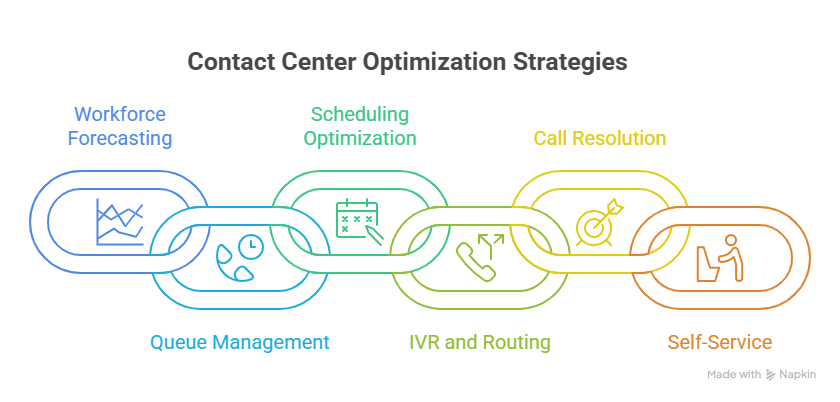
None of these strategies work in isolation. The centers that see the biggest improvement in abandonment rate typically combine two or three, usually starting with forecasting accuracy and a callback option, since those two address both the staffing gap and the customer experience problem at once.
Improve workforce forecasting
Using historical volume patterns, seasonality, and marketing calendars to predict call volume, rather than relying on flat averages, closes the staffing gaps that cause abandonment to spike during predictable peaks. This is usually the foundation everything else builds on, since even the best IVR or callback system can't compensate for a queue that's short-staffed at the wrong hour.
Offer virtual queue callbacks
Letting callers keep their place in line and receive a callback instead of waiting on hold addresses the friction point directly. Vendor-reported studies put the reduction in abandonment from callback adoption in the 30% to 38% range, and roughly three in four callers say they prefer a callback to waiting on hold. For most centers, this is the single highest-leverage change on this list.
Optimize scheduling
Aligning agent shifts to actual intraday call patterns, rather than even eight-hour blocks, closes the gap between forecasted demand and the agents actually available at the specific hours abandonment tends to spike. Forecasting tells you what volume to expect; scheduling determines whether the right people are on the phones when that volume arrives.
Simplify IVR menus
Cutting unnecessary layers, using plain language, and routing callers to the right queue in fewer steps reduces the chances a frustrated caller hangs up before ever reaching a live queue. Every extra menu layer is another opportunity for a caller to give up.
Use skills-based routing
Matching callers to the agent best equipped to resolve their specific issue on the first attempt shortens handle time and reduces the repeat calls that add unnecessary volume to the queue. A caller routed to the wrong specialist the first time often ends up calling back, which compounds the very abandonment problem the team is trying to fix.
Reduce transfers
Giving frontline agents broader training or better routing logic so fewer calls need to bounce between departments matters because each transfer effectively resets the caller's wait and increases the odds of frustration-driven abandonment later in the call.
Improve first call resolution (FCR)
Equipping agents with better tools, knowledge bases, and authority to resolve issues without escalation raises FCR, and industry leaders target rates of 70% to 80%. Higher first call resolution correlates directly with lower repeat-call volume, which in turn keeps queues shorter and abandonment lower.
Deploy AI-powered forecasting
Applying machine learning models to refine volume predictions in near real time, adjusting for anomalies traditional forecasting misses, pushes accuracy further than historical averages alone can reach. Contact centers using AI-assisted forecasting and routing increasingly report abandonment rates under 2%.
Expand self-service options
Moving routine, low-complexity questions to IVR self-service, chatbots, or account portals reduces the volume of calls that reach a live queue in the first place. This eases pressure during peak periods without adding headcount, since a portion of demand never enters the queue at all.
Communicate wait times clearly
Telling callers their queue position or estimated wait time as soon as they enter the queue reduces the anxiety that drives early hang-ups. Callers who know what to expect are considerably more willing to stay on the line than those left waiting in silence.
Improving IVR design and adding a callback option tend to produce the fastest visible results, since both directly address the moment a caller decides whether to stay or go. Forecasting and scheduling improvements take longer to show up in the numbers but address the structural staffing gap that causes abandonment to recur.
The Business Cost of High Call Abandonment
Every abandoned call carries a cost that extends well past the missed interaction itself.
- Lost revenue: It is the most immediate impact, particularly for sales and order-related lines. Estimates for the cost of a single missed call range from roughly $200 to $1,200 depending on industry, and small to mid-sized businesses are estimated to lose well over $100,000 a year in aggregate to missed calls.
- Reduced CSAT: It follows almost automatically. A customer who hangs up after a long wait, only to call back later, starts their next interaction already frustrated, which drags down satisfaction scores even if the eventual resolution is fine.
- Lower NPS: Wait-time frustration is one of the more common reasons customers cite when asked why they wouldn't recommend a brand, even when the product or service itself met expectations.
- Customer churn: It becomes a real risk when abandonment is chronic rather than occasional. Customers who repeatedly can't reach support start looking for alternatives, particularly in categories where switching costs are low.
Frequently Asked Questions
1. What is a good abandonment rate?
Most benchmarks put a healthy range between 3% and 8%, with top-performing centers under 3%. The right target depends on your industry and, more importantly, on the service level behind the number.
2. How long will customers wait?
Patience varies, but most research shows the steepest drop-off happens within the first 60 seconds, with the large majority of remaining abandoners gone by the five-minute mark.
3. Does callback software help?
Yes. Offering a virtual queue callback consistently reduces abandonment, with vendor studies reporting reductions in the 30% to 38% range, largely because it removes the need to stay on hold to keep a place in line.
4. How do AI tools reduce abandonment?
AI-assisted forecasting improves the accuracy of staffing predictions, which closes the gap between expected and actual call volume. AI-powered routing and self-service can also resolve simple issues without ever reaching a live queue.
5. Which KPI should I improve first?
Start with service level and average speed to answer rather than abandonment rate itself. Abandonment is a lagging indicator; fixing the upstream metrics that drive it produces more durable results than chasing the abandonment number directly.
Conclusion
Reducing call abandonment comes down to closing two gaps: the gap between predicted and actual call volume, and the gap between what customers expect while waiting and what they actually experience. Forecasting, scheduling, and AI-assisted routing address the first. IVR simplification, callback options, and clear wait-time communication address the second.
None of these fixes are one-time projects. Call patterns shift with seasonality, marketing campaigns, and customer expectations, which means abandonment rate needs regular monitoring rather than an annual review. Centers that treat it as a continuous optimization loop, rather than a number to fix once and forget, tend to hold their gains over time.