In the competitive world of customer service, resolving user inquiries on the initial try is the ultimate indicator of operational health. When customers are forced to make multiple follow-up calls, their satisfaction levels drop while your operational expenses rise. Businesses that actively track their contact center metrics can streamline these support pathways and eliminate unnecessary communication bottlenecks.
Many global brands partner with professional service networks to optimize these complicated customer communication pipelines. Utilizing specialized call centre outsourcing services provides companies with direct access to advanced technology, structured agent training programs, and comprehensive performance analytics. This definitive guide explores the core principles of first-contact metrics, including standard calculation formulas and key industry benchmarks.
Table of Contents
What Is First Call Resolution (FCR)?
Why First Call Resolution Is a Critical Contact Center KPI
How to Calculate First Call Resolution
What Is a Good First Call Resolution Rate?
How to Improve First Call Resolution
How AI and Automation Improve FCR
How FCR Impacts Other Contact Center Metrics
Best Practices for Sustaining High FCR
What Is First Call Resolution (FCR)?
The term First Call Resolution represents a vital performance indicator that measures how effectively support representatives resolve customer issues during their initial interaction. To achieve this baseline standard, the support operator must solve the customer's problem so thoroughly that they do not need to contact the brand again. Maintaining a high rating across this category confirms that your internal support teams are working efficiently.
While some managers use these terms interchangeably, there is a clear technical distinction between voice-specific and omnichannel metrics. Voice-specific metrics track outcomes purely over phone systems, while omnichannel metrics assess the first-interaction success rate across text chat, emails, and social media platforms. Knowing this operational difference helps companies customize their communication strategies and set accurate performance expectations.
Improve First Contact Resolution With Expert Support
Why First Call Resolution Is a Critical Contact Center KPI
Understanding why your brand should focus on this specific metric can transform your entire customer service strategy. Tracking these performance indicators allows directors to identify system inefficiencies and improve the overall employee environment.
- Customer satisfaction: Resolving issues on the initial attempt is directly linked to higher customer satisfaction scores. Every single percentage improvement in this category correlates with a matching rise in overall consumer satisfaction.
- Reduced customer effort: Customers do not want to spend their free time repeating their problems to multiple agents. Minimizing customer effort builds immediate brand trust and enhances the user experience.
- Lower operating costs: Eliminating repeat calls prevents the accumulation of duplicate support tickets in your queue. This reduction in overall ticket volume generates massive annual savings on labor and digital bandwidth.
- Agent productivity: When frontline workers can resolve issues immediately, they spend less time managing complex backlogs. This extra capacity allows your support representatives to assist more unique customers during their standard shifts.
- Customer retention: Resolving a difficult technical problem quickly reinforces a buyer's confidence in your corporate reliability. Happy consumers are much more likely to remain loyal to your brand over time.
Enterprise brands can easily scale these advantages by utilizing specialized call centre outsourcing services to manage their customer interactions.
How to Calculate First Call Resolution
Calculating your performance score requires dividing your successful initial resolutions by the total number of customer interactions. Support managers must establish clear guidelines defining what counts as a completed resolution to prevent inaccurate data reporting.
To calculate your rate, use this industry formula:

For example, if your team receives 1,000 inbound calls in a week and resolves 740 of them during the first contact, your FCR rate is 74 percent.
Support teams can gather this data using multiple methodologies, including agent disposition codes, customer feedback surveys, and automated speech analytics. Each strategy carries unique challenges, as agent self-reporting can sometimes introduce bias, while customer surveys often suffer from low response rates. Blending these analytical approaches helps your business build a highly accurate, unbiased performance map.
What Is a Good First Call Resolution Rate?
Defining what constitutes a successful rating depends on your specific industry, product complexity, and active communication channels. While tracking a generic global target can guide your team, comparing your scores to direct industry peers is much more valuable.
A standard performance benchmark across most customer service industries falls between 70 percent and 79 percent. Any rating above 80 percent is considered world-class, though only a small percentage of contact centers achieve this level of efficiency. Highly technical support desks usually operate with slightly lower baselines because their complex cases naturally require research and follow-up.
Common Causes of Low FCR
To fix an underperforming support queue, leaders must first understand the operational obstacles that get in the way of immediate resolution. Identifying these root issues early prevents your team from relying on quick, temporary fixes that fail to resolve the underlying problems.
- Knowledge gaps: Frontline representatives often lack the deep product knowledge or updated policy training needed to solve complex inquiries.
- Inefficient processes: Overly complex corporate guidelines may force agents to escalate standard tickets to senior management.
- Poor routing: Disconnected interactive voice response systems frequently route customers to the wrong department, forcing multiple transfers.
- Limited agent authority: Frontline workers are often restricted by strict financial limits that prevent them from issuing simple refunds on the spot.
- Disconnected systems: Agents must waste valuable time switching between multiple software applications to gather basic customer records.
How to Improve First Call Resolution
Improving your first-contact performance requires a strategic combination of employee training, workflow optimization, and advanced software integration. By removing administrative friction, your support representatives can focus on resolving issues thoroughly.
Strengthen agent training
Customer service operators must be equipped with comprehensive communication training and deep technical product knowledge. Interactive role-playing and active-listening exercises help representatives handle complex or unexpected customer scenarios with confidence. Providing ongoing educational courses ensures your team stays up to date on new product features and system upgrades.
Improve knowledge management
A highly organized, searchable internal database allows support agents to locate accurate answers in real time. This database should be updated regularly by product developers to reflect recent system updates and policy changes. Giving your employees instant access to these technical files eliminates the need for them to put customers on long holds.
Optimize call routing
Implementing intelligent routing systems ensures that inbound calls are directed to the most qualified agent from the start. Modern interactive voice menus can assess a caller's intent and match them with a specialist based on historical customer data. This targeted alignment reduces the need for transfers, protecting the customer experience.
Empower frontline agents
Frontline representatives need the professional trust and authority to make minor financial decisions, such as processing a small refund. This trust eliminates the operational delays caused by waiting for senior supervisor approvals. Empowering your staff increases their overall job satisfaction and builds immediate credibility with customers.
Streamline workflows
Consolidating your CRM platforms, billing tools, and customer history databases into a single interface simplifies the workspace. This unified setup prevents agents from having to constantly switch between software programs. Streamlining these daily tasks helps operators resolve issues faster and with fewer errors.
Use quality assurance insights
Supervisors should regularly review recorded calls to pinpoint exactly where agents face technical roadblocks. These audits highlight common customer issues that might require adjustments to your training curriculum. Using quality metrics as a coaching tool helps representatives build long-term, sustainable habits.
Reduce repeat contacts through root cause analysis
Support leaders should investigate why customers frequently call back within a short timeframe for the same issue. Identifying these recurring triggers helps companies fix systemic product defects or clarify confusing user instructions. Resolving these issues at the source naturally lowers your incoming contact volume.
How AI and Automation Improve FCR
The rise of generative intelligence is giving customer service centers powerful new ways to optimize their operations. Modern software helps human agents retrieve accurate answers and process tickets much faster than traditional systems.
- AI agent assist: Smart internal systems analyze live conversations to suggest relevant answers and solution paths directly to the agent's screen.
- Real-time guidance: Algorithmic tools evaluate a customer's tone during a call, offering helpful suggestions to de-escalate tense situations.
- Intelligent routing: Machine learning analyzes the context of a customer's query to pair them with the agent best suited for their issue.
- Speech analytics: Semantic software monitors every recorded conversation to automatically identify training gaps and common customer pain points.
- Generative AI knowledge support: Interactive databases use natural language processing to help agents find specific troubleshooting guides in seconds.
- Workflow automation: Automated scripts handle simple, repetitive background tasks, allowing human agents to focus entirely on the customer.
How FCR Impacts Other Contact Center Metrics
Your first-contact metrics do not exist in isolation; they are closely connected to all your other customer service indicators. Improving this single metric triggers a positive chain reaction across your entire helpdesk ecosystem.
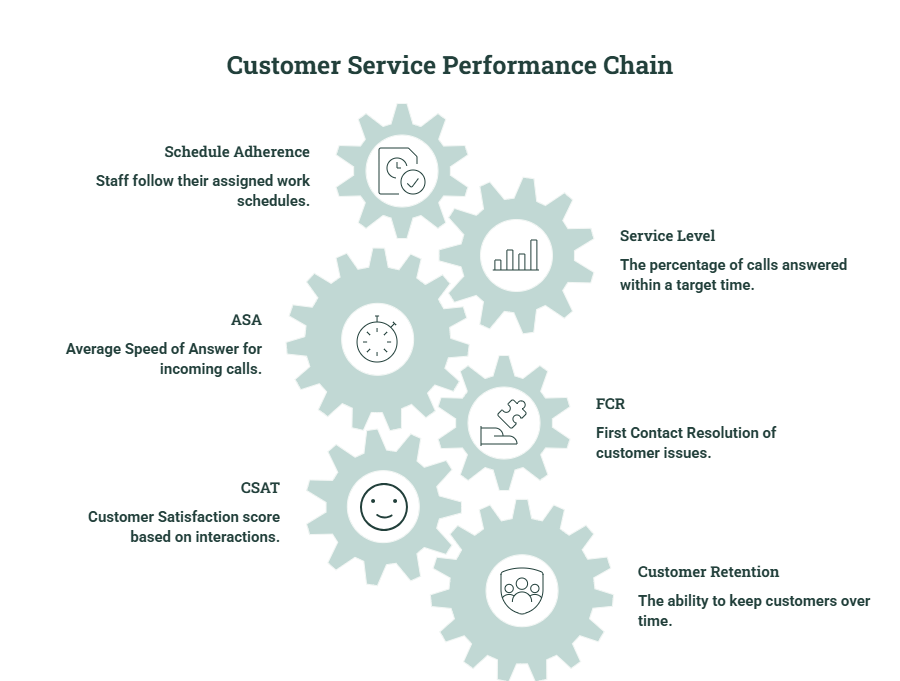
When agents maintain high schedule adherence, queue capacity remains stable throughout the day. This consistent coverage helps teams meet their service level targets, keeping wait times low. When customers connect with unhurried agents quickly, first-contact resolution rates naturally rise, boosting long-term loyalty and customer satisfaction.
Best Practices for Sustaining High FCR
Maintaining excellent resolution rates over time requires establishing disciplined, structured habits across your management team. Consistently tracking your performance keeps your customer service operations aligned with active market demands.
- Continuous monitoring: Review your support metrics weekly to catch sudden performance drops before they impact customer satisfaction.
- Coaching: Provide your agents with personalized, data-supported feedback based on live call recordings.
- Cross-functional collaboration: Build clear communication channels between support, billing, and product development teams to resolve complex issues quickly.
- Customer feedback loops: Use post-call surveys to verify that the customer feels their problem was fully resolved before closing the ticket.
- Performance reviews: Evaluate your internal processes quarterly to ensure your benchmarks match changing consumer habits.
By choosing to partner with a specialized provider for call centre outsourcing services, businesses can easily maintain these management practices. Outsourced teams utilize advanced, real-time quality monitoring tools to keep your resolution rates high year-round.
Frequently Asked Questions
What is a good FCR rate?
A first call resolution rate between 70 percent and 79 percent is considered the standard industry benchmark for high-performing contact centers. Achieving a rate of 80 percent or higher is considered world-class, though it requires highly optimized systems and extensive agent training.
How is FCR measured?
FCR is measured by taking the total number of issues resolved during the first interaction and dividing it by the total number of inbound cases during that same timeframe. This raw percentage is often verified using post-call customer satisfaction surveys and tracking software to confirm no repeat contacts occurred.
What is the difference between FCR and First Contact Resolution?
First Call Resolution traditionally refers only to voice channels, measuring success during the initial phone call. First Contact Resolution is a broader term that evaluates first-interaction success across all digital channels, including email, chat, and social media.
Why is FCR important?
FCR is a critical metric because it directly impacts customer satisfaction, operating costs, and overall agent productivity. Resolving issues on the first try eliminates repeat calls, lowering your overhead while building customer loyalty.
Can AI improve FCR?
Yes, AI improves FCR by powering intelligent routing systems that match customers with the most qualified agent. It also acts as a real-time assistant, suggesting accurate answers to help agents resolve issues faster.
Which metrics should be tracked alongside FCR?
Managers should track average handle time, customer satisfaction scores, and repeat contact rates alongside FCR. Monitoring these related metrics ensures your team is not sacrificing service quality for speed.
Conclusion
Maximizing your First Call Resolution rate is one of the most effective ways to lower contact center operating costs and boost customer loyalty. By investing in agent training, optimizing routing, and consolidating your backend software, you can build a highly efficient support system.
To sustain these high standards long-term, brands should establish a structured action plan focused on identifying the root causes of repeat calls. Partnering with experienced professionals who provide call centre outsourcing services can give your business the scale, tools, and expertise needed to achieve world-class results.