First Call Resolution (FCR): Definition, Formula, Benchmarks & Proven Ways to Improve It

First Call Resolution

In the competitive world of customer service, resolving user inquiries on the initial try is the ultimate indicator of operational health. When customers are forced to make multiple follow-up calls, their satisfaction levels drop while your operational expenses rise. Businesses that actively track their contact center metrics can streamline these support pathways and eliminate unnecessary communication bottlenecks.

Many global brands partner with professional service networks to optimize these complicated customer communication pipelines. Utilizing specialized call centre outsourcing services provides companies with direct access to advanced technology, structured agent training programs, and comprehensive performance analytics. This definitive guide explores the core principles of first-contact metrics, including standard calculation formulas and key industry benchmarks.

What Is First Call Resolution (FCR)?

The term First Call Resolution represents a vital performance indicator that measures how effectively support representatives resolve customer issues during their initial interaction. To achieve this baseline standard, the support operator must solve the customer's problem so thoroughly that they do not need to contact the brand again. Maintaining a high rating across this category confirms that your internal support teams are working efficiently.

While some managers use these terms interchangeably, there is a clear technical distinction between voice-specific and omnichannel metrics. Voice-specific metrics track outcomes purely over phone systems, while omnichannel metrics assess the first-interaction success rate across text chat, emails, and social media platforms. Knowing this operational difference helps companies customize their communication strategies and set accurate performance expectations.

Improve First Contact Resolution With Expert Support

Get a Free Consultation

Why First Call Resolution Is a Critical Contact Center KPI

Understanding why your brand should focus on this specific metric can transform your entire customer service strategy. Tracking these performance indicators allows directors to identify system inefficiencies and improve the overall employee environment.

  • Customer satisfaction: Resolving issues on the initial attempt is directly linked to higher customer satisfaction scores. Every single percentage improvement in this category correlates with a matching rise in overall consumer satisfaction.
  • Reduced customer effort: Customers do not want to spend their free time repeating their problems to multiple agents. Minimizing customer effort builds immediate brand trust and enhances the user experience.
  • Lower operating costs: Eliminating repeat calls prevents the accumulation of duplicate support tickets in your queue. This reduction in overall ticket volume generates massive annual savings on labor and digital bandwidth.
  • Agent productivity: When frontline workers can resolve issues immediately, they spend less time managing complex backlogs. This extra capacity allows your support representatives to assist more unique customers during their standard shifts.
  • Customer retention: Resolving a difficult technical problem quickly reinforces a buyer's confidence in your corporate reliability. Happy consumers are much more likely to remain loyal to your brand over time.

Enterprise brands can easily scale these advantages by utilizing specialized call centre outsourcing services to manage their customer interactions.

How to Calculate First Call Resolution

Calculating your performance score requires dividing your successful initial resolutions by the total number of customer interactions. Support managers must establish clear guidelines defining what counts as a completed resolution to prevent inaccurate data reporting.

To calculate your rate, use this industry formula:

First Call Resolution

For example, if your team receives 1,000 inbound calls in a week and resolves 740 of them during the first contact, your FCR rate is 74 percent.

Support teams can gather this data using multiple methodologies, including agent disposition codes, customer feedback surveys, and automated speech analytics. Each strategy carries unique challenges, as agent self-reporting can sometimes introduce bias, while customer surveys often suffer from low response rates. Blending these analytical approaches helps your business build a highly accurate, unbiased performance map.

What Is a Good First Call Resolution Rate?

Defining what constitutes a successful rating depends on your specific industry, product complexity, and active communication channels. While tracking a generic global target can guide your team, comparing your scores to direct industry peers is much more valuable.

A standard performance benchmark across most customer service industries falls between 70 percent and 79 percent. Any rating above 80 percent is considered world-class, though only a small percentage of contact centers achieve this level of efficiency. Highly technical support desks usually operate with slightly lower baselines because their complex cases naturally require research and follow-up.

Common Causes of Low FCR

To fix an underperforming support queue, leaders must first understand the operational obstacles that get in the way of immediate resolution. Identifying these root issues early prevents your team from relying on quick, temporary fixes that fail to resolve the underlying problems.

  • Knowledge gaps: Frontline representatives often lack the deep product knowledge or updated policy training needed to solve complex inquiries.
  • Inefficient processes: Overly complex corporate guidelines may force agents to escalate standard tickets to senior management.
  • Poor routing: Disconnected interactive voice response systems frequently route customers to the wrong department, forcing multiple transfers.
  • Limited agent authority: Frontline workers are often restricted by strict financial limits that prevent them from issuing simple refunds on the spot.
  • Disconnected systems: Agents must waste valuable time switching between multiple software applications to gather basic customer records.

How to Improve First Call Resolution

Improving your first-contact performance requires a strategic combination of employee training, workflow optimization, and advanced software integration. By removing administrative friction, your support representatives can focus on resolving issues thoroughly.

Strengthen agent training

Customer service operators must be equipped with comprehensive communication training and deep technical product knowledge. Interactive role-playing and active-listening exercises help representatives handle complex or unexpected customer scenarios with confidence. Providing ongoing educational courses ensures your team stays up to date on new product features and system upgrades.

Improve knowledge management

A highly organized, searchable internal database allows support agents to locate accurate answers in real time. This database should be updated regularly by product developers to reflect recent system updates and policy changes. Giving your employees instant access to these technical files eliminates the need for them to put customers on long holds.

Optimize call routing

Implementing intelligent routing systems ensures that inbound calls are directed to the most qualified agent from the start. Modern interactive voice menus can assess a caller's intent and match them with a specialist based on historical customer data. This targeted alignment reduces the need for transfers, protecting the customer experience.

Empower frontline agents

Frontline representatives need the professional trust and authority to make minor financial decisions, such as processing a small refund. This trust eliminates the operational delays caused by waiting for senior supervisor approvals. Empowering your staff increases their overall job satisfaction and builds immediate credibility with customers.

Streamline workflows

Consolidating your CRM platforms, billing tools, and customer history databases into a single interface simplifies the workspace. This unified setup prevents agents from having to constantly switch between software programs. Streamlining these daily tasks helps operators resolve issues faster and with fewer errors.

Use quality assurance insights

Supervisors should regularly review recorded calls to pinpoint exactly where agents face technical roadblocks. These audits highlight common customer issues that might require adjustments to your training curriculum. Using quality metrics as a coaching tool helps representatives build long-term, sustainable habits.

Reduce repeat contacts through root cause analysis

Support leaders should investigate why customers frequently call back within a short timeframe for the same issue. Identifying these recurring triggers helps companies fix systemic product defects or clarify confusing user instructions. Resolving these issues at the source naturally lowers your incoming contact volume.

How AI and Automation Improve FCR

The rise of generative intelligence is giving customer service centers powerful new ways to optimize their operations. Modern software helps human agents retrieve accurate answers and process tickets much faster than traditional systems.

  • AI agent assist: Smart internal systems analyze live conversations to suggest relevant answers and solution paths directly to the agent's screen.
  • Real-time guidance: Algorithmic tools evaluate a customer's tone during a call, offering helpful suggestions to de-escalate tense situations.
  • Intelligent routing: Machine learning analyzes the context of a customer's query to pair them with the agent best suited for their issue.
  • Speech analytics: Semantic software monitors every recorded conversation to automatically identify training gaps and common customer pain points.
  • Generative AI knowledge support: Interactive databases use natural language processing to help agents find specific troubleshooting guides in seconds.
  • Workflow automation: Automated scripts handle simple, repetitive background tasks, allowing human agents to focus entirely on the customer.

How FCR Impacts Other Contact Center Metrics

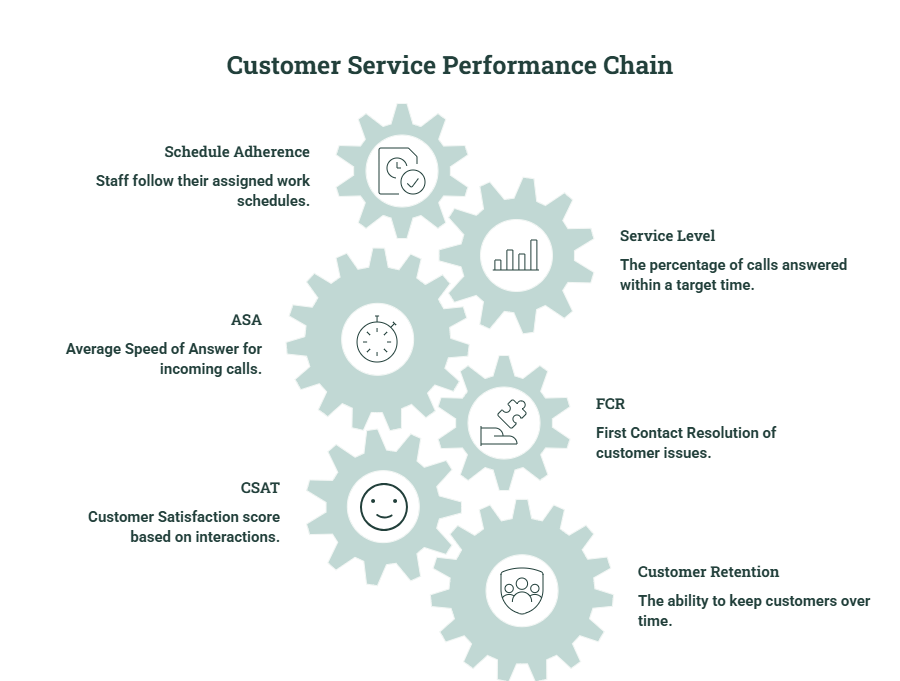
Your first-contact metrics do not exist in isolation; they are closely connected to all your other customer service indicators. Improving this single metric triggers a positive chain reaction across your entire helpdesk ecosystem.
First Call Resolution

When agents maintain high schedule adherence, queue capacity remains stable throughout the day. This consistent coverage helps teams meet their service level targets, keeping wait times low. When customers connect with unhurried agents quickly, first-contact resolution rates naturally rise, boosting long-term loyalty and customer satisfaction.

Best Practices for Sustaining High FCR

Maintaining excellent resolution rates over time requires establishing disciplined, structured habits across your management team. Consistently tracking your performance keeps your customer service operations aligned with active market demands.

  • Continuous monitoring: Review your support metrics weekly to catch sudden performance drops before they impact customer satisfaction.
  • Coaching: Provide your agents with personalized, data-supported feedback based on live call recordings.
  • Cross-functional collaboration: Build clear communication channels between support, billing, and product development teams to resolve complex issues quickly.
  • Customer feedback loops: Use post-call surveys to verify that the customer feels their problem was fully resolved before closing the ticket.
  • Performance reviews: Evaluate your internal processes quarterly to ensure your benchmarks match changing consumer habits.

By choosing to partner with a specialized provider for call centre outsourcing services, businesses can easily maintain these management practices. Outsourced teams utilize advanced, real-time quality monitoring tools to keep your resolution rates high year-round.

Frequently Asked Questions

What is a good FCR rate?

A first call resolution rate between 70 percent and 79 percent is considered the standard industry benchmark for high-performing contact centers. Achieving a rate of 80 percent or higher is considered world-class, though it requires highly optimized systems and extensive agent training.

How is FCR measured?

FCR is measured by taking the total number of issues resolved during the first interaction and dividing it by the total number of inbound cases during that same timeframe. This raw percentage is often verified using post-call customer satisfaction surveys and tracking software to confirm no repeat contacts occurred.

What is the difference between FCR and First Contact Resolution?

First Call Resolution traditionally refers only to voice channels, measuring success during the initial phone call. First Contact Resolution is a broader term that evaluates first-interaction success across all digital channels, including email, chat, and social media.

Why is FCR important?

FCR is a critical metric because it directly impacts customer satisfaction, operating costs, and overall agent productivity. Resolving issues on the first try eliminates repeat calls, lowering your overhead while building customer loyalty.

Can AI improve FCR?

Yes, AI improves FCR by powering intelligent routing systems that match customers with the most qualified agent. It also acts as a real-time assistant, suggesting accurate answers to help agents resolve issues faster.

Which metrics should be tracked alongside FCR?

Managers should track average handle time, customer satisfaction scores, and repeat contact rates alongside FCR. Monitoring these related metrics ensures your team is not sacrificing service quality for speed.

Conclusion

Maximizing your First Call Resolution rate is one of the most effective ways to lower contact center operating costs and boost customer loyalty. By investing in agent training, optimizing routing, and consolidating your backend software, you can build a highly efficient support system.

To sustain these high standards long-term, brands should establish a structured action plan focused on identifying the root causes of repeat calls. Partnering with experienced professionals who provide call centre outsourcing services can give your business the scale, tools, and expertise needed to achieve world-class results.

Contact Center KPIs: 25 Essential Metrics to Measure, Benchmark, and Improve Performance

Contact Center KPIs 25 Essential Performance Metrics

Operating a modern customer service infrastructure requires continuous monitoring of operational metrics and customer satisfaction levels. When leadership lacks clear visibility into data, service quality suffers, and operating costs can spiral out of control. Implementing a structured framework to monitor Contact Center KPIs allows companies to spot communication bottlenecks before they damage brand reputation.

Many expanding brands choose to partner with specialized vendor networks to streamline their customer service workflows. Utilizing professional contact center outsourcing services provides immediate access to enterprise-grade analytics tools and experienced support staff. This exhaustive guide explores the critical categories of measurement, baseline performance formulas, and practical steps to optimize your customer experience.

What Are Contact Center KPIs?

Key Performance Indicators represent the core operational metrics that measure how effectively a support team achieves its primary corporate goals. While standard metrics track everyday data points like total call volume, True indicators measure long-term strategic success. Aligning these high-level calculations with your commercial objectives helps your brand maintain consistent, high-quality client care.

When businesses leverage contact center outsourcing services, these technical targets are explicitly outlined within master service agreements to ensure operational accountability. Evaluating performance data helps support leaders verify that every agent interaction protects the brand's long-term market value. Understanding these definitions helps your organization transition from reactive crisis management to proactive service optimization.

Expose communication bottlenecks and systematically improve your team's performance.

Book a Call With Us

Why Tracking the Right KPIs Is Critical

Monitoring target metrics provides operational clarity, helping support managers protect consumer retention and lower overhead expenses. Operating without reliable analytics data forces teams to rely on guesswork, which leads to scheduling errors and poor customer service.

  • Better customer experiences are achieved by identifying long queue delays and resolving communication friction points early.
  • Improved agent performance driven by objective scorecard metrics, data-supported coaching sessions, and regular transparency reviews.
  • Lower operating costs realized by optimizing handle times and eliminating redundant administrative workflows across shifts.
  • Smarter workforce planning based on historical peak traffic analytics and predictable seasonal volume fluctuations.
  • Data-driven decision-making that replaces management intuition with empirical financial and operational validation.

Contact Center KPI Categories

To manage a modern helpdesk efficiently, leadership must organize their data streams into distinct operational categories. Separating these metrics ensures that your management teams can assess customer satisfaction, agent efficiency, and budget stability independently.

Customer Experience KPIs

Customer experience measurements evaluate how well your staff meets consumer needs and preserves brand loyalty over time. Tracking these scores helps you determine whether your service strategies feel helpful or frustrating to your target market.

  • CSAT (Customer Satisfaction): Measures immediate client contentment following a specific service interaction through post-call feedback surveys.
  • NPS (Net Promoter Score): Assesses long-term brand loyalty by asking consumers how likely they are to recommend your business.
  • CES (Customer Effort Score): Evaluates how simple or complex it felt for a user to resolve their problem.
  • Customer Retention: Tracks the percentage of active consumers your business keeps over specific financial quarters.
  • Customer Effort: Monitors the operational friction points a buyer encounters when reaching out for technical assistance.

Operational KPIs

Operational analytics track the speed, accessibility, and structural health of your communication infrastructure. Monitoring these numbers ensures your support queues move rapidly and customer wait times remain within safe limits.

  • AHT (Average Handle Time): The complete duration of a customer interaction, including talk time and wrap-up administration.
  • ASA (Average Speed of Answer): The average time a consumer spends waiting in a queue before a live representative answers.
  • Service Level: The percentage of inbound calls answered within a specified target timeframe, such as eighty percent in twenty seconds.
  • Queue Time: The total duration a consumer spends waiting in line before connecting with a support professional.
  • Abandonment Rate: The percentage of inbound callers who hang up before reaching an active support agent.
  • Call Transfer Rate: The frequency with which agents must move a caller to a different department to finish a request.
  • Repeat Contact Rate: The percentage of buyers who must call back within a short timeframe to resolve the same issue.

Agent Performance KPIs

Agent performance tracking helps supervisors evaluate individual employee productivity, schedule adherence, and service quality. Maintaining visibility over these metrics ensures that team members utilize their shift hours effectively while following internal guidelines.

  • FCR (First Contact Resolution): The percentage of customer issues resolved completely during the initial interaction without requiring follow-ups.
  • Occupancy: The percentage of logged-in shift hours an agent spends handling active calls versus waiting for new ones.
  • Schedule Adherence: Measures how closely a support employee follows their assigned shift timings, lunch breaks, and training windows.
  • Utilization: Tracks the total time an agent spends performing direct production work compared to their total paid hours.
  • Quality Assurance Score: An objective evaluation of call transcripts conducted by supervisors to confirm compliance with brand scripts.
  • After-Call Work (ACW): The time a representative spends updating customer files and logging notes after a call ends.
  • Agent Productivity: The comprehensive volume of consumer tickets processed by an employee during a standard work shift.

Financial KPIs

Financial metrics reveal the true cost-efficiency and return on investment of your consumer support initiatives. Tracking these values protects your bottom line and helps justify future investments in customer service technology.

  • Cost per Contact: The total operational cost of running the center divided by the absolute number of inbound interactions.
  • Cost per Resolution: The comprehensive financial expenditure required to resolve a customer's issue from start to finish.
  • Revenue per Agent: The total sales volume generated by an individual sales support representative during their shift.
  • ROI (Return on Investment): The financial gains achieved through your support investments compared to the capital spent.
  • Cost to Serve: The total expenses required to deliver continuous helpdesk services to a specific client account.

Omnichannel & AI KPIs

Modern digital platforms require specialized tracking tools to measure the effectiveness of automated chatbots and multi-channel queues. Monitoring these elements ensures that your digital service pathways actually relieve pressure on human agents.

  • Chat Resolution Rate: The percentage of digital text conversations resolved completely within the chat application without escalating.
  • Email Response Time: The total duration from a customer submitting an email ticket to receiving a human reply.
  • Bot Containment Rate: The volume of customer interactions handled fully by automated AI tools without human intervention.
  • AI Deflection Rate: The percentage of inbound traffic resolved by automated self-service systems before a live ticket is generated.
  • Channel Switching Rate: How often a customer must move across text, email, and voice channels to resolve one problem.

KPI Formulas and Benchmark Table

To evaluate your operations accurately, you must understand the mathematical logic behind every key calculation. The following table highlights standard industry formulas, typical market benchmarks, and optimization strategies to guide your team.


KPI Formula Typical Benchmark Why It Matters How to Improve It
First Contact Resolution Total Contacts Resolved on 1st Contact​×100 70% to 75% Drives high CSAT and reduces total call volume. Improve agent training and routing accuracy.
Average Speed of Answer Total Answered Calls/Total Wait Time​ Under 20 seconds Directly impacts initial customer frustration levels. Optimize workforce scheduling and scheduling models.
Abandonment Rate Total Inbound CallsAbandoned Calls​×100 4% to 8% High rates indicate lost sales and frustrated buyers. Deploy callback options and optimize queue messages.
Average Handle Time Total Handled CallsTalk Time + Hold Time + ACW​ 4 to 6 minutes Dictates necessary staffing counts and labor budgets. Simplify desktop tools and knowledge bases.

Maintaining these high standards becomes much easier when partnering with premium contact center outsourcing services. External specialists leverage advanced software suites to maintain these benchmarks consistently, even during major traffic surges.

Leading vs. Lagging KPIs

Support managers must balance two primary forms of metrics to maintain complete control over their customer service ecosystem. Lagging indicators reveal historical outcomes, showing you exactly how your team performed over the previous month. Conversely, leading indicators serve as early warning signs, reflecting real-time behavioral patterns that influence future results.

Balancing both data types allows operations leaders to make proactive scheduling and coaching adjustments before performance drops. For example, tracking low schedule adherence today allows you to address staffing gaps before it ruins your monthly service level metrics. Reviewing these data sets in tandem ensures that your customer support team remains highly resilient against sudden volume changes.

How Contact Center KPIs Work Together

Operational metrics do not exist in isolated bubbles; they operate as a highly connected chain of cause and effect. A small change in one backend variable triggers a predictable domino effect that impacts your final customer satisfaction scores.

When agents maintain high schedule adherence, your live queue capacity remains stable and secure throughout the day. This stable capacity allows the team to hit its service level goals, which slashes your average speed of answer. When customers connect with relaxed, unhurried agents quickly, first-contact resolution rises, driving up long-term customer retention.

Building an Effective Contact Center KPI Dashboard

To maximize the value of your data, you must present customized metrics to the right stakeholders across your organization. Designing specialized visual layouts ensures that everyone can extract actionable insights instantly without getting lost in raw data.

Executive Dashboard

Executive views focus entirely on high-level financial health, long-term brand health trends, and overall return on investment. This layout removes granular hourly details, highlighting broad monthly performance indicators and comprehensive operational costs instead.

Operations Dashboard

Operations views provide call center managers with real-time visibility into active queue queues, service level percentages, and staffing counts. This interactive layout allows directors to shift resources between voice and digital channels the moment traffic spikes.

Team Leader Dashboard

Supervisors require a dedicated view focused on group schedule adherence, quality assurance scores, and average handle times. This tracking tool helps managers identify which teams are meeting standards and which individuals require immediate coaching.

Agent Scorecard

Individual scorecards give representatives direct clarity regarding their personal daily volume, first contact resolution rates, and compliance trends. Providing this personal data dashboard encourages employee accountability and supports self-guided career improvement.

Common KPI Tracking Mistakes

Focusing blindly on raw data without evaluating the underlying human experience can lead to severe operational failures. Support directors must look past simple numbers to confirm their metrics encourage the right workplace behaviors.

  • Overemphasizing AHT forces agents to rush off calls with buyers, which ruins first contact resolution and frustrates consumers.
  • Tracking too many KPIs dilutes your operational focus, leaving your staff confused about which goals matter most.
  • Ignoring quality metrics in favor of pure call volume results in compliance errors and inconsistent customer care.
  • Using outdated benchmarks that fail to reflect modern omnichannel consumer behaviors can lead to inaccurate staffing models.
  • Measuring without action plans creates a culture of passive monitoring rather than active, continuous operational improvement.

Best Practices for Improving Contact Center KPIs

Optimizing your helpdesk performance requires establishing disciplined routines and leveraging modern analytical technology. Follow these core operational strategies to ensure your support infrastructure scales efficiently over time.

  • Set SMART targets that provide your team with clear, realistic performance goals based on historical data.
  • Review KPIs regularly to ensure your active operational strategies adapt smoothly to changing customer volumes.
  • Coach agents with data gathered from live recordings to improve conversational quality and compliance scores.
  • Use workforce management tools to align your scheduled employee counts directly with projected call patterns.
  • Leverage AI and automation to resolve simple questions early, keeping your live agent queues clear for complex cases.
  • Benchmark against industry standards to ensure your support campaigns deliver a highly competitive user experience.

Frequently Asked Questions

What is the most important contact center KPI?

First contact resolution is widely considered the most valuable metric because it directly influences both operational expenses and customer happiness. Resolving an issue during the first call eliminates expensive repeat inquiries, which lowers your total contact volumes. It also creates a seamless experience for the consumer, which naturally improves long-term brand loyalty scores.

How many KPIs should a contact center track?

While a modern helpdesk gathers hundreds of data points, leadership should focus on five to seven core metrics on their main dashboards. Tracking too many indicators simultaneously creates data fatigue and leaves employees confused about their primary targets. Limiting your focus ensures your support team can execute targeted, measurable improvements across shifts.

What is the difference between KPIs and metrics?

Metrics are general data points that track everyday business activities, such as total inbound calls or average talk time minutes. Key Performance Indicators are a select group of critical calculations that directly measure success against high-level corporate goals. All indicators are metrics, but only the most strategically vital metrics serve as true performance indicators.

What are good benchmark values for CSAT, FCR, and AHT?

A strong customer satisfaction score generally sits above eighty percent, while a healthy first contact resolution rate ranges between seventy and seventy-five percent. Standard industry benchmarks for average handle time typically hover between four and six minutes depending on industry complexity. Comparing your team against these targets helps identify hidden operational inefficiencies early.

Which KPIs are most important for omnichannel contact centers?

Multi-channel environments must closely track channel switching rates, email response times, and consistent chat resolution scores. It is also vital to monitor cross-channel customer effort scores to ensure users experience zero friction when moving from chat to phone. Keeping these integrated channels fully optimized protects your brand consistency across all digital touchpoints.

How can AI improve contact center KPIs?

Artificial intelligence improves your core metrics by deflecting simple, repetitive questions through smart self-service chatbots. This technical automation slashes inbound wait times, reduces abandonment rates, and lowers the average speed of answer. By removing routine tickets, AI allows human agents to handle complex issues patiently, which boosts first contact resolution scores.

Top 7 Call Center & BPO Services for Growing Businesses

Call Center Services

Customer expectations have never been higher. Fast response times, 24/7 availability, and personalized service are no longer competitive advantages, they are baseline requirements.

According to Statista, the global Business Process Outsourcing (BPO) market is projected to reach over $410 billion in revenue in 2024, highlighting the increasing reliance of businesses worldwide on outsourced services such as customer support, call centers, and back-office operations.

This explosive growth reflects a simple reality: businesses are turning to BPO providers not just to cut costs, but to scale faster, improve service quality, and remain competitive in a demanding marketplace.

For growing businesses, choosing the right call center partner can directly impact customer retention, operational efficiency, and long-term profitability.

Table of Contents

Vserve  #1 Call Center & BPO Partner

Wowcustomer Support: Comprehensive Outsourcing Solutions

Teleperformance: World-Class Global CX Leader

Concentrix: Analytics-Driven Customer Engagement

Atento: Strong CRM & Multi-Channel Services

Majorel: End-to-End BPO and CX Excellence

Qualfon: Flexible Global Outsourcing Provider

1. Vserve #1 Call Center & BPO Partner

Why it’s here: Vserve earns the top spot because it blends highly customizable outsourcing solutions with transparent analytics, dedicated support, and scalable delivery models that fit both burgeoning startups and established brands.

What Vserve Offers

  • Full contact center solutions: Inbound/outbound support, help desk, escalation management
  • Omnichannel engagement: Telephone, live chat, email, social media support
  • Back-office operations: Data processing, CRM tasks, order management
  • Sales enablement: Lead generation, tele-sales support, conversion teams

Why Vserve Excels

  • Custom strategy alignment: Services are tailored according to your business goals, not pre-packaged.
  • Real-time performance data: Sophisticated dashboards give clients close insight into SLA compliance, quality scores, and KPIs.
  • Adaptive scalability: From seasonal surges to long-term growth, Vserve expands and contracts services with your needs.

Bottom line: Whether you want to optimize customer interactions, build out scalable teams, or gain performance insights, Vserve stands out as a partner that grows with the business, not just for today’s metrics but tomorrow’s goals.

2. Wowcustomer Support: Comprehensive Outsourcing Solutions

Why it’s here: Wowcustomer Support takes the #2 position as a reliable, flexible, and efficient outsourcing partner designed for businesses that want professional customer service delivery without the extensive overhead of in-house teams.

Services Offered

  • Multichannel support: Voice, chat, email, and SMS
  • 24/7 operations: Around-the-clock support for global customers
  • Technical & help desk support: Tier-1 and escalation support
  • Quality assurance & performance reporting: Ongoing agent coaching and SLA tracking
  • CRM integration: Seamless service with leading customer platforms

Strengths

  • Client-centric execution: Focuses on responsiveness, customer retention, and brand consistency.
  • Cost-effective scalability: Flexible plans that support growth at every stage — from startups to mid-sized firms.
  • Industry versatility: Good fit for ecommerce, SaaS, tech, and service providers.

Bottom line: Wowcustomer Support offers a balanced mix of quality, affordability, and flexibility. It’s ideal for businesses that want to boost customer satisfaction without complex agency overhead.

3. Teleperformance: World-Class Global CX Leader

Why it’s here: Known worldwide for its global reach and established expertise, Teleperformance is one of the largest BPO firms, delivering comprehensive call center and customer experience services.

Key Features

  • Vast international footprint with operations in 80+ countries
  • Full suite of support including voice, digital channels, customer care, and technical support
  • Strong compliance, training, and quality frameworks

Why it matters: Teleperformance handles high volumes across sectors like finance, telecom, retail, and healthcare, making it a top choice for enterprises needing dependable, world-class support at scale.

4. Concentrix: Analytics-Driven Customer Engagement

Why it’s here: Concentrix is known for combining client support with analytics and insights that improve customer engagement and operational performance.

Strengths

  • Integrated digital services and automation
  • Data-driven performance optimization
  • Support across diverse industries

Why it’s important: Concentrix helps businesses not just deliver support but refine it over time with analytics and insights, turning data into customer experience advantages.

5. Atento: Strong CRM & Multi-Channel Services

Why it’s here: Atento offers robust CRM and multi-channel outsourcing and is one of the largest providers in Latin America and beyond.

Core Offerings

  • Customer care and support
  • Sales and credit management
  • Back-office operations
  • Technical and help desk support

Why it’s included: Atento’s extensive global network and CRM focus make it a strong contender for businesses seeking consistent support across geographies and channels.

6. Majorel: End-to-End BPO and CX Excellence

Why it’s here: Majorel combines global scale with robust customer experience solutions, serving brands in multiple industries around the world.

Highlights

  • Broad BPO and CX services portfolio
  • Large global workforce and infrastructure
  • Strong presence in EMEA, Americas, and Asia

Why it’s relevant: Majorel is particularly suitable for multinational operations that require integration of support and process optimization at scale.

7. Qualfon: Flexible Global Outsourcing Provider

Why it’s here: Qualfon offers professional call center and BPO services with an emphasis on adaptability and personalized engagement.

Key Services

  • Customer support and helpdesk
  • Telemarketing and lead generation
  • Back-office process outsourcing

Why it’s included: A good fit for mid-market businesses that want professional delivery without enterprise-level cost structures.

Frequently Asked Questions (FAQ)

1: What exactly is a call center BPO?

A call center BPO (Business Process Outsourcing) partner manages customer interactions like calls, emails, chats, and social support for a business, helping reduce costs, improve service quality, and enable scalability.

2: Why do companies outsource customer service?

Companies outsource to cut operational costs, access specialized expertise, support 24/7 operations, scale quickly during demand surges, and improve customer satisfaction.

3: Can small businesses benefit from BPO services?

Absolutely — many small and mid-sized companies use outsourced support to gain enterprise-level service without hiring full internal teams.

Conclusion

The call center and BPO industry continues to grow rapidly as businesses prioritize customer experience, cost optimization, and operational efficiency. From global giants like Teleperformance and Concentrix to flexible providers like Qualfon and Atento, there’s a solution for virtually every business need.

However, if your goal is to find a partner that combines customized solutions, transparent performance insights, and scalable engagement, Vserve rises to the top as the #1 choice for fast-growing companies of all sizes.

And for businesses that want versatile, reliable, and affordable outsourced customer support, Wowcustomer Support offers strong, client-focused services built around your growth goals.

10 Valid Reasons To Outsource Inbound Call Center Services

Outsource Inbound Call Center Services

Call center outsourcing has rapidly gained traction as companies across the globe lean on professional BPOs to manage customer communication channels with precision. Handling calls, emails, webchats internally demands infrastructure. It needs technology, training and ongoing management. And all of that costs a lot. That’s why more Fortune 500 enterprises and government agencies now prefer to outsource inbound call center services. It is a lot easier than juggling the in-house complexities.

Inbound call center services exist for one simple purpose. The purpose is to manage incoming customer calls efficiently. Trained agents handle every query and solve issues. They ensure that every call reflects the brand’s professionalism. Typically, an inbound call center service provider offers teams of agents, advanced systems, and data tools to manage this process.

But why should your business consider inbound call center outsourcing? What exactly are the hidden benefits of letting experts take over your customer touchpoints? Let’s look closer.

Table Of Contents

1. 24×7 Service For Your Customers

2. Offers Flexibility And Scalability

3. Stability And Attractive IT Policies

4. Expert Support Staff And Management

5. Focus On Core Operations

6. No Capital Investments

7. Access To The Latest Technology And Tools

8. Eliminates Staffing Issues And Increases Continuity

9. Detailed Reports On Data Analytics

10. Utilize Currency Exchange Rate Difference

FAQs

Wrapping Up On Inbound Call Center Services

Inbound Call Center Services

1. 24×7 Service for Your Customers

Customers are shopping at every hour, especially in global markets. Businesses today need voices that answer at all hours. When you outsource inbound calls, you unlock a 24×7 support cycle. This kind of support ensures not a single query is missed.

Companies in North America and Europe find it beneficial to outsource inbound call support to India. This is due to the time zone advantage. The result is round-the-clock service. With inbound support outsourcing, your customers always find help waiting for them, no matter the hour.

Did you know that the global inbound services segment of call and contact-center outsourcing generated USD 57,932.2 million in 2024, and is projected to reach USD 93,810.7 million by 2030 (CAGR ~9 %).

2. Offers Flexibility and Scalability

Workloads fluctuate. Seasons bring unpredictable call volumes. Some days are calm, others chaotic. Inbound customer service outsourcing gives you flexibility to expand or scale down without staffing chaos.

In India, inbound call center projects outsourcing is popular. Providers already have trained resources on standby and are ready to adapt to your demand. That flexibility also saves money and time. These are two assets every business wants to keep a close eye on.

Flexibility and Scalability

3. Stability and Attractive IT Policies

India’s tech ecosystem is built on stability and strong IT governance. The government’s pro-IT stance, tax benefits, and infrastructural support make it quite an ideal hub for inbound call center outsourcing.

When your customers experience consistent service quality, they perceive your brand as dependable. This stability leads to loyalty, and loyalty creates growth. When you outsource, you inherit both efficiency and an ecosystem that thrives on reliability.

Expert Support

4. Expert Support Staff And Management

Behind every successful inbound call is a well-trained expert who knows what they’re doing. Inbound tech support agencies bring years of domain experience. They handle varied industries with ease.

In India alone, millions of English-speaking graduates enter the workforce annually. That means you get language proficiency, cultural adaptability, and professional etiquette, and you get all of these without paying premium local wages. With inbound call center benefits like these, your brand voice becomes quite polished and consistent across all conversations.

5. Focus on Core Operations

Customer support is vital, but it’s not your core operation. When you outsource inbound call center tasks, you reclaim valuable time and energy. Your teams can now focus on innovation, product development, or sales instead of customer engagement.

This separation of focus ensures both quality and efficiency. Your core grows quite stronger while customers stay happy.

6. No Capital Investments

Setting up an internal customer service department isn’t cheap. Office space, software, servers, and training all add up. However, when businesses outsource inbound call center services, they eliminate those heavy investments.

You pay for what you use, nothing more. Providers already have the infrastructure. They give you instant access to advanced tools, optimized call handling, and top-tier performance. All of this happens without quite draining your budget.

7. Access to the Latest Technology and Tools

Every inbound call center service provider invests in sophisticated tools. They need CRM software, AI chatbots, cloud telephony, analytics, and omnichannel support systems. These upgrades are quite expensive for single companies to manage. They come included when you outsource inbound call support.

India’s fast-growing digital transformation ensures that outsourcing partners always stay ahead in technology adoption. They give you world-class tools without capital expenditure.

8. Eliminates Staffing Issues and Increases Continuity

Recruitment. Training. Retention. All these challenges vanish when you outsource inbound call center operations. Providers manage staffing, shift planning, quality monitoring, and performance assessments.

Business continuity improves quite drastically because outsourcing firms guarantee uptime. They ensure 24×7 support and operational consistency so your business never pauses. With inbound support outsourcing, stress simply fades away.

Eliminates Staffing Issues

9. Detailed Reports On Data Analytics

Data is gold in customer service. Outsourcing companies collect, analyze, and interpret call data to enhance performance.

With inbound customer service outsourcing, you get quite detailed analytics. You get real-time dashboards and performance tracking reports. You’ll know your customers better, understand peak hours, query patterns, and even agent productivity. These insights lead to quite smarter decisions and superior service delivery.

10. Utilize Currency Exchange Rate Difference

Here’s the quiet advantage: currency. When Western companies outsource inbound call center operations to India, the cost difference due to exchange rates translates into massive savings. It often results in 60–70% lower costs.

And there’s no compromise on quality. You get premium service from quite highly skilled professionals at a fraction of the domestic cost. That’s the power of global collaboration.

FAQs

1. What are the key inbound call center benefits?

They include 24×7 availability, cost savings, scalability, expert staffing, and enhanced data insights.

2. Why should I outsource inbound calls?

To improve efficiency, cut costs, and ensure customer satisfaction without heavy investments.

3. What do inbound tech support agencies provide?

They offer trained agents, advanced tools, and continuous monitoring to handle customer queries and technical issues efficiently.

4. How does inbound support outsourcing affect business growth?

It frees up internal resources, improves customer experience, and supports business scalability.

5. Can small businesses benefit from inbound call center projects outsourcing?

Yes. It allows access to professional infrastructure and skilled agents without hiring full-time staff.

Wrapping Up

Outsourcing is no longer just a trend; it’s a growth necessity. When you outsource inbound call center services, you gain partners who elevate your brand with care. There is consistency of service and cost-effectiveness.

The benefits go quite beyond savings. You gain focus, flexibility, and flawless service continuity. For startups and enterprise, inbound customer service outsourcing strengthens your connection with customers and builds a foundation of trust.

In today’s fast-moving market, success depends on responsiveness. And that’s exactly what outsourcing delivers. You get timely responses, satisfied customers, and a sharper business edge.

Transform Your Customer Experience With WOW Customer Support

Looking to elevate your customer engagement? Partner with WOW Customer Support, one of the most trusted inbound call center service providers. With expertise in inbound call center benefits, multilingual agents, and 24×7 availability, we help brands create seamless support experiences that delight customers and build loyalty.

Get Started with WOW Customer Support

Suggested Reads

Top 8 Enterprise Call Center Solutions for Scalable Growth

Call Center Solutions

Scaling a business is never just about selling more. It is about supporting more customers without losing service quality, response time, or brand trust. For many growing companies, customer support becomes the bottleneck long before revenue does. This is where enterprise call center solutions play a critical role.

Business owners today are increasingly choosing to outsource call center services to maintain flexibility, control costs, and ensure professional customer interactions at scale. This guide breaks down the most effective enterprise-level call center solutions that support sustainable, scalable growth.

Call Center Solutions

Table of Contents

Why Enterprise Call Center Solutions Matter

Top 8 Enterprise Call Center Solutions for Scalable Growth

How Outsourcing Supports Business Expansion

FAQs

Why Enterprise Call Center Solutions Matter

Growing customer demand does not only create more sales opportunities. It also places intense pressure on support teams to deliver rapid, reliable service every time. When internal teams are not equipped to manage rising call volumes, the consequences can be measurable and costly.

For example, missed calls directly impact revenue potential. According to industry research, even a 5% rate of missed calls on a business that generates $500,000 per year can translate into about $25,000 in lost revenue annually. In addition, studies show that as many as 85% of callers who are not answered never try to reach the business again, an indication of just how damaging unanswered service can be to retention and brand trust.

Customer expectations are rising alongside competition. Most customers (about 60%) say that long wait times are their biggest point of frustration with customer support, reflecting the importance of getting service right on the first try. In the absence of efficient handling processes and tools, calls wait longer, agents struggle to catch up, and customers feel ignored.

These factors directly tie into business performance. Positive interactions at the call center level have been shown to increase customer retention by up to 33%, while high satisfaction is recognized as a reason customers are willing to pay more for service overall. This matters because retention and lifetime customer value are core drivers of long-term revenue growth.

Top 8 Enterprise Call Center Solutions for Scalable Growth

Scaling customer support is one of the biggest challenges growing businesses face. As customer volumes increase, internal teams often struggle to maintain response times, consistency, and service quality. Enterprise call center solutions are designed to solve this problem by combining trained agents, technology, and scalable infrastructure.

Below are eight enterprise call center solutions that help businesses grow without compromising customer experience.

1. Omnichannel Customer Support

Create seamless customer conversations across every channel

Modern customers expect to connect with businesses through phone, email, live chat, and social media. When these channels operate separately, customers are forced to repeat issues and agents lack context.

Enterprise call center solutions unify all customer interactions into one system. This allows agents to see full conversation histories and respond faster with personalized service. Businesses that outsource call center services with omnichannel capabilities reduce friction, improve satisfaction, and maintain consistency as customer volume grows.

Why it matters for growth:
Omnichannel support reduces resolution times, improves retention, and supports professional service delivery at scale.

2. Inbound Customer Service Management

Handle high call volumes without sacrificing service quality

Inbound support is often the primary point of contact between a business and its customers. Poor handling leads to frustration, churn, and lost revenue.

Enterprise inbound solutions use intelligent call routing, skill-based assignments, and real-time monitoring to ensure every call reaches the right agent quickly. When businesses outsource call center services, they gain structured processes that maintain quality even during peak demand. This is especially valuable for call center services for small businesses transitioning into higher-volume operations.

Why it matters for growth:
Efficient inbound management protects customer loyalty and prevents service breakdowns as demand increases.

3. Outbound Sales and Customer Engagement

Drive revenue and retention through purposeful outreach

Outbound call center services support more than sales. They play a key role in follow-ups, renewals, surveys, and customer retention campaigns.

Enterprise call center solutions focus on relationship-driven outreach. Agents are trained to communicate value, gather insights, and engage customers professionally. Businesses that outsource call center services for outbound initiatives can expand into new markets and strengthen customer relationships without overloading internal teams.

Why it matters for growth:
Structured outbound engagement supports predictable revenue growth and long-term customer value.

4. Technical Support and Help Desk Services

Resolve complex issues efficiently and consistently

As products and services become more sophisticated, reliable technical support becomes essential. Customers expect fast and accurate resolutions when problems arise.

Enterprise call center solutions offer tiered technical support models. Basic issues are resolved quickly, while complex cases are escalated to specialized agents. Outsourcing technical support reduces internal workload while maintaining service accuracy. It also enables affordable call center services without compromising expertise.

Why it matters for growth:
Strong technical support increases customer confidence and reduces churn in complex service environments.

5. Scalable Staffing Models

Adjust support capacity without long-term risk

Customer demand rarely remains constant. Seasonal spikes, promotions, and product launches can overwhelm fixed internal teams.

Enterprise call center solutions provide flexible staffing that scales up or down based on demand. When businesses outsource call center services, they avoid long-term hiring commitments while maintaining service quality. This is particularly beneficial for call center services for small businesses experiencing rapid growth.

Why it matters for growth:
Scalable staffing ensures consistent customer support while keeping costs predictable.

6. Data Analytics and Performance Reporting

Turn customer interactions into actionable insights

Enterprise call centers are built on performance measurement. Every interaction generates data that can be used to improve service quality and operational efficiency.

By outsourcing call center services, businesses gain access to detailed reports on key metrics such as average handling time, first call resolution, and customer satisfaction. These insights support informed decision-making and continuous improvement. This is one of the reasons affordable call center services can still deliver enterprise-level performance.

Why it matters for growth:
Data-driven support enables smarter scaling and ongoing service optimization.

7. Compliance and Security Management

Protect customer data while meeting regulatory requirements

As businesses grow, data protection and compliance become increasingly complex. Mishandling customer information can lead to serious financial and reputational damage.

Enterprise call center solutions are built with security and compliance at their core. Professional providers follow strict protocols, conduct regular audits, and train agents on data protection standards. This safeguards customer information while maintaining operational transparency.

Why it matters for growth:
Secure and compliant support builds trust and reduces risk as operations expand.

8. Cost-Efficient Global Delivery

Balance service quality with cost control

Global delivery models allow businesses to access skilled support teams while managing operational costs. This approach is a key component of many enterprise call center solutions.

By choosing to outsource call center services globally, businesses benefit from trained agents, structured quality assurance, and cost efficiency. This makes affordable call center services possible for both large enterprises and growing companies, without sacrificing professionalism or reliability.

Why it matters for growth:
Cost-efficient delivery frees resources for innovation, expansion, and customer acquisition.

How Outsourcing Supports Business Expansion

When companies outsource call center services, they shift operational complexity to specialists. This allows leadership teams to focus on growth strategies rather than daily support challenges.

Well-managed call center services for small businesses often serve as a foundation for enterprise-level expansion. As customer volume increases, outsourced models scale seamlessly without disrupting service continuity.

Subtly, platforms like WOW Customer Support demonstrate how structured outsourcing aligns technology, people, and processes into one dependable service ecosystem that grows with the business.

FAQs

1. Is outsourcing call center services suitable for growing businesses?

Yes. Outsourcing provides scalable support without the cost and complexity of building internal teams.

2. How do enterprise call center solutions improve customer experience?

They use trained agents, advanced systems, and performance monitoring to ensure consistent, high-quality interactions.

3. Are outsourced call centers cost-effective?

Yes. Many providers offer affordable call center services by optimizing staffing and leveraging global resources.

4. Can small businesses use enterprise-level call center services?

Yes. Many call center services for small businesses are designed to scale as the business grows.

9 Automation Tools That Make Outsourced Call Centers More Efficient

Call-Center-Services

There are hundreds of automation tools available today that claim to boost productivity, reduce costs, and make agents more efficient. But in the real world of call center support services, especially for small and mid-sized businesses, choosing the right stack is less about hype and more about results. At Wow Customer Support, we specialize in affordable call center services that combine trained agents with AI-enhanced customer service outsourcing tools to deliver fast and scalable results.

Before we break down the actual automation tools we use or recommend, here’s a quick overview of who we are and what we bring to the table.

Wow Customer Support

Your Partner in Human-Centered Call Center Outsourcing

Specifics

Details

Key Services

Inbound and outbound customer support, technical helpdesk, call handling, email and live chat support, order management

Industries Served

E-commerce, retail, healthcare, finance, logistics, tech startups, SaaS, home services, and more

Support Channels

Voice, email, live chat, ticketing, social media messaging, WhatsApp, and helpdesk systems

Technology Used

Freshdesk, Aircall, CloudTalk, Talkdesk, Zendesk, Five9, Salesforce, Intercom, and more

Locations Served

USA, Philippines, India, and other global support regions

Contact Details

🌐 www.wowcustomersupport.com

At Wow, we believe technology should support the human connection, not replace it. While AI-powered tools are great at routing calls, flagging issues, or reducing hold times, the real customer experience still depends on empathy, accuracy, and clarity, things only real people can deliver. That’s why our 24/7 call center services focus on blending human skill with automation tools that enhance, not override, agent performance.

Now, let’s dive into the top automation platforms helping us (and our clients) deliver better, faster support in 2025.

Table of Contents

Why Automation Is Crucial in Modern Call Center Services

Zendesk: The Workflow Backbone of Affordable Call Center Services

Five9: Cloud-Based AI Call Center Outsourcing

Observe.AI: AI-Enhanced Customer Service Outsourcing Monitoring

Tidio: Smart Chat + Voice Bot for Small Business Call Centers

Talkdesk: Smart Routing for AI Enterprise Call Center Solutions

Kustomer: CRM-Integrated AI Call Center Services

Assembled: Workforce Automation for Better Scheduling

Verbit: Live Transcription & Accessibility

Zapier: The Hidden Automation Hero in Call Center Workflows

Case Study: Scaling Smart with Hybrid AI-Human Call Center Support

Frequently Asked Questions (FAQs)

Key Takeaways

Why Automation Is Crucial in Modern Call Center Services

I’ve seen firsthand how automation has changed the way call support services operate. When we first started, everything was manual calls were logged by hand, notes were scribbled on sticky pads, and agents often worked blind with little customer history.

Today, automation platforms allow us to:

  • Route calls based on skill, availability, or urgency
  • Transcribe and summarize calls in real-time
  • Trigger workflows automatically (e.g., send follow-up emails, create support tickets)
  • Record quality scores without hours of review

According to Deloitte, 62% of contact centers plan to increase their automation budgets in 2025. That’s because automation allows businesses to offer low cost call center support while improving resolution quality.

Here are the tools making it happen.

1. Zendesk: The Workflow Backbone of Affordable Call Center Services

Zendesk is a customer support platform, but more importantly for us, it’s a full-blown automation engine.

We use Zendesk to:

  • Auto-create tickets from missed calls and voicemails
  • Set rules for escalation
  • Trigger reminders for unresolved queries
  • Sync chats, emails, and calls in one customer view

A real estate client outsourced their AI-powered outsourced customer support to us, and we implemented Zendesk with custom triggers. The result? They cut customer wait times by 40% without adding new agents. That’s what budget-friendly AI call center solutions look like in action.

2. Five9: Cloud-Based AI Call Center Outsourcing

Five9 gives us smart call routing, live call coaching, and post-call summaries all in one place. Its AI-enhanced engine learns from past interactions to improve agent responses.

Features we love:

  • Sentiment detection in live calls
  • Auto-dialing for outbound campaigns
  • Drag-and-drop call flow automation

For one DTC skincare brand, we used Five9 to reduce average handling time (AHT) by 22%. That’s massive savings when your volume crosses 100+ calls per hour.

3. Observe.AI: AI-Enhanced Customer Service Outsourcing Monitoring

Call center managers often struggle with coaching there’s never enough time to listen to every call. That’s where Observe.AI helps.

It transcribes, scores, and flags calls based on:

  • Tone of voice
  • Compliance keywords
  • Escalation risks

One of our clients in fintech used Observe.AI through our AI-powered enterprise customer support package. Within weeks, they identified training gaps in 3 agents who were mishandling security scripts. Fixing this helped them pass an upcoming audit with flying colors.

4. Tidio: Smart Chat + Voice Bot for Small Business Call Centers

While we don’t believe bots should replace humans, Tidio provides a powerful front line. We configure it to handle:

  • FAQs
  • After-hours inquiries
  • Lead capture

It’s ideal for businesses that want AI-enhanced customer service for small enterprises but aren’t ready for a full agent team. We’ve deployed Tidio for multiple eCommerce brands needing low cost call center at night while live agents rest.

5. Talkdesk: Smart Routing for AI Enterprise Call Center Solutions

Talkdesk is built for scale. When we work with clients handling 1,000+ calls daily, we rely on it to:

  • Route based on behavior history
  • Offer voice biometrics for authentication
  • Connect seamlessly with CRMs like Salesforce

A logistics company we support wanted real-time voice authentication to prevent fraud. With Talkdesk, we enabled AI-powered enterprise customer support that could handle security needs without frustrating good customers.

6. Kustomer: CRM-Integrated AI Call Center Services

Kustomer isn’t just a call center tool; it’s a full conversation history tracker. We use it when clients need:

  • Multichannel histories in one view
  • Triggered actions (e.g., refunds, alerts)
  • Personalized support using past data

For a fashion retailer, we helped reduce return-related call volume by 35% using Kustomer’s automation to suggest instant solutions like store credit or tracking links via WhatsApp and voice support.

7. Assembled: Workforce Automation for Better Scheduling

Scheduling live agents is a puzzle. Assembled uses AI to predict call volumes and automate schedules accordingly.

Key benefits:

  • No more overstaffing or understaffing
  • Real-time agent monitoring
  • Built-in productivity reports

This has been key for clients scaling call center support services on weekends or holiday seasons. One retail brand avoided $8,000 in overtime costs in a single month after switching to Assembled via our affordable call center services plan.

8. Verbit: Live Transcription & Accessibility

Whether for compliance or internal training, transcription is crucial. Verbit offers:

  • Real-time voice-to-text with 99% accuracy
  • Multilingual support
  • Auto-generated summaries

We use it for AI-enhanced customer service outsourcing clients needing global language coverage or internal documentation for training.

9. Zapier: The Hidden Automation Hero in Call Center Workflows

Zapier connects everything together. We build “Zaps” that:

  • Send agent performance data to Google Sheets
  • Alert Slack channels for VIP tickets
  • Trigger follow-up surveys after calls

It may not be glamorous, but it saves hundreds of hours and keeps small teams lean. For budget-friendly AI call center solutions, that’s game-changing.

Case Study: Scaling Smart with Hybrid AI-Human Call Center Support

A U.S.-based meal delivery startup approached us looking for AI call center outsourcing to reduce headcount but not CX quality. They had 5,000+ monthly calls and were missing over 700 of them.

Here’s what we did:

  1. Implemented Five9 for smart routing
  2. Added Tidio bot for basic inquiries
  3. Layered in Zendesk for ticket management
  4. Used Observe.AI for quality control

We kept 6 agents on staff but reduced missed calls by 95%, improved resolution time by 3 minutes per call, and cut costs by 30% without compromising satisfaction.

The brand now recommends our AI-powered small business customer support to other startups in their accelerator program.

Frequently Asked Questions (FAQs)

1. Can small businesses afford AI-driven call handling for SMEs?

Yes. Many AI tools now offer low-cost tiers ideal for SMEs. When paired with an outsourced team, it’s often more affordable than hiring in-house.

2. Will AI replace all human agents?

No. AI handles simple tasks. Complex issues, empathy, and escalation still require trained humans. Hybrid support is the future.

3. How long does it take to set up these automation tools?

Initial setup can take 2–4 weeks depending on tools and integration needs. Most of our clients see ROI within the first quarter.

Key Takeaways

Here’s a quick wrap-up on how automation is transforming outsourced call centers:

  • AI supports, not replaces: The smartest call center support models use automation to enhance not eliminate human service.
  • Efficiency is scalable: Tools like Five9, Zendesk, and Observe.AI make even small teams highly productive.
  • Affordability meets quality: You don’t need a massive budget to benefit from AI-powered outsourced customer support just the right tools and strategy.

At Wow Customer Support, we blend automation with human skill to deliver the best of both worlds. If you’re exploring affordable AI call center services, let’s connect.

We’d love to hear your thoughts, drop your questions or experiences in the comments section.

To stay up-to-date on customer support insights and strategies, remember to check out our social media accounts too: Facebook, and LinkedIn.

Top 5 Best Omnichannel Contact Center Softwares This 2025

Omnichannel Contact Center

There are thousands of contact center software platforms available today that promise seamless communication, real-time customer support, and unified ticket resolution. However, with so many options offering overlapping features, it’s hard for growing businesses to know which solution is right for their customer experience goals. Acknowledging this challenge, Wow Customer Support, a leader in outsourced contact center solutions, shares a carefully curated list of the top omnichannel contact center software for 2025. This list reflects tools we’ve used, tested, and optimized in real-world client environments. But before diving into the list, let’s take a closer look at some key details about Wow Customer Support.

Wow Customer Support

Your Partner in Omnichannel Contact Center Outsourcing

Specifics

Details

Key Services

24/7 omnichannel customer support, email/chat/call handling, live chat outsourcing, ticket resolution, voice support, escalation management

Industries Served

E-commerce, retail, healthcare, fintech, SaaS, logistics, home services, travel, and education

Support Channels

Voice, email, live chat, SMS, WhatsApp, Facebook Messenger, Instagram, and helpdesk platforms

Technology Used

Zendesk, Freshdesk, Gorgias, Intercom, Salesforce Service Cloud, Help Scout, Talkdesk, and other contact center platforms

Locations Served

USA, UK, Canada, Australia, India, Philippines, and other global customer support markets

Contact Details

🌐 www.wowcustomersupport.com

📧 info@wowcustomersupport.com

📞 +1 332 223 8085

Wow Customer Support has become a trusted name for companies looking to deliver exceptional customer care without building massive in-house teams. From contact center outsourcing services for fast-growing eCommerce brands to fully managed omnichannel support teams for global enterprises, our approach balances advanced technology with compassionate, well-trained agents.

While there’s a growing focus on AI-enabled contact center services, we believe automation should enhance—not replace—human connection. That’s why we use smart tools for routing, ticket triage, and customer history tracking, but rely on real people for tone, empathy, and relationship-building.

Now that we’ve introduced who we are and how we help businesses grow, let’s walk through the top omnichannel contact center software platforms in 2025 that are transforming customer service operations.

Table of Contents

1. Zendesk – Still the Gold Standard in Unified Support

2. Freshdesk Omnichannel – Feature-Rich Without the Bloat

3. Talkdesk – Cloud-Native and Built for Speed

4. NICE CXone – Enterprise-Level with Personal Touch

5. Intercom – Chat-First with Powerful Workflows

Real-Life Case Study: From Chaos to Cohesion

Frequently Asked Questions (FAQs)

Key Takeaways

1. Zendesk – Still the Gold Standard in Unified Support

If I had to pick one platform that consistently delivers across voice, chat, email, and social—it’s Zendesk. It’s not new, but it’s polished. Zendesk lets agents handle multiple channels in one dashboard and integrates with nearly every major CRM, eCommerce, and help desk platform.

What makes Zendesk stand out:

  • Clean, intuitive interface
  • Robust automation and macros
  • Easy integration with Shopify, Slack, and HubSpot
  • Live chat, bots, and phone all under one roof

One of our clients, a growing wellness brand, used Zendesk before they reached out to us for contact center outsourcing. They were overwhelmed managing tickets solo. After onboarding with Wow and using Zendesk with our support team, their first response time dropped by 45% and customer satisfaction rose to 92%.

Zendesk does include AI automation for customer support, especially through chatbots and ticket tagging, but it still relies heavily on human agents to resolve nuanced or emotional queries. That’s where we come in.

2. Freshdesk Omnichannel – Feature-Rich Without the Bloat

89% of customers say they are frustrated by having to repeat themselves to multiple agents across different channels. Freshdesk, from Freshworks, has earned its place on this list thanks to its simplicity. For mid-sized companies that want everything in one place (voice, email, chat, social), this is a fantastic choice.

Highlights:

  • Built-in ticketing, call center, and chatbot support
    Great mobile agent tools
  • Custom SLAs, time tracking, and automation
    Affordable pricing tiers

We deployed Freshdesk for a client in the fashion eCommerce space. They were growing fast and couldn’t keep up with returns, order issues, and sizing questions. With Freshdesk and our team handling all channels, we reduced resolution time by 38% and improved order retention rates significantly.

While Freshdesk offers AI-enabled contact center services, especially for self-service help centers, its true power lies in how well it enables human agents to collaborate and escalate with ease.

3. Talkdesk – Cloud-Native and Built for Speed

Talkdesk is newer to some, but quickly climbing the ranks. It’s cloud-native, incredibly fast, and ideal for companies looking for enterprise-grade features without the enterprise-level headache.

Why I recommend Talkdesk:

  • Smart routing and real-time analytics
  • Powerful voice tools and IVR builder
  • Voice + chat AI suggestions for faster responses
  • Easy onboarding for remote teams

A fintech client of ours switched to Talkdesk while outsourcing to us. With our human support and their AI-enhanced routing, abandonment rates on voice support dropped by 50% in just one quarter. The combo of AI contact center platform plus trained agents created a smoother, smarter experience.

AI here helps with agent guidance and automation—but the emotional, high-stakes inquiries still go to our human reps trained in empathy and compliance.

4. NICE CXone – Enterprise-Level with Personal Touch

NICE CXone is a serious platform, often used by enterprises. But in my experience, it can also be powerful for mid-sized businesses looking to scale their customer care outsourcing services while keeping control.

What makes it great:

  • Omnichannel engagement via one smart console
  • AI-powered agent assist tools
  • Real-time workforce analytics
  • Strong security and compliance features

We implemented NICE for a large travel client with high seasonal surges. Their in-house team was too small to handle peak volumes, so we stepped in with our customer service outsourcing services. With our team using NICE CXone, we improved their first-contact resolution rate by 33% and reduced training time for new agents by half.

The platform’s AI automation for customer support helped, but the real gains came from trained agents who could defuse stress and handle urgent cases with care.

5. Intercom – Chat-First with Powerful Workflows

Intercom is known for live chat, but it has grown into a full AI contact center solution with great automation, smart routing, and seamless CRM sync.

Key perks:

  • In-app messaging, chatbot flows, and email all connected
  • Great for SaaS and subscription-based businesses
  • Behavioral triggers and customer journey workflows
  • Built-in knowledge base with automation

We recently worked with a SaaS startup that wanted to outsource omnichannel contact center operations while keeping messaging personal. Intercom let us manage chat, email, and product inquiries with ease. After implementation, churn dropped and onboarding satisfaction jumped.

Intercom’s AI features are good at routing and surfacing help docs—but the actual conversion and relationship building? That still comes from live agents.

Real-Life Case Study: From Chaos to Cohesion

A multi-channel DTC brand came to us overwhelmed. They had three tools: one for chat, one for calls, and one for email—and no unification. Their team was burning out, and customers were bouncing between platforms.

Here’s how we helped:

  • Moved everything to Zendesk Omnichannel
  • Consolidated reporting into one dashboard
  • Deployed our team to handle all inbound traffic

Within 60 days:

  • Response time dropped 47%
  • SLA compliance improved from 61% to 95%
  • CSAT hit a record 93%

This is why contact center outsourcing platforms matter—but only when paired with a real support partner like Wow.

Frequently Asked Questions (FAQs)

1. What’s the benefit of outsourcing a contact center instead of building in-house?

Outsourcing gives you scalability, flexibility, and trained staff ready to plug into your tools—without the overhead of hiring or training.

2. Can these platforms replace human agents?

No. They assist with routing, automation, and analytics, but real conversations still need emotional intelligence and critical thinking.

3. Is AI reliable for all customer support?

AI is great for repetitive tasks or routing. But for empathy, issue resolution, and brand tone? Human agents still win.

Key Takeaways

In wrapping up this list of the best omnichannel contact center software in 2025, it’s clear that success comes from the right blend of tools and talent. Here are three takeaways:

  • Omnichannel Is a Must: Customers switch channels. Your platform should too—and unify everything in one space.
  • AI Supports, Not Replaces: Let AI handle the basics, but let trained agents handle real connections.
  • Outsource Smartly: Working with a team like Wow Customer Support ensures your tools are backed by people who understand your brand and customers.

We’ve helped companies scale, save time, and improve satisfaction—all by combining the right tech with the right team.

To stay ahead of CX trends and outsourcing best practices, follow us on Facebook and LinkedIn.

Why Your Current Call Response Times Are Slipping and How Enterprise Call Center Solutions Can Help

Call Center Services

Let’s be honest—there’s nothing more frustrating than hearing from customers that they’ve been on hold “forever.” If your business is growing and your call response times are slipping, it’s not just annoying to customers—it’s costly. I’ve worked with businesses of all sizes, and I’ve seen how missed or delayed calls directly impact customer trust, repeat sales, and even reputation.

The reality is that slow response times are rarely about employees being too busy. They're an indication that your existing systems aren't coping. That's where AI enterprise call center solutions enter the picture—and no, they're not only for large corporations anymore. In this post, I'll take you through the reasons why this issue occurs, what to watch for, and how the appropriate outsourcing or support model (including AI-based solutions) can correct it—without sacrificing that special touch your brand is famous for.

Table of Contents

Why Call Response Times Are Slipping (Even If You Think You're Staffed Well)

The Hidden Costs of Slow Call Handling

How Enterprise Call Center Solutions Fix the Problem

Where AI Fits Into the Picture (and Where It Doesn’t)

Case Study: Turning Around Call Delays for a Home Services Brand

Frequently Asked Questions (FAQs)

Key Takeaways

Why Call Response Times Are Slipping (Even If You Think You're Staffed Well)

When new customers come to us, they generally think that their staff is sizable enough to take care of call volumes right now. Then we get deep in and discover:

  • Calls are not being optimally routed
  • Team members are overly engaged with tasks after the calls
  • Staffing during peak periods is maxed out
  • Overflow plan doesn't exist
  • Self-service alternatives don't exist

Here's something that might surprise a lot of business owners: 90% of customers, according to a report by HubSpot, say an immediate response is critical when they have a customer service question. "Immediate," incidentally, means within 10 minutes. If you're outside of that timeframe, it's already a red flag.

From my own experience, the problem is seldom about bad customer service reps—it's more often about systems that don't scale as quickly as customer demand increases.

The Hidden Costs of Slow Call Handling

Most companies only notice the surface-level cost of slow responses, such as losing a sale because the customer grew impatient waiting. But there's more happening under the surface.

Here's what I usually tell clients:

  • Brand Damage: One negative experience travels quickly—particularly in reviews and social media.
  • Employee Burnout: Agents under stress make more errors, which contributes to the issue.
  • Lost Upsell Opportunities: If your agents are speeding through calls, they're passing up opportunities to form deeper connections.
  • Low First-Call Resolution Rates: More callbacks = more expense and less satisfaction.
  • Inefficient Workflows: Manual note-taking, disorganized call handling, and no call data analytics all waste time.

We once worked with a client in the retail tech space who didn't understand how many customers were letting their calls go until we revealed their data to them. After we organized their call handling through enterprise call center solutions, they were able to capture more than 25% of lost leads.

How Enterprise Call Center Solutions Fix the Problem

So what is it that makes enterprise call center solutions work so well?

These solutions are engineered not just to process calls but to maximize every phase of the customer engagement process. When we bring clients into our call center support system, we emphasize:

  • Omnichannel Routing: Calls, chat, and email flow through one unified system so agents aren't toggling tools.
  • Priority Queues: VIP customers or high-priority requests are addressed first, with no manual sorting required.
  • Call Scripting & Training: Agents are trained to answer quicker and more confidently.
  • Overflow Management: During volume surges, we have backup teams standing by to help.
  • Performance Dashboards: Managers view response time data in real time.

For small businesses, these systems can be miniaturized into cost-effective outsource call center services without sacrificing efficiency. For enterprise customers, these tools can enable AI-powered outsourced customer support for corporations that integrate across departments and geographies.

Where AI Fits Into the Picture (and Where It Doesn’t)

It’s impossible to talk about call centers today without touching on AI-powered enterprise customer support. I’ve seen firsthand how tools like smart IVRs, voice analytics, and intent-based routing help reduce hold times and improve call outcomes.

Some of the ways AI enterprise call center solutions include:

  • AI-driven call handling for SMEs that identifies caller needs before reaching an agent
  • Speech-to-text technology that auto-logs notes, saving agents 30–40 seconds per call
  • AI sentiment analysis that identifies frustrated customers in real time
  • Chatbots that respond to simple FAQs and free up human agents

All that being said, we don't depend solely on automation. Human agents are still central to providing empathy, problem-solving, and judgment. We leverage AI features to augment—not replace—our live agents. And that's a critical distinction, particularly for brands that value keeping a human-first experience.

Case Study: Turning Around Call Delays for a Home Services Brand

Let me give an actual example. A client, a rapidly expanding home services company, was getting flooded with seasonals. Its small internal crew was fielding more than 400 calls a day, and the average wait time increased to 6 minutes. That may not sound excessive, but when homeowners are calling due to heating or plumbing problems, it's already too late.

We intervened and assisted them in outsourcing affordable call center services with a group of agents trained to process overflow, provide scheduling support, and transfer priority calls in a timely manner. The following are the solutions that we introduced:

  • A hybrid voice-chat support
  • Call scripting, consistent with the tone of their brand
  • AI-enabled call summarization (for the reduction of handling time)
  • Real-time management dashboards

Within 30 days:

  • The abandon rate was reduced from 32% to 7%
  • Average wait time reduced to below 1 minute
  • Customer satisfaction (CSAT) rating increased by 22%

That's the advantage of combining human service with intelligent systems. We provide the same assistance to small businesses and enterprises seeking to maximize performance—without exhausting in-house teams.

Frequently Asked Questions (FAQs)

1. Are business call center solutions too costly for small companies?

Not necessarily. Most providers (ours included) provide scalable, cost-effective call center services made specifically for SMEs.

2. Does outsourcing equate to losing control of the customer experience?

Not if you do it correctly. With the correct partner, you can remain on track through training, performance measures, and ongoing reporting.

3. Can AI replace human agents entirely?

No. While AI assists with routing and simple support, difficult or emotional issues need a human touch to resolve correctly.

Key Takeaways

Your call response times aren't lagging because your staff isn't working hard—they're lagging because your current system isn't designed for growth. We've discussed how to correct that with better solutions.

  • Call response time problems indicate underlying system weaknesses: If you're behind on calls, it's time to examine beyond staffing and into the process of how your calls are routed from beginning to end.
  • Business call center solutions bring order and velocity: With optimized workflows, overflow management, and intelligent call routing, you are faster to respond and better serve your customers.
  • Human service still matters, and AI assists: Utilize tools for efficiency but do not lose the human experience expected by customers.

If your call queue is spiraling out of control or you simply need to audit your existing configuration, let's chat. We assist brands large and small in bringing order to the madness with intelligent, human-powered support.

To keep in touch with customer support tips and tactics, be sure to visit our social media channels as well: Facebook, and LinkedIn.

We're constantly sharing actionable tips and behind-the-scenes hacks to help you upgrade your customer service.

Affordable Call Center Services That Improve Response Times & Customer Satisfaction

Call Center Services

Having a business, either small or big, involves multitasking. As your business expands, handling customer calls in an efficient manner is something you would struggle with. And that's where call center outsourcing can save the day when you don't want to spend a fortune yet deliver incredible customer service. I'll explain in this blog why cheap call center services are what you need to ensure response times are faster and customers are happier at a lower cost.

Table of Contents

What Are the Benefits of Outsourcing Call Center Services for Small Businesses?

How Do Affordable Call Center Services Improve Response Times for Businesses?

What Are the Key Features of Enterprise Call Center Solutions?

How Can Outsourcing Call Center Services Help Small Businesses Reduce Costs?

What Makes Affordable Call Center Services a Great Option for Startups?

What Types of Call Center Services Are Available for Small Businesses?

How Do Call Center Solutions Enhance Customer Satisfaction and Retention?

What Are the Advantages of Outsourcing Call Center Services to a Third-Party Provider?

How Can Enterprise Call Center Solutions Improve Scalability for Large Businesses?

What Factors Should Businesses Consider When Choosing Affordable Call Center Services?

Frequently Asked Questions (FAQs)

Key Takeaways

What Are the Benefits of Outsourcing Call Center Services for Small Businesses?

Outsourcing call center services has many benefits for small businesses that may not be able to handle customer support internally. To begin with, it enables small businesses to concentrate on their core business while leaving the intricacies of customer service to professionals.

One of the most significant advantages is cost savings. Recruiting in-house agents has expenses such as salaries, training, benefits, and office space, which can be very expensive for small companies. Outsourcing provides businesses with access to quality customer support at a fraction of the expense. As per a report by Statista, the average cost per minute for inbound call center services is between $1 and $3, depending on the degree of expertise needed.

Another major advantage is 24/7 availability. Outsourced call center operations can provide round-the-clock support, which can be a business game-changer for companies that serve customers in various time zones. This guarantees that your customers are always able to get the assistance they require, enhancing their experience and satisfaction.

How Do Affordable Call Center Services Improve Response Times for Businesses?

Response time is everything for customer support. Studies confirm that 47% of clients await a 24-hour reply while 12% anticipate an under-hour response. Call centers at budgeted rates support the business expectations while not swamping internal personnel.

Outsourcing enables companies to scale rapidly and process more calls without compromising on response times. With the help of a specialized team that works to answer customer queries, companies can minimize waiting times and enhance their response times.

For example, Vserve's call center solution aids firms such as Electronics in optimizing their customer service process, resulting in a 30% decrease in response time. This enabled them to enhance their products while continuing to offer excellent customer service.

What Are the Key Features of Enterprise Call Center Solutions?

Enterprise call center solutions are intended to address large-scale businesses with intricate needs. Enterprise call center solutions feature sophisticated call routing, automated attendant, and integration with CRM solutions for smooth delivery of services.

The most significant features of enterprise call center solutions are:

  • Omni-channel support: Enterprise solutions offer support across various channels such as phone, chat, email, and social media.
  • AI-powered analytics: Enterprise solutions apply artificial intelligence in analyzing customer interactions, offering insights to enhance the quality of services.
  • Scalability: Business call centers are designed to manage huge volumes of customer calls, guaranteeing your organization can expand while maintaining service level quality.

They guarantee that the large organizations will be able to offer consistent quality support to their customers, should they require it for a problem with a product or have queries regarding billing.

How Can Outsourcing Call Center Services Help Small Businesses Reduce Costs?

Outsourcing is one of the best methods small companies have of saving themselves money on customer service without cheapening their product. The expense of hiring and training internal agents, particularly for small teams, is prohibitive. Outsourced call centers, however, provide a pay-as-you-use solution, so you only have to pay for what you use, which is an economical approach.

Also, outsourcing eliminates the requirement for expensive infrastructure. You will not have to offer office space, equipment, or software for in-house agents, so you can invest those savings in expanding your business. For instance, a Retail, small company, discovered that by outsourcing their customer service, they cut overhead by 40% within the first six months.

What Makes Affordable Call Center Services a Great Option for Startups?

Startups usually have to deal with the dilemma of supporting customers using few resources. Cost-effective call center services enable startups to offer professional customer support without having to strain their budget. Outsourcing provides startups with seasoned agents who are capable of handling questions professionally so that they can concentrate on other key business operations such as marketing and product development.

For instance, a technology startup that started to outsource call center services operations to Vserve saw customer satisfaction scores increase by 50% while also saving on training and infrastructure expenses.

What Types of Call Center Services Are Available for Small Businesses?

Small businesses have access to several call center services that are specifically designed for them, such as:

  • Inbound support: Answering customer questions, complaints, and support calls.
  • Outbound support: Taking surveys, follow-up calls, and lead generation.
  • Technical assistance: Providing expert support for technology products or services.
  • Order administration: Assisting with ordering products, processing, and delivery notifications.

Outsourcing these services enables small businesses to provide expert support without breaking the bank.

How Do Call Center Solutions Enhance Customer Satisfaction and Retention?

Customer satisfaction is the foundation of any successful enterprise. Through call center solutions, companies can guarantee that customer concerns are resolved promptly and effectively. Trained call center representatives are equipped to handle customer inquiries with compassion and knowledge, resulting in increased satisfaction levels and better retention.

For example, A software company outsourced its customer support to a call center company that provided 24/7 support. This resulted in their customer retention growing by 20% within one year.

What Are the Advantages of Outsourcing Call Center Services to a Third-Party Provider?

Outsourcing call center services to a third-party vendor has numerous benefits:

  • Cost savings: You avoid infrastructure and employee-related costs.
  • Scalability: Scalable customer support easily during peak times such as holidays or new product launches.
  • Expertise: Providers possess experience and trained staff who are knowledgeable about customer service best practices.
  • Focus on core business functions: Outsourcing enables you to focus on business growth without being hampered by routine customer support hassles.

How Can Enterprise Call Center Solutions Improve Scalability for Large Businesses?

As companies expand, so do their customer service requirements. Enterprise call center solutions have scalability as they enable companies to cope with more calls without sacrificing service quality. The solutions can be integrated into CRM systems easily, and companies can coordinate inquiries from more than one channel.

For instance, a major retail corporation was in a position to expand its customer service activities for a big product launch, answering more than 1,000 calls daily without adding more employees in-house. This was achievable by incorporating enterprise call center solutions.

What Factors Should Businesses Consider When Choosing Affordable Call Center Services?

In selecting cost-effective call center services, businesses need to look at:

  • Service level: Make sure the provider provides you with the level of service you require (e.g., 24/7 support).
  • Experience: Select a provider with experience in your field to make sure they can answer customer-specific questions.
  • Technology: Make sure the provider employs contemporary tools such as CRM solutions, AI-powered support, and analytics.
  • Scalability: Select a provider that can scale with your business and accommodate higher demand as you expand.

These considerations guarantee that companies can select the most suitable call center service provider that suits both their financial and operational requirements.

Frequently Asked Questions (FAQs)

1. What kind of services do call center providers provide?

Call center providers provide a variety of services, ranging from inbound and outbound support to technical support, order management, and customer retention services. Companies can select the services that best suit their needs.

2. How much are call center services for small companies?

The price of call center services varies depending on the number of calls, the amount of expertise needed, and the service provider. On average, small companies pay $1 to $3 per minute for inbound assistance.

Key Takeaways

To wrap up, outsourcing call center services has many advantages for business houses of various sizes, most importantly enhancing response times and customer satisfaction. Three things stand out to remember:

  • Cost Savings: Outsourcing call center services reduces overhead expenses significantly and enables businesses to continue providing efficient customer support.
  • Scalability: Call center solutions can be scaled easily as per the needs of expanding businesses, so you do not have to settle on service quality at any time.
  • Expertise: Outsourcing provides companies with skilled experts who can deal with sophisticated customer inquiries, thus enhancing customer retention and satisfaction.

For even more tips and trends in customer support, don't forget to stay tuned to Wow Customer Support on our social media handles: Facebook and LinkedIn. Let's navigate the changing customer service landscape together, staying engaged and informed.

A Technical Breakdown of How Call Center Services Use AI to Improve Customer Experience

Call Center Services

When it comes to customer experience, call center services are often at the frontline. With Artificial Intelligence (AI) integration, these services have transformed, offering unmatched efficiency, accuracy, and personalization. As someone who has closely studied this evolution, I’ll explain how AI reshapes call center services and why it matters to businesses and customers alike.

Understanding 24/7 Call Center Services and Their Impact

What are 24/7 call center services, and how do they enhance customer experience?

24/7 call center services are the set services that cater to customer needs around the clock to ensure satisfaction. They are the main operation of call centers, ensuring that support teams are available at any time of the day or night. These services include resolving an issue, tracking an order, and addressing queries.

Here, AI plays a significant role. For example, call routing systems based on AI can analyze real-time call data and connect customers with the right agents faster. A report by Gartner states that AI-enabled routing reduces wait times by up to 40%.

Imagine an eCommerce business globally, with inquiries coming in from various time zones. Combining AI chatbots and live agents ensures a seamless customer experience, irrespective of the time. Our call center services tap into these capabilities to provide 24/7 support customized to your business needs.

image2

How AI Revolutionizes Call Answering Services

How does AI improve call answering service efficiency and accuracy?

AI is basically programmed to perform routine or complex tasks in conjunction. For example, NLP enables an AI to process and understand customer queries and return precise answers within seconds.

For instance, in a retail company, AI call answering will be able to pick up key words such as "order status" or "return policy" and immediately flash the relevant details. According to IBM Watson, AI chatbots can handle as much as 80% of customer inquiries automatically, thereby ensuring faster response and accuracy.

It helps the business accelerate resolution and also decrease human error so that customers receive accurate and consistent information.

The Role of Call Center Outsourcing Companies in AI Integration

What role does a call center outsourcing company play in implementing AI solutions?

A call center outsourcing company provides expertise in deploying and managing AI-powered systems. They understand the specific needs of businesses and customize AI tools accordingly.

For instance, our team collaborated with a telecom client to integrate AI-driven sentiment analysis tools. These tools can analyze the customer's tone and emotions during calls so that agents could adjust their responses in real-time. This, in turn, not only boosts customer satisfaction but also develops more robust relationships.

Outsourcing to an experienced partner helps businesses adopt AI solutions without the overhead of in-house development, thus making it cost-effective and efficient.

AI-Powered Customer Services: Faster, Smarter, Better

How can AI-powered call center customer services improve response times?

Speed is everything in customer service. Predictive analytics and automated workflows make the whole process smoother, hence faster, for the customers.

A real-world example comes from Amazon, where AI tools prioritize inquiries based on urgency and complexity. This ensures critical issues are addressed first, improving overall efficiency. A report by Deloitte revealed that AI-driven customer services could cut average response times by 50%.

Our call center solutions integrate similar AI capabilities, ensuring customers never have to wait long for resolutions.

image5

The Benefits of AI in Call Center Services

What are the benefits of integrating AI into call center services?

AI brings a lot of benefits to call center services:

  • Efficient Call Centers: Automated call centers leave room for agents to solve complex problems.
  • Personalization: It is critical since AI uses data on the customer to provide appropriate recommendations.
  • Cost efficiency: Dependence on human agents decreases, and operational costs decrease.

For instance, a McKinsey study reports that companies using AI-enabled call center services have 25% less operational expenses and improved customer satisfaction scores.

Personalization Through AI-Driven Call Center Solutions

How do AI-driven call center solutions personalize the customer experience?

AI uses customer data, including purchase history and preferences, to offer personalized experiences. When a customer calls, AI tools like CRM integrations provide agents with all relevant details, ensuring conversations are meaningful and effective.

Imagine a subscription box service where AI suggests products based on past orders. This level of personalization not only improves satisfaction but also drives revenue. Salesforce states that businesses that use AI for personalization increase customer loyalty by 20%.

Tools Driving AI-Enhanced Call Center Services

What tools are used in AI-enhanced call center services to optimize customer support?

Several cutting-edge tools are revolutionizing call center services:

  • NLP and Speech Recognition: For interpreting customer intent.
  • CRM Integrations: For the real-time availability of customer insights to agents.
  • Sentiment Analysis: Monitoring the tone of the customer for adjustment in response.
  • Robotic Process Automation (RPA): Automation of repetitive backend work.

Our call center solutions bring all these together to provide your customers with a smooth and efficient support experience.

AI Chatbots and 24/7 Call Center Services

How do AI chatbots complement 24/7 call center services?

AI chatbots provide instant responses to common questions, thus reducing the workload for human agents. They can also escalate complex issues to live agents seamlessly, ensuring customers always get the help they need.

For example, the AI chatbot of an airways company would cater to inquiries relating to flight schedule changes or cancellation requests, whereas for booking issues it would refer calls to a live agent. Businesses using AI-powered chatbots save over $8 billion annually, notes Juniper Research.

The Cost and Quality Benefits of AI Integration

What are the cost benefits of outsourcing call center services with AI integration?
How does AI ensure better quality control in call center services?

AI cuts costs through task automation and enhancing the productivity of agents. Further, outsourcing these services saves more money since no in-house infrastructure is required.

AI also increases quality control as it monitors calls for compliance and detects areas of improvement. Real-time monitoring and automated feedback loops are some of the tools that ensure consistent service quality.

Businesses which make use of AI-driven call center services find cost savings with simultaneous improvement in customer satisfaction levels-a win-win.

image4 (32)

Frequently Asked Questions (FAQs)

Can AI handle complex customer issues in call centers?

While AI is excellent at handling repetitive tasks, it escalates complex issues to human agents, ensuring customers get the best possible resolution.

Are AI-powered call center services suitable for small businesses?

Absolutely! AI solutions are scalable and cost-effective, making them a great fit for businesses of any size.

What industries benefit most from AI-driven call centers?

Industries like eCommerce, telecommunications, and healthcare benefit greatly from AI-driven solutions due to high customer interaction volumes.

Key Takeaways

AI is transforming call center services, offering faster response times, improved efficiency, and personalized customer experiences

  • Round-the-Clock Support: 24/7 AI-powered services ensure that the customer is always getting the support they need.
  • Quality and Accuracy Improved: Human errors are reduced with AI, thereby improving the quality of service.
  • Cost-Effective Solutions: Outsourcing with AI integration saves money for businesses while increasing satisfaction. If your business needs to enhance the customer experience, our AI-powered call center services are here to deliver excellence.

Stay updated on customer support innovations by following us on Facebook, and LinkedIn. Let's shape the future of customer service together!