
Customer support has moved past the point where phone, email, and chat can operate as separate systems. A shopper who starts a return over chat and then calls to confirm a refund expects the agent on the phone to already know what happened in chat.
When that continuity breaks, resolution slows down and customer trust erodes. This is the operational problem an omnichannel call center is built to solve. This guide covers what omnichannel call centers are, how they function, the benefits they deliver, and how to evaluate and implement one.
Table of Contents
What Is an Omnichannel Call Center?
Omnichannel Call Center vs Contact Center vs Multichannel
How an Omnichannel Call Center Works
Benefits of Omnichannel Call Centers
Omnichannel Call Center Use Cases by Industry
How AI Is Transforming Omnichannel Call Centers
Best Practices for Implementing an Omnichannel Call Center
Common Challenges and How to Overcome Them
KPIs to Measure Omnichannel Call Center Success
What Is an Omnichannel Call Center?
An omnichannel call center is a customer support model that unifies voice, chat, email, SMS, and social media into a single system, with one customer profile and one conversation history behind every channel. Unlike traditional call centers built around phone queues, an omnichannel setup treats every channel as an entry point into the same ongoing conversation.
The core components are a unified customer data platform, cross-channel routing logic, an integrated agent desktop, and a CRM layer that keeps every interaction, regardless of channel, attached to the same customer record.
Omnichannel Call Center vs Contact Center vs Multichannel
These terms are often used interchangeably, which creates confusion during vendor evaluation.
|
Model |
Channel Availability |
Data Continuity |
Customer Experience |
| Call Center | Voice only | N/A | Single channel, no cross-channel context |
| Multichannel Contact Center | Multiple channels offered | Siloed per channel | Customer repeats information across channels |
| Omnichannel Contact Center | Multiple channels offered | Unified across channels | Continuous conversation regardless of entry point |
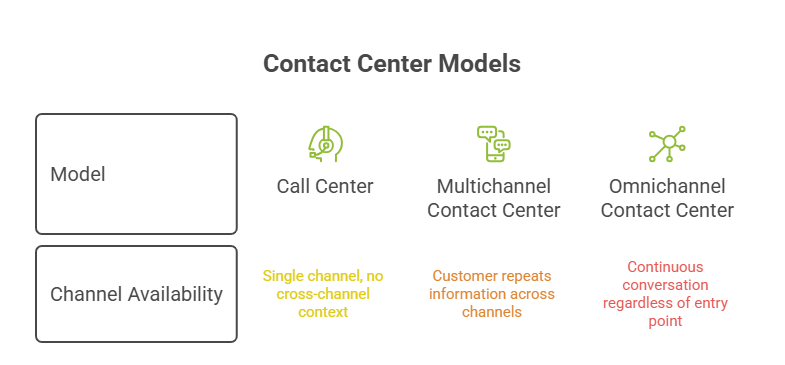
The common misconception is that offering several channels automatically makes a center omnichannel. Without unified data behind those channels, it is still multichannel, and the customer experience reflects that gap.
How an Omnichannel Call Center Works
The system is built around a few connected functions:
- Unified customer profile: Every interaction, past and present, is tied to a single record so agents see full context regardless of which channel a customer used.
- Channel integration: Voice, chat, email, SMS, and social platforms feed into the same interaction layer instead of separate queues.
- Intelligent routing: Conversations are directed based on customer history, agent skill set, and urgency rather than simple first-available logic.
- CRM synchronization: Interaction data updates the CRM in real time, so sales, support, and operations teams work from the same information.
- AI-powered assistance: Machine learning models support agents with suggested responses, summaries, and next-best-action prompts during live interactions.
Benefits of Omnichannel Call Centers
Organizations invest in omnichannel support not only to improve service quality but also to create more efficient, scalable, and customer-centric operations.
- Improved customer experience: Maintaining continuity across multiple channels minimizes repetition and creates a smoother customer journey.
- Faster resolution: Agents can access complete interaction histories, allowing them to solve problems more quickly and accurately.
- Higher first-contact resolution: Fewer transfers, escalations, and callbacks are needed to resolve customer issues.
- Increased agent productivity: A unified platform reduces the need to switch between tools and lowers administrative workloads.
- Better personalization: Consolidated customer profiles enable agents to deliver more relevant and tailored support experiences.
- Higher customer retention: Consistent and convenient support interactions strengthen customer loyalty and reduce churn.
- Cost savings: Self-service tools and AI-assisted workflows help lower the cost of handling customer interactions over time.
Omnichannel Call Center Use Cases by Industry
Retail and ecommerce: Order status, returns, and exchange requests often move across chat, email, and phone within a single customer journey. Unified profiles let agents pick up mid-journey without asking the customer to repeat order details, which matters most during peak volume periods like holiday returns.
Telecom: Billing disputes, plan changes, and technical support frequently span self-service portals, chat, and voice. Omnichannel routing reduces the back-and-forth common in telecom support, where customers are often already frustrated before contacting the center.
How AI Is Transforming Omnichannel Call Centers
Speech analytics now processes voice interactions in real time, surfacing compliance issues or escalation risk before a call ends. Sentiment analysis extends this across text channels, flagging frustration signals in chat or email that a human reviewer might miss in high volume.
Automated summaries reduce after-call work by generating interaction notes automatically, and agent-assist tools suggest responses or relevant knowledge base articles mid-conversation, shortening resolution time without removing agent judgment from the interaction.
Best Practices for Implementing an Omnichannel Call Center
Define customer journeys across all channels before selecting technology, so the system is built around real behavior rather than assumptions. Centralize customer data into a single source of truth before adding new channels.
Integrate CRM and other business systems early rather than treating integration as a later phase. Train agents on cross-channel context, not just individual channel tools. Monitor KPIs from day one to catch routing or integration issues quickly. Continuously optimize based on interaction data rather than treating implementation as a one-time project.
Common Challenges and How to Overcome Them
- Data silos: Legacy systems often store channel data separately; a unified customer data platform is typically required before true omnichannel routing is possible.
- Legacy systems: Older infrastructure may lack API support; middleware or phased replacement is often necessary.
- Agent adoption: New unified desktops change daily workflows; structured training reduces resistance.
- Integration complexity: Connecting CRM, WMS, and support tools takes planning; prioritize high-impact integrations first.
- Security and compliance: Unified data increases the surface area for risk; access controls and encryption need to scale with integration.
- Scaling operations: Systems that work at low volume can break under peak load; load testing before major sales periods is essential.
KPIs to Measure Omnichannel Call Center Success
- First Contact Resolution (FCR): Measures the percentage of customer issues resolved during the first interaction without requiring follow-up communication.
- Average Handle Time (AHT): Tracks the average amount of time agents spend handling customer interactions across all channels.
- Customer Satisfaction (CSAT): Evaluates how satisfied customers are with a specific interaction based on their direct feedback.
- Net Promoter Score (NPS): Measures the likelihood that customers will recommend the company to others, providing insight into long-term loyalty.
- Customer Effort Score (CES): Assesses how much effort customers must expend to resolve an issue or complete a task.
- Agent Utilization: Calculates the proportion of an agent's working time spent on productive customer interactions and related activities.
- SLA Compliance: Measures how consistently the organization meets its predefined response and resolution time targets.
How to Choose the Right Omnichannel Call Center Solution
Evaluate vendors against a short list of essentials: native support for all required channels, real integration capabilities with existing CRM and operational systems (not just API availability on paper), built-in AI features such as sentiment analysis and agent assist, and proven scalability under peak load.
Pricing models vary between per-agent and usage-based structures, so cost should be assessed against expected volume growth, not just current headcount. During vendor evaluation, request references from companies of similar scale and industry, since implementation complexity often depends more on existing systems than on the platform itself.
Conclusion
An omnichannel call center is defined less by the number of channels offered and more by whether those channels share one continuous view of the customer. That continuity is what drives faster resolution, higher first-contact resolution rates, and stronger retention. Choosing and implementing the right solution comes down to data unification, realistic integration planning, and KPIs tracked from the start rather than added later.
Frequently Asked Questions
1. What is an omnichannel call center?
An omnichannel call center unifies voice, chat, email, SMS, and social media into one system with a shared customer profile, so agents have full context regardless of which channel a customer uses.
2. Is omnichannel better than multichannel?
Omnichannel typically delivers a better customer experience because interaction data is unified. Multichannel offers similar channel variety but without shared context, which often means customers repeat information.
3. How does AI improve omnichannel support?
AI supports agents through real-time sentiment and speech analytics, automated call summaries, and next-best-action suggestions, reducing resolution time and administrative work.
4. What channels should an omnichannel call center support?
Most implementations cover voice, live chat, email, SMS, and at least one social channel, chosen based on where the customer base is actually active.
5. How long does implementation take?
Timelines vary by existing infrastructure, but most mid-market implementations take several months, from data unification through agent training and phased channel rollout.
6. What are the biggest challenges in migration?
Data silos from legacy systems and integration complexity with existing CRM or operational tools are the most common obstacles during migration.
7. What KPIs matter most?
First Contact Resolution and Customer Effort Score are strong early indicators of whether unification is actually improving the customer experience, alongside AHT and CSAT for operational tracking.
8. Which industries benefit the most?
Retail, ecommerce, and telecom see some of the clearest gains, since their support volume regularly spans multiple channels within a single customer issue.