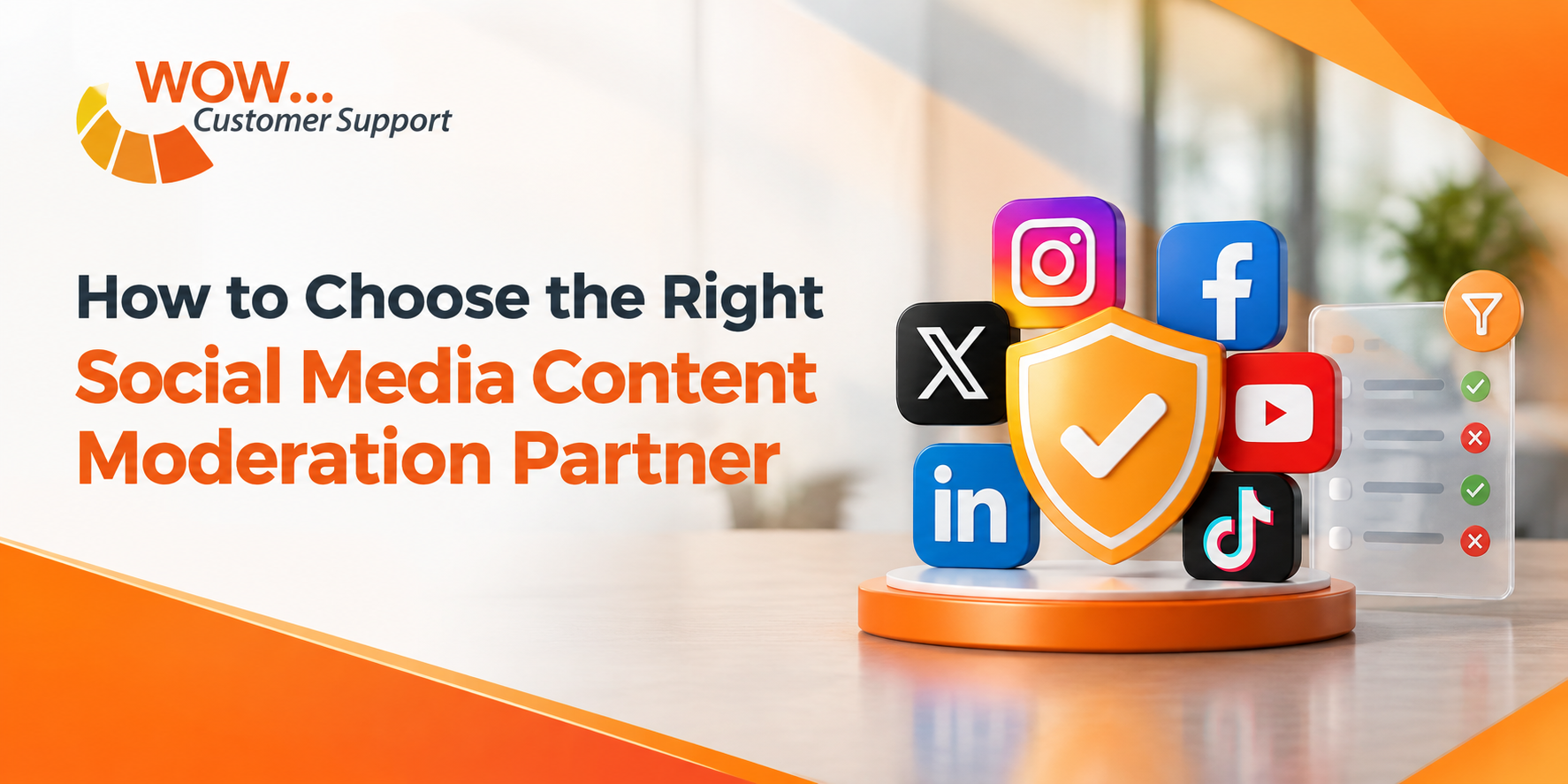
Selecting a third-party partner to protect your digital channels requires evaluating operational efficiency, risk mitigation, and technical capability. Business leaders cannot treat online risk management as an administrative utility, as a single unmoderated brand crisis directly damages revenue and market equity.
According to a global consumer trust benchmark study conducted by Bazaarvoice, 69% of consumers report significant concern over inappropriate or fraudulent social media content, with 40% immediately abandoning a brand after encountering just one piece of toxic or fake user media. Investing in professional content moderation services safeguards user safety and maintains platform integrity across global digital audiences.
Table of Contents
What Does a Social Media Content Moderation Outsourcing Partner Do?
12 Factors to Evaluate When Choosing a Moderation Outsourcing Partner
How to Compare Content Moderation Outsourcing Providers
What Does a Social Media Content Moderation Outsourcing Partner Do?
An outsourced moderation partner enforces platform guidelines, filters harmful media, and maintains brand safety across user-generated content channels. Specialized providers deploy hybrid operational teams that pair natural language processing with human judgment to process text, image, and video submissions at enterprise scale.
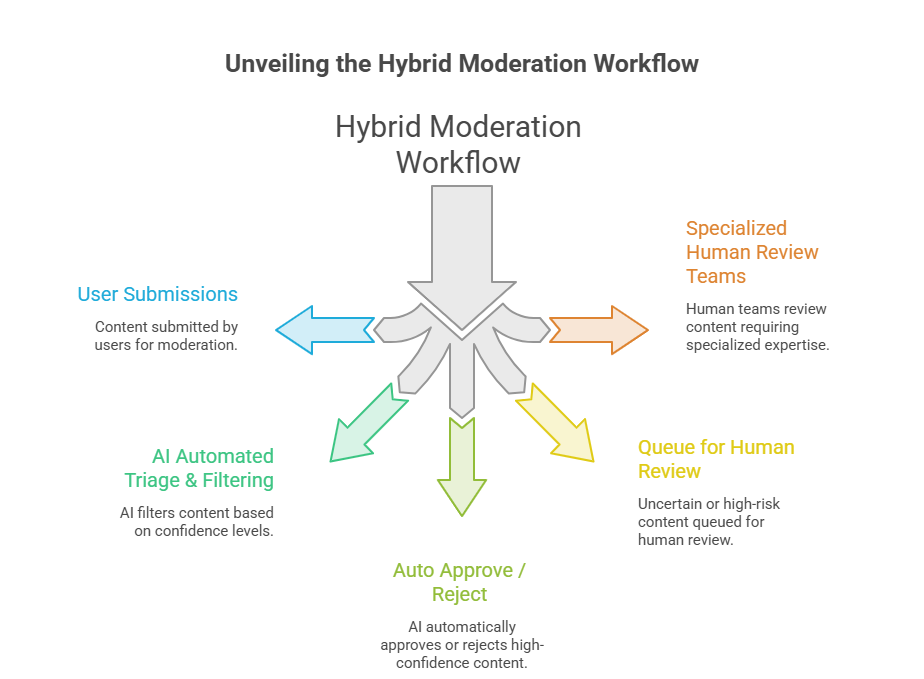
Integrating external social media content moderation teams allows organizations to maintain continuous operational coverage across global consumer channels. These specialized vendors handle complex workflow queues, analyze context-specific edge cases, and apply swift policy enforcement to safeguard user communities.
12 Factors to Evaluate When Choosing a Moderation Outsourcing Partner
Selecting an enterprise partner requires analyzing twelve core operational, technical, and organizational capabilities to ensure complete brand safety alignment.
1. Social media and industry experience
Domain expertise directly impacts how effectively moderation teams navigate subtle contextual nuances, slang, and brand-specific communication guidelines. Vendors with established track records in your vertical understand platform-specific compliance requirements, community behaviors, and unique risk profiles.
Evaluating historical client engagements ensures the provider has successfully managed similar channel architectures and content risks. Experienced vendors bring refined training modules and established operational workflows that significantly reduce onboarding timelines for new platforms.
2. Moderation accuracy and quality assurance
Precision in policy enforcement prevents the accidental removal of legitimate user contributions while ensuring swift deletion of harmful media. Leading providers maintain structured quality assurance programs, conducting double-blind audits and calibration sessions to measure decision consistency.
Procurement teams must evaluate a provider's historical F1 score and the statistical balance between precision and recall rates across high-volume queues. High-quality standards rely on clear documentation, continuous agent training, and real-time policy updates aligned with emerging online trends.
Choose a social media content moderation outsourcing partner built to protect your digital channels 24/7.
3. AI and human moderation capabilities
Modern platform defense requires a tightly integrated hybrid architecture that combines machine speed with human contextual reasoning. Automated AI tools excel at high-speed pre-filtering, OCR scanning, and pattern detection, while trained human agents handle nuanced edge cases and sensitive content.
|
Capability Layer |
Primary Functional Focus |
Enterprise Operational Advantage |
| AI Pre-Filtering | High-speed pattern matching, OCR, profanity blocks | Instantly removes 80%+ of obvious platform violations |
| Human Tier-1 | Contextual text review, image evaluation, slang checks | Accurately processes subtle cultural nuance and intent |
| Human Tier-2 | Complex policy edge cases, legal escalations, PR risks | Protects executive leadership from high-profile exposure |
Evaluating a vendor's technical stack ensures their automated systems stream seamless decision context to human reviewers without introducing workflow latency. Tightly coupled content moderation services lower cost-per-item metrics while preserving high accuracy across complex moderation queues.
4. Scalability and peak-volume capacity
User-generated content volumes fluctuate unpredictably during product launches, viral marketing campaigns, breaking news cycles, and corporate crises. A mature outsourcing partner must offer dynamic capacity management to absorb sudden ticket spikes without violating established response SLAs.
Inquire about the vendor's bench strength, cross-training protocols, and historical performance during unexpected client traffic surges. Flexible staffing models protect operational continuity and maintain platform integrity during critical high-volume events.
5. Language and cultural expertise
Global brands require localized moderation capabilities that understand regional dialects, local slang, emerging memes, and specific cultural sensitivities. Relying on direct translation tools often results in severe policy misinterpretations, leading to unjustified content bans or missed violations.
Enterprise partners deploy native-speaking moderation teams embedded in target regional markets to ensure accurate contextual evaluation. Comprehensive social media content moderation requires deep cultural awareness to distinguish harmless regional banter from genuine online hate speech.
6. Response times and SLA coverage
Rapid turnaround times are vital for minimizing user exposure to inappropriate material and preserving brand reputation across real-time feeds. Operational contracts must define strict response times based on content severity, assigning immediate priority to high-risk categories like hate speech or violence.
|
Content Priority Level |
Target Response SLA |
Target Resolution Time |
Primary Escalation Path |
| Critical Risk (Legal/Safety) | Under 5 minutes | Under 15 minutes | Immediate Executive & Legal Alert |
| High Risk (Harassment/Hate) | Under 15 minutes | Under 30 minutes | Tier-2 Senior Moderator Queue |
| Medium Risk (Spam/Self-Promo) | Under 1 hour | Under 4 hours | Automated Filter / Tier-1 Review |
| Low Risk (General Inquiry) | Under 4 hours | Under 12 hours | Standard Community Operations |
Reviewing a vendor's historical SLA compliance records reveals their true operational discipline under real-world workload conditions. Clear SLA structures hold providers accountable while ensuring predictable platform performance across all active time zones.
7. Data security and privacy
Moderation workflows frequently expose external personnel to sensitive user data, personally identifiable information, and confidential company metrics. Outsourcing providers must maintain rigorous data protection standards, including ISO 27001, SOC 2 Type II, and GDPR compliance certifications.
Secure operations require restricted physical facilities, zero-device clean rooms, encrypted transmission channels, and strict role-based access permissions. Partnering with security-aligned UGC moderation services protects proprietary organizational data and prevents costly compliance breaches.
8. Regulatory and platform-policy compliance
Digital safety regulations are expanding rapidly worldwide, imposing strict content removal timelines and transparency reporting mandates on platform operators. Vendor operational teams must remain fully versed in evolving international legislation, such as the EU's Digital Services Act and regional child safety mandates.
Providers should actively update their internal moderation workflows to reflect changes across major social media API policies and legal frameworks. Compliant operational processes insulate platform leadership from regulatory fines, legal scrutiny, and public compliance failures.
9. Technology and platform integration
Seamless integration with your existing technological infrastructure eliminates manual data transfers and accelerates real-time ticket routing. Mature vendors offer robust API connectors, webhook integrations, and compatibility with leading customer service and community management platforms.
Evaluating technical compatibility early prevents costly custom development projects and delays during operational onboarding. Advanced software integrations allow internal product managers to retain real-time visibility over external queue volumes and workflow states.
10. Reporting and analytics
Data-driven visibility into moderation metrics allows executive teams to identify emerging platform risks, user sentiment shifts, and operational bottlenecks. Top-tier providers deliver comprehensive dashboard analytics covering ticket volumes, accuracy rates, queue latency, and agent productivity.
Standardized reporting supports continuous operational optimization and provides transparent evidence of vendor value and SLA compliance. Access to granular queue data empowers business leaders to refine platform policies based on empirical user behavior.
11. Pricing and total cost
Understanding the complete cost structure prevents unexpected budget overruns and aligns vendor expenditure with business volume. Vendors typically offer transparent pricing models based on per-unit item checks, hourly agent billing, or dedicated monthly team allocations.
Procurement officers must evaluate total cost of ownership by accounting for software setup fees, platform integrations, and tier-two escalation pricing. Flexible, transparent commercial terms ensure that scaling your moderation program remains financially sustainable over long-term growth phases.
12. Communication and account management
Transparent communication channels and dedicated account leadership ensure rapid alignment during operational crises and policy updates. Experienced partners assign dedicated client success managers, lead calibration specialists, and technical account directors to oversee daily operations.
Establishing regular performance reviews, weekly calibration calls, and joint crisis response protocols maintains complete strategic alignment. Clear account management frameworks ensure that external teams operate as a seamless extension of your internal community team.
How to Compare Content Moderation Outsourcing Providers
Systematically comparing competing vendors requires structuring objective evaluation methodologies that go beyond marketing claims and high-level sales decks.
Build a vendor shortlist
Creating an initial shortlist involves auditing candidate providers against essential operational credentials, security certifications, and industry domain experience. Procurement teams should filter initial vendor lists by verifying five foundational operational criteria:
- Relevant experience: Verify proven track records in your specific market vertical and platform ecosystem.
- Client references: Speak directly with current enterprise clients to audit real-world service reliability and partnership flexibility.
- Case studies: Review documented performance metrics demonstrating successful handling of volume spikes and complex policy shifts.
- Security credentials: Confirm current ISO 27001, SOC 2 Type II, and regional privacy compliance certifications.
- Service coverage: Ensure native multi-language support and true 24/7/365 follow-the-sun operational presence.
Create a weighted vendor scorecard
Deploying a weighted scoring matrix eliminates internal evaluation bias and allows leadership to rate vendors objectively based on organizational priorities.
|
Evaluation Criteria |
Priority Weight |
Vendor A Score (1-10) |
Vendor B Score (1-10) |
Vendor C Score (1-10) |
| Accuracy & QA Protocols | 25% | 9 | 8 | 7 |
| Security & Compliance | 20% | 10 | 9 | 8 |
| AI & Tech Integration | 15% | 8 | 9 | 6 |
| Scalability & SLA Speed | 15% | 8 | 7 | 9 |
| Cultural & Language Depth | 10% | 9 | 8 | 7 |
| Pricing & Value Alignment | 15% | 7 | 9 | 8 |
| Weighted Total | 100% | 8.60 | 8.25 | 7.40 |
Compare providers on the same criteria
Evaluating candidate vendors on unequal terms creates misleading cost and operational conclusions that distort procurement decisions. Comparing pure hourly agent rates against comprehensive, technology-bundled item pricing leads to inaccurate budget projections and unexpected scope additions.
Procurement teams must enforce standardized bidding templates that force all participating vendors to quote against identical volumes, SLAs, and security architectures. Standardized operational proposals ensure that executive leadership evaluates true head-to-head value across competing content moderation services.
How to Choose Between Two or More Shortlisted Providers
When finalist vendors demonstrate similar technical credentials and pricing models, apply this seven-step decision framework to identify the optimal partner:
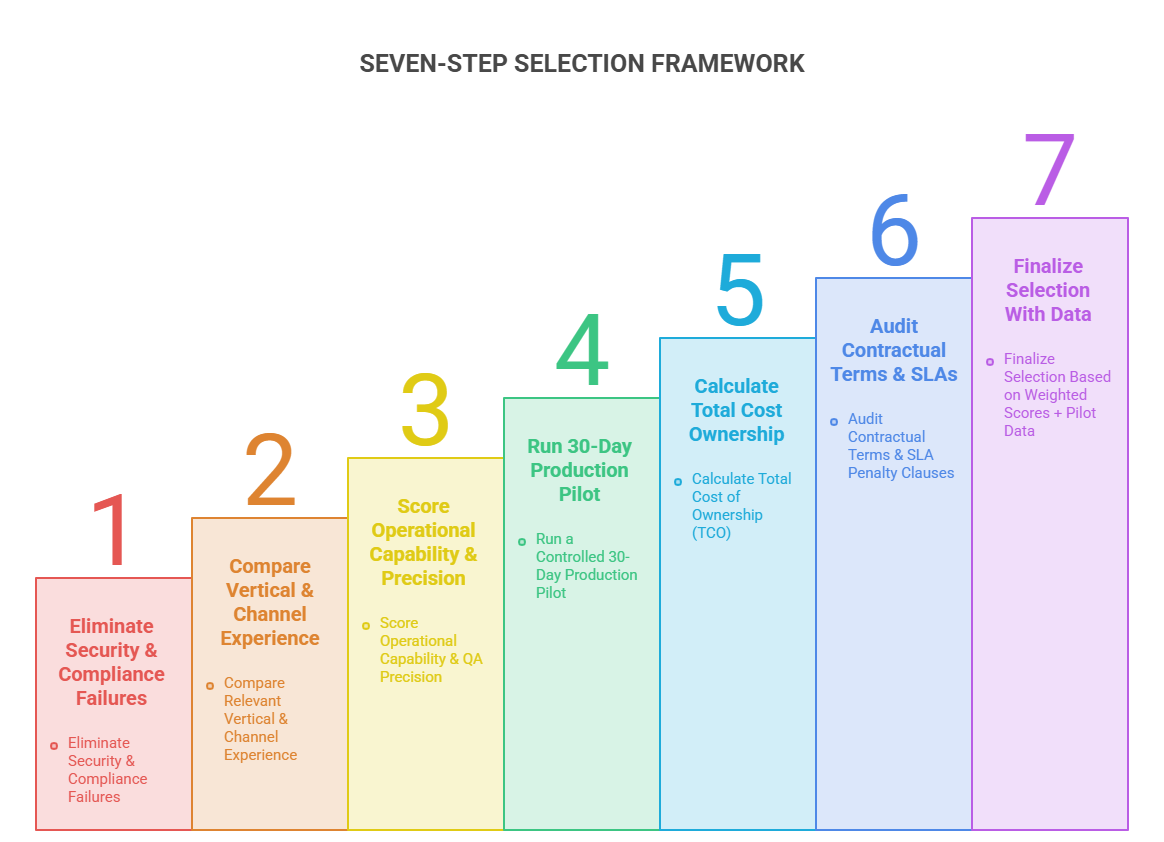
- Eliminate security/compliance failures: Immediately remove any candidate vendor that fails basic SOC 2, ISO 27001, or data privacy requirements.
- Compare relevant experience: Rank remaining providers by their verified track record in managing your specific channel types and media workflows.
- Score operational capability: Evaluate technical architecture, hybrid AI integration, and agent wellness programs using your weighted scorecard.
- Run the pilot: Deploy a controlled 30-day production pilot using identical live traffic streams to measure real-world precision, recall, and SLA speed.
- Compare total cost: Calculate complete annual financial commitments, factoring in platform setup fees, integration costs, and potential SLA penalties.
- Review contract/SLA: Audit proposed contract terms to confirm clear escalation paths, explicit penalty structures, and flexible termination options.
- Select based on weighted score + pilot results: Combine objective scorecard metrics with empirical pilot performance data to award the final contract.
FAQs
What should I look for in a content moderation outsourcing partner?
Focus on verified industry experience, hybrid AI-human capabilities, strict SLA commitments, and high-quality assurance standards. Confirm robust data security certifications, native multi-language coverage, and proven agent wellness programs to ensure sustainable service delivery.
How much does outsourced social media content moderation cost?
Costs vary based on pricing models, content formats, media complexity, and language requirements. Dedicated human moderation ranges from $12 to $35 per hour depending on geographic region and language complexity, while per-item pricing typically spans $0.01 to $0.10 per reviewed unit.
Is it better to outsource content moderation or manage it in-house?
Outsourcing offers superior financial flexibility, immediate access to 24/7/365 global coverage, and rapid scalability during unexpected volume spikes. Managing moderation entirely in-house requires substantial overhead investments in recruitment, continuous agent training, wellness infrastructure, and specialized software.
What types of social media content can be outsourced?
Outsourced teams process user-generated text comments, product reviews, direct messages, live video streams, image uploads, and audio files. Providers can also handle brand reputation monitoring, spam detection, customer inquiry triage, and specialized policy enforcement queues.
How do I evaluate a content moderation company's accuracy?
Audit historical precision and recall metrics, F1 scores, and internal quality assurance calibration routines. Running a live, parallel production pilot provides clear empirical data on how accurately candidate vendors enforce your specific community guidelines.
What KPIs should a content moderation provider offer?
Key performance indicators must include First Action Time, Mean Time to Resolution, Accuracy Rate, F1 Score, SLA Compliance Percentage, and Agent Quality Audit Scores. Advanced providers also supply real-time dashboards tracking queue volume trends and user sentiment distributions.
How do content moderation outsourcing companies use AI?
Modern providers utilize AI models for automated pre-filtering, automated spam removal, OCR text extraction, and computer vision classification. AI engines process high-speed routine items instantly, routing complex contextual edge cases to human agents for detailed review.
What should be included in a content moderation SLA?
A comprehensive service level agreement must specify maximum turnaround times by severity level, target accuracy rates, minimum uptime guarantees, and clear escalation protocols. SLAs should also outline financial penalty structures for missed targets and define exact agent training standards.
How long should a content moderation pilot last?
A standard pilot runs between 30 and 60 days to capture sufficient traffic variability, volume fluctuations, and edge cases. This duration allows internal teams to thoroughly evaluate vendor accuracy, workflow integration, SLA compliance, and communication transparency.
Conclusion
Outsourcing social media moderation transforms platform safety from a reactive operational challenge into a strategic competitive advantage. Partnering with an experienced vendor provides enterprise platforms with the scale, technology, and specialized expertise needed to protect brand equity and maintain user trust across global markets.
Selecting the right partner requires auditing candidate capabilities against strict technical, operational, and security standards using empirical evaluation frameworks. Deploying specialized content moderation services empowers internal teams to focus on core product growth while ensuring continuous, high-quality platform protection.