A customer stuck at checkout or confused about a return policy will not wait long for an answer. If live chat is slow, robotic, or disconnected from the rest of the support system, the customer either abandons the purchase or ends up more frustrated than when they started. Simply having a chat widget on the website does not solve this. The businesses that see real gains from live chat are the ones that treat it as a discipline, not a feature.
This article breaks down what separates functional live chat from live chat that actually improves satisfaction, retention, and revenue. The practices below fall into four connected areas: how chat is set up and staffed, how agents are trained and supported, how chat is used to support sales without becoming pushy, and how teams measure and refine performance over time. Getting all four right is what turns live chat into a dependable part of the customer experience rather than a box checked on a features list.
Table of Contents
Why Live Chat Best Practices Matter
Customers who get fast, accurate help through chat tend to rate their overall experience higher, and that satisfaction carries into how they perceive the brand elsewhere. Response speed matters because chat is inherently a real-time channel; a delayed reply defeats the purpose of offering it. Businesses that handle chat well also see it reflected in retention, since customers who feel supported are less likely to churn after a bad experience.
Chat also has a direct line to revenue. Agents who can answer product questions or handle objections in the moment influence purchase decisions that would otherwise stall. On the internal side, well-run chat operations improve agent productivity by cutting down repetitive lookups, and that efficiency lowers the cost per resolved conversation compared to phone or email support.
Deploy 24/7 live chat services for your business.
10 Live Chat Best Practices
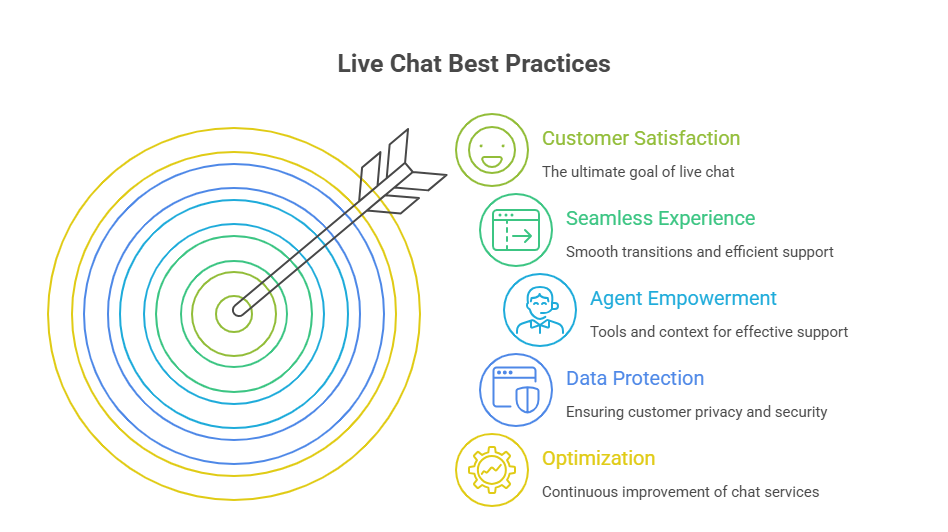
The practices below cover the operational, technical, and human factors that determine whether live chat performs well or simply exists as a checkbox feature.
1. Place Live Chat Where Customers Need It Most
Chat should not be a single floating icon that appears everywhere and nowhere in particular. It works best when placed with intent. Product and pricing pages benefit from chat because these are moments of comparison and hesitation, where a quick answer can prevent a customer from leaving to research elsewhere. Checkout pages and other high-intent moments deserve chat access too, since friction at this stage directly threatens a sale.
Support and help center pages need chat as a fallback when self-service articles do not fully answer the question. Proactive chat triggers, such as a message appearing after a visitor spends extended time on a page without acting, can also open a conversation before the customer decides to leave. The goal is coverage where hesitation is likely, not chat for the sake of having it everywhere.
2. Set Clear Response Expectations
Uncertainty is often more frustrating to customers than a wait itself. Publishing business hours prevents customers from expecting a live response when no agent is available. Showing estimated wait times, even roughly, helps customers decide whether to stay in the queue or try another channel. Internally, teams should define response-time targets for first reply and for resolution, since these targets shape staffing and routing decisions.
When live chat support is offline, a clear after-hours message with alternative contact options, such as email or a callback request, keeps the interaction from feeling like a dead end. Setting these expectations upfront, rather than leaving customers guessing, aligns what the business promises with what it can realistically deliver, which is the foundation of a dependable service-level standard.
3. Respond Quickly With Personalized Support
First response time is one of the most visible measures of chat quality, and customers notice when it slips. Speed alone is not enough, though. Using the customer's name and referencing relevant context, such as an order in progress or a page they were viewing, signals that the conversation is not starting from zero. Access to purchase and prior interaction history lets agents avoid asking customers to repeat information they have already provided elsewhere.
Urgent conversations, such as a payment failure or a shipping issue tied to a deadline, should be prioritized over routine questions. None of this works if responses sound scripted. Personalized, human phrasing, even when using templated starting points, makes the difference between a transaction and a genuinely helpful exchange.
4. Collect the Right Information Upfront
A short intake form before the chat begins can route the conversation to the right agent and reduce back-and-forth. Useful fields typically include the customer's name, relevant order or account details, and a general issue category so the conversation starts with context rather than a blank slate. Capturing basic customer context, such as which page they were on, adds further clarity without requiring the customer to explain it manually.
The risk is overcorrecting. Long forms with too many required fields discourage customers from starting the chat at all, especially on mobile devices. The right approach asks for only what is necessary to resolve the issue efficiently, leaving deeper details to be gathered conversationally once an agent is engaged.
5. Train Agents and Maintain a Consistent Brand Voice
Agents need solid product knowledge to answer questions accurately without escalating routine issues. Beyond knowledge, chat etiquette matters: clear phrasing, appropriate pacing, and knowing when to ask a clarifying question instead of guessing. Tone and empathy are harder to standardize but can be taught through examples of what strong responses to frustrated customers look like.
Role-playing difficult scenarios, such as an angry customer disputing a charge, prepares agents for situations that scripts alone cannot cover. Canned responses are useful for efficiency, but they need to be edited with personalization rather than pasted verbatim, since customers can tell when they are reading a generic template. Ongoing coaching, not a one-time onboarding session, is what keeps brand voice consistent as the team grows.
6. Make Transfers, Escalations, and AI Handoffs Seamless
Every live chat system eventually needs to move a conversation from one agent to another, or from a bot to a human. Clear escalation triggers, such as a customer explicitly asking for a person or a bot failing to resolve an issue after a set number of exchanges, prevent conversations from stalling. Skill-based routing ensures the right specialist, rather than the next available agent, picks up complex issues like billing disputes or technical troubleshooting.
AI-to-human handoffs deserve particular attention, since a poorly executed transition is one of the fastest ways to frustrate a customer. The full conversation history and any context the bot gathered should transfer automatically. When this works correctly, the customer never has to repeat their issue from the beginning, which is often the single biggest complaint about escalated support interactions.
7. Give Agents the Context and Tools They Need
Agents cannot deliver personalized, efficient support without the right systems behind them. CRM integration surfaces customer history and account status directly inside the chat window. A connected knowledge base lets agents pull accurate answers quickly instead of relying on memory or asking a colleague. Order management system access is essential for ecommerce support specifically, since a large share of chat volume involves order status, shipping, or returns.
Unified customer profiles that combine chat, email, and phone interactions prevent agents from working with a partial picture. Cross-channel conversation history matters just as much, since customers frequently switch channels mid-issue and expect the new agent to already understand what happened before.
8. Use Live Chat for Sales Without Being Intrusive
Chat can support revenue when it identifies genuine buying signals, such as a visitor comparing product pages or lingering on a pricing tier, and offers help at that moment. Product recommendations delivered through chat feel more natural than a pop-up because they respond to something the customer is actively doing.
Agents trained to handle objections, such as price concerns or comparison questions, can resolve hesitation that would otherwise end in an abandoned cart. Proactive chat triggered by cart abandonment behavior can recover sales that would be lost entirely without intervention. The line to watch is intrusiveness. Chat that interrupts browsing too aggressively or pushes products before a customer has shown interest tends to damage trust rather than build it.
9. Protect Customer Data and Make Chat Accessible
Chat often involves sensitive information, from account details to payment references, which makes security a non-negotiable requirement. Authentication and access controls should limit who can view account-specific data within a conversation. Encryption protects personally identifiable information both in transit and at rest, and any payment-related exchange should route through a secure, compliant process rather than being typed directly into open chat.
Accessibility deserves equal attention. A mobile-friendly chat interface is essential given how much support traffic now originates from phones, and keyboard navigation support ensures the widget works for customers using assistive technology. Multilingual support extends accessibility further, allowing chat to serve a broader customer base without forcing everyone into a single language experience.
10. Measure, Learn, and Continuously Optimize
Live chat performance is not something to set up once and leave alone. Monitoring customer sentiment during conversations can flag frustration before it turns into a formal complaint or a lost customer. Post-chat CSAT surveys and open feedback give a direct read on how customers experienced the interaction, while periodic reviews of actual conversation transcripts reveal patterns that aggregate metrics miss.
A/B testing widget placement, greeting copy, and proactive trigger timing helps teams find what actually converts rather than relying on assumptions. For businesses using AI in live chat, tracking bot performance separately from human agent performance clarifies where automation helps and where it creates friction. All of this feeds into staffing optimization, ensuring coverage matches actual demand patterns instead of guesswork.
Frequently Asked Questions
1. What are the most important live chat best practices?
Fast, accurate first responses combined with proper context are the foundation. Beyond that, clear escalation paths, agent training, and ongoing measurement determine whether chat performance holds up as volume grows.
2. What is a good live chat response time?
There is no single universal benchmark, since expectations vary by industry and customer type, but chat is generally expected to be faster than email. Businesses should set an internal target for first response and track it consistently rather than relying on a generic industry figure.
3. How can businesses improve live chat customer service?
Improvement usually comes from a combination of better agent training, tighter integration between chat and other customer systems, clearer escalation processes, and regular review of past conversations to identify recurring gaps.
4. Should live chat use AI or human agents?
Most effective setups use both. AI handles routine, repetitive questions and initial triage, while human agents manage complex, sensitive, or emotionally charged conversations. The handoff between the two needs to be seamless for this combination to work well.
5. How many chats can one agent handle?
This depends on the complexity of the issues being handled and the tools available to the agent. Simple, well-supported queries allow for higher concurrency than technical or emotionally sensitive conversations, so a single fixed number rarely applies across use cases.
6. What KPIs should live chat teams track?
Common metrics include first response time, resolution time, CSAT, chat volume by channel entry point, and agent-level performance. Teams using AI should also separate bot resolution rates from human-assisted outcomes.
7. How can live chat increase conversions?
Chat increases conversions primarily by resolving hesitation at the moment it occurs, whether that is a product question, a pricing concern, or an objection at checkout. Proactive engagement based on browsing behavior can also recover visitors who would otherwise leave without acting.
8. What should agents never say in live chat?
Agents should avoid dismissive or vague responses such as telling a customer to simply check the website again, and should avoid making commitments, like guaranteed refund timelines, that the business cannot reliably keep. Clear, honest communication holds up better than reassurance that turns out to be inaccurate.
Conclusion
Live chat service works best when speed, personalization, context, and human judgment operate together rather than in isolation. A fast reply without the right account context still frustrates customers, and a well-trained agent without proper tools still struggles to resolve issues efficiently. Treating chat as a full system, supported by clear processes and consistent measurement, produces better outcomes than optimizing the widget alone.
Businesses that want to strengthen this system without building it entirely in-house often turn to experienced outsourcing partners. When the underlying data is reliable, live chat agents can resolve issues faster and with fewer errors, which is often the difference customers actually notice.