UG Content Moderation: A Guide To Moderating Users’ Content To Make Your Brand’s Social Media Presence Top-Grade

Content Moderation Services

The Internet is producing content every second. It could be fast, creative, careless, inspiring, and sometimes disturbing. Brands today are not just publishing content; they are hosting it. Images, videos, comments, reviews, reels, opinions, and more are flowing in from users who want to engage with the brand.

This is where moderating user generated content becomes unavoidable. User-generated content can elevate a brand. However, unmanaged content can erode trust, reputation, and credibility. That is why UGC content moderation becomes a daily discipline.

User-generated content moderation, or UGC moderation, is the structured process of reviewing, filtering, approving, or rejecting content submitted by users. By doing so, the brand aligns with platform rules, legal frameworks, and brand values. Freedom to post does not mean freedom from responsibility. Indeed, not all content deserves a stage.

UG Content Moderation

Table of Contents

Is User-Generated Content Important?

Types Of Content Moderation

Frequently Asked Questions

Conclusion

User-Generated Content

Is User-Generated Content Important?

User-generated content speaks when brands stay silent. It is real and raw. It is trusted. Reviews, testimonials, images, and videos created by users carry more credibility than polished ads. This makes user content moderation crucial. This content about what users say becomes what your brand sounds like.

Attract New Users

Some audiences ignore ads and scroll past banners. However, they pause for people. When influencers or everyday users share authentic experiences, they quietly persuade new buyers. UGC travels faster than brand messaging ever could.

Better Rankings In Search Engines

UGC improves discoverability. Users naturally use long-tail phrases, conversational terms, and unexpected keywords. This organic variety helps search engines understand relevance. With proper UGC moderation, this content boosts rankings without risking brand safety.

Makes The Existing Customers Happy

Sharing user content feels like applause. It rewards loyalty and builds belonging. Customers trust customers, and moderated UGC becomes social proof that prods decisions gently, not aggressively.

Make Optimum Use of UGC with Social Media Moderation

Social media moderation filters confusion into clarity. Millions of posts flood platforms daily:

  • Twitter: 500 million tweets
  • Facebook: 350 million photos
  • Snapchat: 5 billion snaps
  • Instagram: 95 million photos and videos
  • YouTube: 500 hours of video every minute

This volume explains why moderating user generated content must be consistent, scalable, and intelligent.

Understand the Customers

UGC reveals patterns people do not plan to show. Emotions often repeat, complaints come back, and praise usually comes in groups. Reviewing moderated content helps brands understand sentiment shifts and hidden expectations.

Up the Quality of Brand Campaigns

Campaigns fueled by moderated UGC perform better. They feel human. But without UGC content moderation, campaigns risk being hijacked by offensive visuals or harmful narratives. Scalable moderation protects creativity without killing it.

Better Online Visibility

Studies show nearly 25% of search results for large brands come from UGC links. But visibility without moderation invites risk. User content moderation ensures that visibility attracts, not repels.

Acts As a Shield to Your Brand and Users

Moderation protects both sides of the screen. It removes hate, violence, harassment, and misinformation. It aligns content with brand ethics while protecting users from bullying and abuse.

Good To Build Better Relations With Users

Featuring user content builds closeness. Edited and moderated properly, UGC feels curated, not censored. This balance creates trust and long-term engagement.

Shape The Purchasing Behavior For Good

Before buying, users read, and they compare. Moderated reviews influence choices. Clean, honest UGC nudges buyers toward confidence and checkout.

Implementing UG Content Moderation

Moderation selects what deserves attention. To do it well, structure matters.

Be Clear About The Rules

Define what is allowed. Be firm with illegal, violent, hateful, or explicit content. Do not erase all criticism. Some negative feedback is feedback, not sabotage.

Outline The Process Of Submission

There are three moderation approaches:

  • Pre-moderation: Content is reviewed before publishing
  • Post-moderation: Content goes live, reviewed later
  • Reactive moderation: Content reviewed only after complaints

Each model serves different platforms. UGC moderation must match speed with sensitivity.

Adhere To Certain Restrictions

Restrictions protect ecosystems. Require user accounts. Limit new-user privileges. Lift restrictions as trust builds. This slows spam and improves quality.

Keep an Eye on Pages with UGC

UGC pages need constant monitoring. Whether in-house or outsourced, user content moderation must be continuous, not seasonal.

Link the Marketing Goals with Great User Experiences

Moderation should support marketing goals, not block them. Best practices include:

  • Clear permission agreements
  • Transparent usage rights
  • Defined submission rules
  • Strong calls to action

Consistency matters. One Australian brand scaled globally using two hashtags and a unified visual style. Moderation kept everything aligned.

Types Of Content Moderation

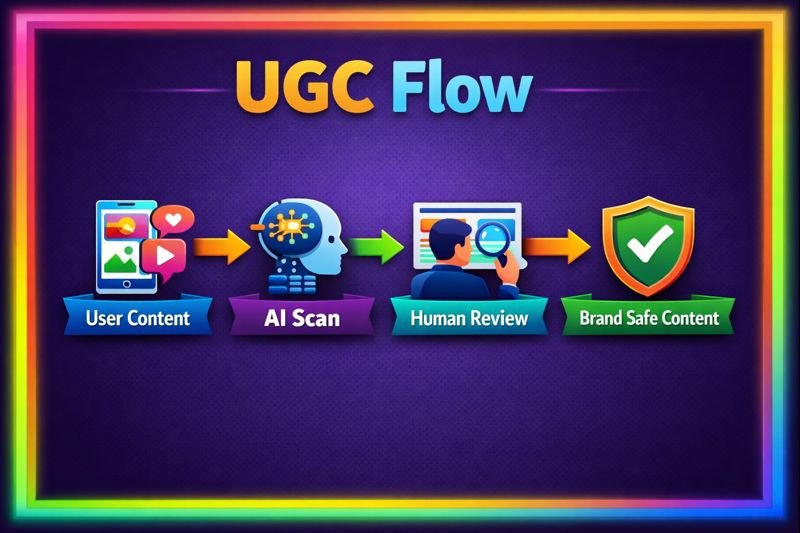
Human-Based Content Moderation

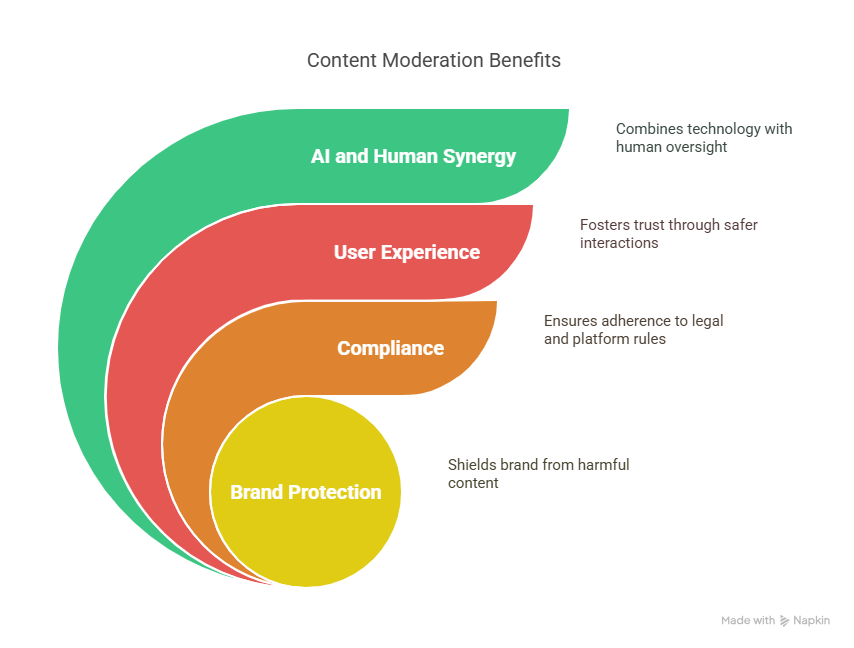
People understand details, context, and feelings. But it takes effort, and burnouts can happen. And it’s hard to stay fast when there’s a lot of work.

AI Content Moderation

AI scans fast. It flags violence, nudity, weapons, and hate efficiently. But it sometimes lacks context. Not every weapon is a threat. Not every conflict is harmful.

A Hybrid Approach: AI + Human Moderation

This is the smartest approach. AI filters volume, and humans refine judgment. Together, they deliver scalable, accurate UGC content moderation.

Frequently Asked Questions

1. What is UGC content moderation?

It is the process of reviewing and filtering user-created content to meet platform and brand standards.

2. Why is moderating user generated content important for brands?

It protects brand reputation, users, and improves trust, visibility, and conversions.

3. Can AI replace human moderators completely?

No. AI lacks contextual understanding. Human review remains essential.

4. How does UGC moderation improve SEO?

Moderated UGC adds fresh, relevant keywords without risking offensive content penalties.

5. Is user content moderation expensive?

Hybrid moderation models reduce costs while maintaining quality and speed.

Conclusion

User-generated content is powerful. But power without control can be damaging. With structured UGC moderation, brands turn content into a narrative. Moderation is not censorship. It protects and refines. It amplifies what matters and silences what harms.

In a world overflowing with content, moderation is the quiet force that keeps brands credible.

Looking to manage UGC without losing speed or sanity?

WOW Customer Support offers scalable, accurate, and brand-safe content moderation solutions. From social media to forums and apps, we help you moderate smarter, faster, and better.

Let WOW Customer Support turn your user content into your strongest asset.

Suggested Reads

10 Promising Trends in Content Moderation Services Your Business Shouldn’t Ignore

10 Promising Trends in Content Moderation Services Your Business Shouldnt Ignore

Building brand recognition involves developing the trust in the minds of your target audience. One of the most effective ways to build that trust over time is through user-generated content. According to recent statistics, customers say that user-generated content is 35% more memorable and 50% more trustworthy than other media types.

However, publishing appropriate user-generated content can be tricky because you need to figure out how to ensure that your brand portrays a positive image. In addition, simply relying on user-generated content could hurt your business because, without moderation, it's inevitable for some content to be viewed as offensive or harmful.

To meet all your content publishing requirements, it's essential to leverage the right form of content moderation services. If you're planning to start moderating your content or enhance your existing system, the following content moderation trends can point you in the right direction.

Table of Contents

Ten content moderation trends you can't miss

The future of the content moderation industry

The Growing Role of Content Moderation in Digital Commerce (2025 Update)

How the Content Moderation Industry Is Evolving in 2025

Conclusion

Frequently Asked Questions (FAQ)

Ten content moderation trends you can't miss

1. Working with multi-skilled content moderators

Content moderation goes beyond understanding the fundamental characteristics of a brand. It involves going through hundreds, if not thousands, of content that may seem unnecessary, pointless, or harmful. For this reason, an increasing number of online platforms have started working with multi-skilled moderators who can -

Commit to global standards, have expertise on regional dialects and local culture
Have an open mind to accept views and opinions of others
Respect the rules for developing content for your brand, and,
Replace ineffective content with more valuable alternatives.

2. Adopting a hybrid approach that includes technology and humans

While AI and machine learning can predict different trends regarding the likes and dislikes of your target audience, you still need human judgment to improve your content. The most reliable and effective content moderation services focus on combining the power of technology and humans to boost the quality of user-generated content. While human judgment is essential in developing innovative content, AI can prove effective in discovering trends that could negatively impact your content.

3. Managing content quality

Public reviews play a crucial role in content filtering choices. Moderating content requires an all-encompassing action plan to efficiently identify and correct errors in your content that may invite negative remarks from prospective customers. Therefore, it has become a must to hire content moderators who can quickly identify these errors, set up effective control programs, and develop excellent content that upholds your brand's reputation.

4. Following real-world policies

Sometimes, content developers are so engrossed in conveying their personal opinions through their work that the content may adversely affect the brand. However, content moderation services can rectify such errors by adhering to real-world policies to avoid content that may be sensitive towards political viewpoints or hurt religious sentiments. In addition, content moderations need to constantly update themselves with the latest policies and implement the same in their work to avoid controversies that may impair your brand's reputation.

5. Eliminating offensive and objectionable content

Insensitive remarks or cruel statements are a strict no-no as they can provoke a section of your audience to go against your brand. Any responsible content moderator should guide you in understanding the laws and provisions against hate speeches.

Your content doesn't include the words or phrases that may start a chaotic situation among different communities. They are well aware of defensive languages that can make your content impactful without hurting anyone's sentiments.

6. Prioritizing the safety and privacy of your audience

One of the growing trends in content moderation is forming a special team for monitoring and filtering content that doesn't necessarily follow the norms of content moderation policies against privacy violations.

Cybersecurity threats such as malware, data breaches, and identity theft are increasing concerns for online users. As a result, it's necessary to ensure that the content you publish doesn't compromise the privacy or safety of your audience. Safeguarding the identity and personal information of your users needs to rank high on your priority list.

7. Avoiding false information

Companies are now more conscious than ever about cross-checking the information they publish. But, with trolls waiting for the smallest gap to bash your brand online, you can't afford to give them any breathing room. And the best way to shut them down is by checking the authenticity of your content.

Develop a content moderation system that follows a strict list of policies and prohibits spreading false information, misrepresentation, or fake news. Even the smallest of mistakes can blow up your brand's reputation because of posts made viral by trolls.

8. Increasing transparency

It's high time for your online platform to create and publish a transparency report if you don't have one yet. This report includes the moderation rules you implement on your platform, which helps to inform users about what they can and cannot publish. The biggest social media platforms all provide transparency reports about how they handle private information, copyrights, protection of intellectual property, and data requests.

9. Handling machine-generated and spam content

AI's machine-generated content (including generative AI) is now becoming even more sophisticated in 2025. Platforms are increasingly relying on AI-detection tools combined with human moderators to identify harmful or misleading content. The primary drawback of this system is that it may lead to the dissemination of malicious information, thus degrading your audience's experience and, in turn, denting your brand's reputation. Individuals or organizations with ill intentions can create multiple accounts on your platform and publish spam content in bulk. Boosting the security of your site and finding unique solutions to the moderation of this kind of content are imperative to provide the best user experience.

10. Developing a localized approach

It's important to remember that each country has its own regional, cultural, and socio-political nuances. If your website attracts an international audience, you need to take this into account to cater to their content needs. Simply outsourcing content moderation services to the first company you find online may not yield the best results. In 2025, the trend is toward multi-regional moderation teams and AI-assisted cultural adaptation to meet global audience expectations. It's better to work with a company with multiple regional and local hubs so you can create an effective location-based strategy.

The future of the content moderation industry

There is no denying that AI controls the advertisements and posts that we see on our social media feed every day. A lot of content that we come across are not what we would like to see, but they pop up on our feed anyway. What if your e-commerce brand mistakenly posts something that your target audience doesn't like, even if you have no intention of stirring up controversy? Such a situation can wreak havoc on your brand.

Since it's becoming a challenge to handle machine-generated content, the best way to counter this problem is to rely on content moderation. It can effectively eliminate content that may hurt your viewers' sentiments or create a divide among your audience. The demand for advanced moderation solutions is projected to grow significantly in 2025 as e-commerce, social media, and generative AI expand. It's reasonable to assume the continuous growth of content moderation for as long as the e-commerce industry and social media platforms exist.

The Growing Role of Content Moderation in Digital Commerce

The content moderation business has become a critical component for brands operating in highly competitive digital environments in 2025. As online platforms scale, businesses increasingly depend on structured moderation frameworks to maintain trust, reduce risk, and comply with updated platform regulations. This is especially relevant as customer interactions continue to move toward user-driven ecosystems.

For content moderation for eCommerce websites in 2025, moderation plays a vital role in managing product reviews, customer images, seller listings, and user comments. Effective moderation helps prevent misleading claims, offensive language, and fraudulent listings, ensuring a safe and reliable shopping experience for customers while protecting brand credibility.

How the Content Moderation Industry Is Evolving in 2025

The content moderation industry is evolving rapidly in 2025 as platforms face increased scrutiny from regulators, users, and advertisers. With the rise of AI-generated content, stricter global data privacy regulations, and platform accountability, moderation services are no longer optional but a strategic necessity.

As digital communities grow, the demand for scalable, transparent, and culturally aware moderation solutions continues to increase. Businesses that invest early in advanced moderation strategies are better positioned to manage risk, build trust, and sustain long-term growth.

Conclusion

Keeping up with the latest trends in content moderation requires a significant time investment. Still, it holds the key to developing the best strategy for monitoring and filtering the content you publish online. If you want to work with the leading content moderation service provider, feel free to get in touch with Wow Customer Support. We have a team of experienced professionals who can offer 24/7 services to help you monitor your social media page, e-commerce website, blog, or forum.

Allow us to review your existing content, analyze future posts, and ensure that every content you publish helps you increase leads and conversions. Also, don't forget to like, share, and comment on our blog.

Frequently Asked Questions (FAQ)

1. What is content moderation?

Content moderation is the process of monitoring, reviewing, and managing user-generated content to ensure it follows platform guidelines and legal standards.

2. Why is content moderation important for businesses?

It helps protect brand reputation, prevent harmful content, and build trust with users.

3. Is content moderation necessary for eCommerce websites?

Yes, it helps manage reviews, product listings, and user interactions to ensure a safe shopping experience.

4. Can AI fully replace human content moderators?

No, AI works best when combined with human judgment for accuracy and context.

Decisions to Make While Hiring Content Moderation Services

Decisions to Make While Hiring Content Moderation Services

If you think you need Content Moderation Services for your business’s online presence, you are on the right track. Online platforms are growing fast, people are posting content at high speed, and with this comes spam, trolls, and harmful users. The content moderation services market exists for this very reason: to protect, clean, and keep online spaces safe so they remain trusted places for real interaction.

AI and automation are useful, yes—but they cannot replace human judgment. Machines often miss context, while people can tell the difference between jokes, sarcasm, rude behavior, and useful feedback. This is why many companies now choose to outsource content moderation services instead of depending only on in-house teams or software.

Did you know that in 2024, the cloud deployment segment accounted for about 68.41% of the content moderation market? It is predicted to grow further between 2024-2030.

Table Of Contents

Why Should You Outsource Content Moderation Services?

Choosing The Right People For Content Moderation Services

Decisions To Make While Hiring Social Media Content Moderation Services

Online Content Moderation – A Necessity

FAQs

Final Thoughts

Why Should You Outsource Content Moderation Services?

Outsourcing is no longer just an option—it is a smart choice. When businesses hire a content moderation agency or content moderation contact center, they get skill, tools, and speed all in one place. Here’s why outsourcing works so well:

Access to Professional Content Moderators

With a content moderation service provider, you get trained experts who understand rules, sensitivity, and context. They make sure all content on your platform fits your brand image and policies.

Cost-Efficient

Hiring an in-house team is costly. Content moderation outsourcing cuts tool costs, training, and other expenses. The savings are clear.

Access To Latest Tools And Resources

By working with a content moderation agency, you also get advanced tools, reports, and AI support without paying extra. These agencies stay updated to serve you better.

Time-Saving

When you use outsourced content moderation support, your creative teams don’t waste time on monitoring. They can focus on growth and new ideas while moderators keep the platform safe.

Choosing The Right People For Content Moderation Services

Picking the right team is very important. Whether you hire outsourced content moderation specialists or a content moderation contact center, the people you hire matter as much as the process. Look for:

  • Good Analytical Skills – To separate harmful posts from healthy comments.
  • Critical Thinking – For quick decisions and spotting hidden risks.
  • Excellent Communication – To explain findings clearly, often in different languages.
  • Adaptability – Because online rules and user behavior change often.

These skills make the difference between average and great moderators.

Decisions To Make While Hiring Social Media Content Moderation Services

Before you sign a deal with a content moderation outsourcing agency, think about these points:

Monitoring vs. Moderation

Do you want only observation of content, or active removal of harmful posts? Both have different purposes.

Number Of Accounts/Pages

Decide which platforms need moderation. The content moderation services market is wide—some focus on TikTok, others on Facebook or smaller communities. Match your needs with their skills.

Rules of Moderation

Be clear on what is allowed and what is not. This helps your content moderation service provider apply fair rules.

Reporting Format and Frequency

Do you want daily, weekly, or monthly reports? A good content moderation contact center can also share useful insights about user behavior.

Scalability

As your users grow, moderation must grow too. The best agencies provide flexible solutions.

Type Of Moderation

Choose between pre-moderation, post-moderation, or reactive moderation (after flags). Sometimes, a mix works best.

Online Content Moderation – A Necessity

Unmoderated platforms can quickly become unsafe. Spam, offensive posts, and harmful content can damage trust and your brand’s image in no time. That’s why content moderation sourcing and outsourcing are smart investments—not optional extras.

If you want trusted services, WOW offers outsourced content moderation support with 24/7 experts. Our team ensures safety, compliance, and a smooth user experience, while keeping your brand’s voice in mind.

FAQs

1. What is the main advantage of outsourcing content moderation?

It cuts costs while giving you skilled people and advanced tools.

2. How does a content moderation agency differ from in-house teams?

Agencies bring scale, skill, and updated tools without extra in-house costs.

3. Can outsourced content moderation specialists handle multiple languages?

Yes, many agencies offer multilingual support for global businesses.

4. Is content moderation outsourcing safe for user privacy?

Trusted providers follow strict rules for data safety and privacy.

5. What industries benefit most from content moderation services?

Any business with user content—eCommerce, gaming, social media, and forums.

Final Thoughts

Picking the right content moderation service provider is about more than cost—it’s about safety, trust, and long-term success. The content moderation services market is growing fast because companies now see that unmonitored platforms can fail under negativity.

Be clear. Be careful. And always choose scalable, flexible moderation solutions.

We’d love to hear your thoughts—share your experiences in the comments below to keep the discussion alive.

Connect with WOW Customer Support

At WOW, we provide simple, customized content moderation outsourcing built for your brand. Whether you need a content moderation agency for growth, a content moderation contact center for quick replies, or outsourced content moderation support for 24/7 coverage—we’re here for you.

Turn your online space into a safer, more engaging place with WOW.

Suggested Reads:

3 Simple Ways to Find Effective Content Moderation Company

3 Simple Ways to Find Effective Content Moderation Company

Social media moderation is no longer a luxury; it has become a lifeline. Your brand’s image, trust, and credibility depend on how you manage your online space. Every business—big or small—now relies on digital platforms to connect with people and grow. And what shows up on these platforms—every comment, post, review, or photo—can shape how people see you.

From the outside, content moderation may look simple. But in reality, it takes effort, time, and skill. Not every business can do it well. That’s why picking the right content moderation company is just as important as moderation itself.

Did you know that the content moderation services market worldwide was valued at USD 9.67 billion in 2023 and is expected to expand to USD 22.78 billion by 2030, advancing at a CAGR of 13.4%?

Meanwhile, the content detection and moderation segment generated close to USD 9.38 billion in revenue in 2024 and is projected to climb to nearly USD 19.32 billion by 2030, growing at an annual rate of about 12.9% between 2025 and 2030.

Table Of Contents

How To Choose A Company That Provides Content Moderation Services Effectively?

Other Considerations While Looking For Social Media Moderation Company

Effective Social Media Content Moderation Made Easy

FAQs

Conclusion

How to Choose a Company That Provides Content Moderation Services Effectively?

1. Check if the Company You Are Hiring Has a Good Focus on Content Moderation Services

The first step is to see if the company truly focuses on this service. Many agencies claim to do it all, but the leading content moderation companies treat moderation as a main service. Look for content moderator companies that have trained, skilled teams.

Even more important: does the company have people trained only for social media content moderation? This role needs judgment, patience, and awareness. Content moderation vendors that invest in training will protect your brand better.

2. Make Sure You Know Your Business Requirements Well

Before choosing a content moderation service provider, be clear about your needs. Ask yourself:

  • What type of content do you need moderated? (Posts, comments, blogs, reviews, videos?)
  • Which platforms need attention? (Social media, forums, eCommerce sites?)
  • How much content is posted daily?

Top content moderation companies ask these questions to shape the right plan. You should look for a service that offers flexible solutions. As your audience grows, so does the content. Your content moderation contact center must be able to scale without slowing down.

3. Check the Moderation Methods That the Company Has Experience in

Moderation is not the same everywhere. The best content moderation companies know how to mix automation with human skills. Common methods are:

  • AI moderation: Quick but limited.
  • Pre-moderation: Content is checked before it goes live.
  • Post-moderation: Content is posted first, checked soon after.
  • Reactive moderation: Action is taken when users report issues.

The best option is a mix of human and AI. A strong content moderation agency trains people to handle sensitive content while using tools to speed up routine checks.

Other Considerations While Looking for Social Media Moderation Company

Beware of Cheap Pricing: Very low-cost services often cut corners. Choose a content moderator company that balances price with quality.

Respect for Data Privacy: Rules vary across countries. The best content moderation companies must follow international data safety laws to keep user information secure.

Effective Social Media Content Moderation Made Easy

Content moderation is no longer optional—it is the base of digital trust. By working with the right content moderation agencies, you can protect your brand, build healthy discussions, and keep customer trust strong.

At WOW Customer Support, we have years of proven experience. Our trained team uses both human judgment and smart tools to give reliable content moderator services. Whether you are a startup or a global business, we shape solutions that grow with you and keep your platforms safe.

FAQs

1. What are content moderation companies?

A: These are agencies that check and manage user-generated content online to keep it safe and brand-friendly.

2. How do content moderation vendors differ from agencies?

A: Vendors may provide staff or tools only, while agencies offer complete solutions—planning, execution, and scaling.

3. Are AI-only solutions enough for content moderation?

A: No. AI is fast but lacks context. The best companies combine AI with human judgment.

4. What industries need a content moderator company?

A: eCommerce, gaming, social media, education, healthcare, and any business with user content.

5. How do I evaluate a content moderation service provider?

A: Check their experience, training, scaling ability, compliance with privacy rules, and customization.

Conclusion

The online world depends on interaction, but without moderation, it can turn messy fast. Choosing from the best content moderation companies means knowing your needs, checking their methods, and picking experience over price.

We’d love to hear your thoughts—share your views in the comments below.

Partner With WOW Customer Support

Looking for a content moderation company that fits your brand’s tone? WOW Customer Support offers reliable, scalable, and human-driven content moderator services to protect your business and build trust. From social media to forums to eCommerce—we’ve got you covered.

Discover WOW Customer Support’s Moderation Services

Suggested Reads:

How Content Moderation Services Review Text, Images, Video, and Live Streams at Scale

Content Moderation Services

At Wow, we specialize in helping platforms maintain a safe, user-friendly environment by offering end-to-end content moderation services for text, images, videos, and even live streams. From social media networks and eCommerce marketplaces to dating apps and UGC-driven communities, we help businesses of all sizes filter out inappropriate content, enforce guidelines, and protect their brand reputation without relying entirely on automation.

While AI content moderation plays a helpful supporting role, the real power lies in human judgment. That’s why we offer trained, culturally aware human moderators who can identify nuanced issues, apply brand-specific rules, and act quickly when real-time moderation is needed.

In this blog, I’ll explain exactly how content moderation services handle different media types at scale, what goes into reviewing text, images, video, and live content, and why human-led moderation remains essential even in an AI-driven world.

Let’s break it down.

Table of Contents

Why Content Moderation Is More Important Than Ever

How Content Moderation Services Handle Text at Scale

How Image Moderation Services Keep Platforms Safe

How Video Content Moderation Works in Practice

How We Manage Live Stream Moderation in Real Time

The Role of AI in Moderation (And Where It Falls Short)

Case Study: A UGC Marketplace That Needed Full Coverage

Frequently Asked Questions (FAQs)

Key Takeaways

Why Content Moderation Is More Important Than Ever

The internet is powered by content, and much of it is user-generated. But not all content is safe, respectful, or appropriate. Offensive language, hate speech, nudity, misinformation, and graphic violence can appear anywhere. Brands that fail to moderate this type of content risk alienating users, getting flagged by regulators, or damaging public trust.

According to Statista, over 70% of social media users say they’re more likely to leave a platform that tolerates abusive or harmful content. This applies across sectors whether you're running a review site, a fashion marketplace, or a live streaming platform.

This is why social media moderation, UGC moderation services, and online moderation services are no longer optional; they’re essential.

How Content Moderation Services Handle Text at Scale

Text moderation is typically the first step for any platform with user interaction, including comments, captions, product reviews, or chat messages. But scaling this process is tricky when you're dealing with thousands (or millions) of posts a day.

Here's how professional content moderator services approach it:

  1. Rule-based Filtering
     Keywords or phrases related to hate speech, explicit language, or banned topics are automatically flagged for review.
  2. Machine Learning Content Moderation
     AI can identify trends in text and flag contextually suspicious patterns, like sarcasm, slurs, or coded hate speech. But it’s not perfect.
  3. Human Review
     This is where we come in. Our team reviews flagged content for false positives and applies platform-specific guidelines, ensuring decisions are accurate and fair.

Real example? One of our clients, a global job board, faced an issue with inappropriate messages slipping through automated filters in their chat system. We deployed a human-led moderation team that reviewed flagged messages 24/7. Within 45 days, incident reports dropped by 60%, and user engagement improved due to increased trust in platform safety.

How Image Moderation Services Keep Platforms Safe

Images are harder to moderate than text because offensive content might not contain any flagged words it’s visual, and often subtle.

Our user-generated content moderation services for images follow this process:

  • Automated Scanning using AI tools for nudity, gore, or banned symbols.
  • Contextual Human Review for memes, satire, deepfakes, and edge cases that automation can't assess.
  • Brand Guidelines Enforcement to remove low-quality images, irrelevant uploads, or photos that damage user experience.

For example, we helped a family-focused eCommerce site reduce user-submitted image violations by deploying a real-time image moderation queue. Within 30 days, the platform saw a 72% decrease in inappropriate image uploads and increased buyer trust, resulting in a 12% bump in product review submissions.

How Video Content Moderation Works in Practice

Video brings even more challenges. Unlike images or text, it requires checking for inappropriate visuals, sounds, and spoken language, all in context. This is especially critical for short-form video platforms, gaming communities, and live sellers.

Here’s how video content moderation services scale effectively:

  • Frame-by-frame scanning using AI for nudity, violence, or restricted visuals
  • Speech-to-text conversion for audio transcriptions and keyword spotting
  • Scene analysis to detect sudden changes in tone, flashing images, or other red flags
  • Human Validation to catch what's missed, especially for regional slang, cultural references, or misleading content.

While AI video content moderation tools help with volume, they can’t always distinguish between graphic content in a news clip vs. content meant to shock or harm. That’s why our human team plays a critical role in verifying, context-checking, and escalating issues to clients when needed.

How We Manage Live Stream Moderation in Real Time

Live content is the hardest to control because there’s no chance to review before it goes public. That’s where live stream moderation becomes mission-critical.

At Vserve, we provide live UGC moderation services that work like this:

  • Real-time AI detection flags banned words, violent behavior, or NSFW visuals as the stream runs
  • Live human moderators watch high-risk segments, such as influencer broadcasts, product demos, or user-hosted Q&A sessions
  • Multi-lingual and region-specific coverage ensures accuracy across global audiences

One of our clients a gaming app with user-hosted streams, saw a drop of 85% in moderation escalations within three months after introducing our human-in-the-loop system. Player satisfaction and retention rose accordingly.

The Role of AI in Moderation (And Where It Falls Short)

AI moderation tools are good at scale, but bad at nuance. Automated content moderation can:

  • Flag hate speech using keyword lists
  • Detect explicit imagery using visual recognition
  • Scan large volumes of content quickly

But AI can’t:

  • Understand sarcasm or cultural context
  • Recognize borderline cases (like art vs. explicit)
  • Follow evolving slang or inside jokes
  • Enforce brand tone or reputation-based guidelines

That’s why hybrid moderation support, where AI handles the bulk and humans make the final call, is the model we follow. It brings speed, scale, and accuracy together.

Case Study: A UGC Marketplace That Needed Full Coverage

A global UGC-driven marketplace that allowed product reviews, seller photos, and video Q&As came to us struggling with review bombing, fake listings, and NSFW content.

We built them a full-stack moderation solution that included:

  • Real-time text filtering using brand-safe keyword lists
  • AI scanning of all image/video uploads
  • A 12-hour moderation turnaround SLA
  • 24/7 human moderation team handling escalations and appeals

Results after 90 days:

  • Fake reviews dropped by 68%
  • Content takedown times improved by 80%
  • Seller complaints reduced by 41%

This success came not from pure automation, but from smart, scalable content moderation support that combined technology with people who cared about getting it right.

Frequently Asked Questions (FAQs)

1. What’s the biggest risk of using only automated moderation?

AI misses context. It may flag safe content or allow harmful posts, which leads to user backlash and compliance risks.

2. How fast can content moderation work at scale?

With the right tools and human team, moderation can happen in near real-time for live content and within minutes for text or image-based UGC.

3. Do small platforms need moderation services?

Absolutely. Even low-traffic platforms are vulnerable to inappropriate content and spam. Early moderation sets the tone for community growth.

4. Can moderation services adapt to unique brand guidelines?

Yes. At Vserve, we build brand-specific rulebooks and train our moderation teams to meet each client's standards and tone.

Key Takeaways

In wrapping up, here are the key insights on how content moderation services review content at scale:

  • Text, image, video, and live streams each require tailored review methods
  • AI helps, but human oversight ensures brand safety and accuracy
  • Hybrid models scale better and protect the user experience across platforms

Content moderation isn’t just a back-end task; it’s a front-line defense for your community, brand, and business. If you're dealing with high volumes of UGC or live content, the right content moderation service can help you grow with safety and integrity.

To stay up-to-date on content safety strategies and digital trust trends, follow us on Facebook, and LinkedIn.

Google’s Updated Guidelines Are Targeting Fake EEAT Content Like Never Before

EEAT Content

Before we dive into Google’s latest update, let me quickly introduce who we are. At Wow Customer Support, we help businesses build credibility and scale through expert-led remote teams. Whether it's hiring skilled content creators, sourcing verified experts, or crafting authentic user-driven experiences, we bring real people to the forefront of digital growth. That’s why Google’s recent move to penalize fake EEAT content is a game-changer and one we’ve been preparing our clients for.

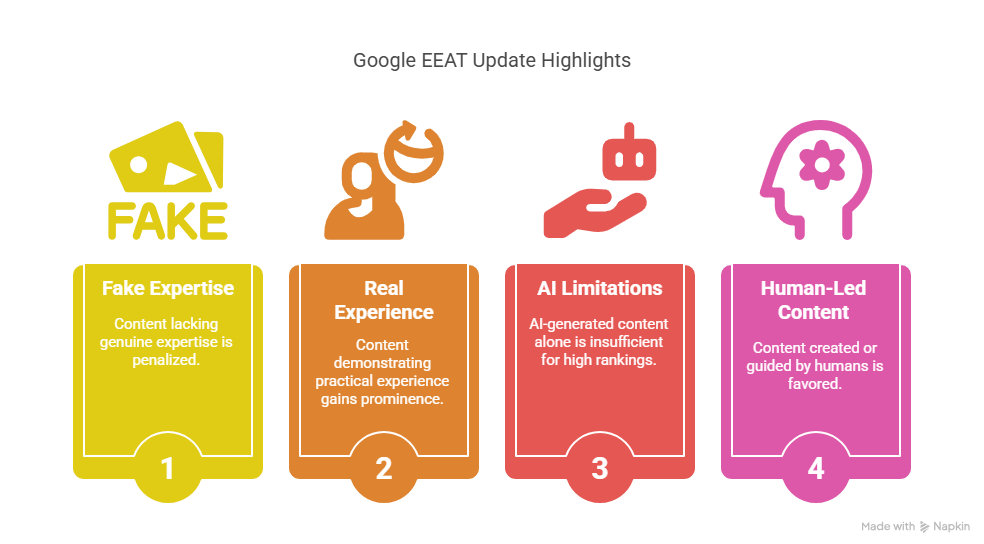
Recently, Google rolled out a significant change to its Quality Rater Guidelines, and it’s putting the spotlight on one thing: Deceptive Content that fakes EEAT signals. This update has huge implications for anyone relying on AI SEO content, and it sends a clear message: expertise must be real.

Table of Contents

Understanding the EEAT Update Google Just Rolled Out

The Problem with Fake EEAT and What Google’s Targeting Now

Real Case Study: AI Content Gone Wrong

What Content Creators Should Do Differently Now

Is AI Still Safe for SEO?

Frequently Asked Questions (FAQs)

Key Takeaways

Understanding the EEAT Update Google Just Rolled Out

The EEAT update Google implemented targets content that mimics Expertise, Experience, Authoritativeness, and Trustworthiness without actually demonstrating it. This matters more than ever, given the surge in AI generated content SEO being used in blogs, product reviews, and landing pages.

For context, Google SEO has always rewarded authentic, useful content. However, with Google AI content making it easier to produce text at scale, the focus is now on filtering out fake authority and surfacing trustworthy results. Raters are now trained to detect content that looks informative but lacks actual depth or personal experience, especially in target product search queries where trust is critical.

In other words, AI content rank in Google depends on more than optimization it now hinges on truth, relevance, and human input.

The Problem with Fake EEAT and What Google’s Targeting Now

Let’s be honest there’s a lot of fluff out there. Between AI SEO content generators and repurposed blog templates, it’s easy to publish posts that look expert-level but say very little. The problem? Google’s raters are now flagging this as Deceptive Content.

This affects:

  • Sites using AI content for SEO with fake bios and no real-world experience
  • Posts filled with keywords like “expert” without backing credentials
  • Reviews and comparisons not written from firsthand use
  • Generic medical, financial, or tech advice with no cited authority

If you’re a target content creator relying heavily on automation, it’s time to re-evaluate. Does Google penalize AI SEO content? The answer is: yes, when it lacks credibility, depth, and value.

Real Case Study: AI Content Gone Wrong

A client in the eCommerce health niche approached us after losing visibility post-update. They’d scaled fast using Google SEO AI generated content, banking on low-cost automation. Initially, traffic grew. But after Google’s crackdown, they lost 40% of their target product search rankings, and bounce rates surged.

Their mistake? Every article was created using an AI SEO content generator, without human review or verification. There were no personal stories, credentials, or original data just optimized fluff.

We helped rebuild their content strategy using verified nutritionists and experienced writers through Wow Customer Support. Each post included firsthand product insights, real results, and proper citations.

The outcome:

  • Rankings returned within 8 weeks
  • Organic traffic jumped by 31%
  • User time on site increased by 46%

This isn’t just SEO it’s the new standard for trust.

What Content Creators Should Do Differently Now

If you’re a marketer or content creator trying to stay competitive, the message is simple: stop faking EEAT. Google’s raters and algorithms are now working in sync to detect content that tries to cheat the system.

Here’s what to prioritize:

  1. Show real experience. Don't just describe a tool use it and document it.
  2. Verify your BIOS. Link to social profiles, certifications, or real-world work.
  3. Stop chasing word count. Focus on clarity, purpose, and true authority.

The EEAT update Google introduced isn’t just about accuracy it’s about trust. That’s why we help businesses source real experts, not just AI prompts.

Is AI Still Safe for SEO?

Short answer: Yes, but not on its own.

AI tools like Google AI generated content or an AI SEO content generator can still support your workflow. But AI content generation SEO only works when it’s backed by human oversight. Google rewards hybrid approaches where automation helps, but people lead.

To keep your AI content ranked high in Google:

  • Always add human editing and insights
  • Combine AI drafts with real data or experience
  • Avoid misleading headers, fake authors, and keyword stuffing

So, does Google penalize AI content? Not inherently. But if your content feels robotic, unauthentic, or misleading, it’s going to be flagged.

Frequently Asked Questions (FAQs)

1. Can I use AI tools like ChatGPT for SEO content?

Yes, but ensure it's reviewed and enriched with human experience, especially in YMYL (Your Money or Your Life) niches.

2. What does EEAT mean for product reviews?

Product content must now reflect actual use. Fake or AI-only reviews won’t pass Google’s credibility checks.

3. How do I stay compliant with the new EEAT standards?

Collaborate with verified experts, show clear author bios, and use content that reflects real-world knowledge not just optimized templates.

Key Takeaways

Google’s latest guidelines are clear: real expertise now determines search visibility. Here’s what to remember:

  • Be Authentic: Real experience and authority now define success, not formatting tricks.
  • Balance AI with Human Insight: Use tools to assist, not replace.
  • Credibility Wins: Collaborate with professionals to craft trustworthy, user-centric content.

We’ve walked through what’s changed and what to do next. Need help aligning your content with the new standards? Wow Customer Support is here to help.

To stay updated on content trends, SEO strategy, and building expert teams, follow Wow Customer Support on Facebook, and LinkedIn.

How to Implement Automated Content Moderation Solutions for Real-Time Monitoring

Automated Content Moderation

The evolution of the digital world comes with a need for stringent content moderation. Be it a social media platform, an e-commerce website, or a community forum, nothing is worse than letting inappropriate or offensive content, which can indeed cause harm to another person, slip through the cracks. In my opinion, embracing automation as much as possible in terms of content moderation is needed. But how does one begin this, exactly? Let's dive into what I learned about working with content moderation solutions and why real-time monitoring is a game-changer.

Why Automated Content Moderation is the Future

If you have ever handled user-generated content, you know how overwhelming it can get. Until recently, moderation was largely manual: human moderators reviewed endless posts, comments, and media. Human moderation is still valuable, yet not scalable for large platforms. Automated content moderation solutions are meant to step in in the general automation of segments of moderation work, with businesses then in a position to be ahead on real-time content monitoring.

By automating most content moderation, it will achieve great speed with fewer human errors. Statistics prove the same. Recent data shows that it could review and filter the content 60% faster than any human moderator. Almost instant flagging and removing obscene or objectionable content would improve user experience and protect brand reputation.

Selecting the Best Automated Moderation Tools

When I first began researching automated moderation tools, I needed help keeping up. Every platform came in a different package with different features for a specific purpose. Some are text-focused, and others focus on video, audio, and graphics content. To get started on a good solution, you must determine what kind of content you will be moderating.

I recommend tools that use natural language processing to interpret any post's context and tone. It is important to decide whether a post that seems harmless is truly offensive. Such tools can use image recognition to screen objectionable pictures or videos—a nice bonus in many social media sites where users upload their own content.

Here are a few must-haves in content moderation solutions:

  • Real-Time Monitoring: Ability to flag and review content as it is posted.
  • Machine Learning Algorithms: Continuously improve accuracy by learning from past moderation decisions.
  • Multi-Language Support: Important for global platforms.
  • Contextual Moderation: Much deeper than keywords, assessing tone and meaning.

image5

How to Integrate Content Moderation Services into Your Platform

Once you have decided on the right tools, you need integration. This is where things can get tricky. Depending on your platform, you might need custom APIs or third-party content moderation services to integrate these moderation tools properly. For example, social media sites like Facebook or YouTube require sophisticated solutions to handle millions of real-time posts. Ensure the tool you settle on is scalable and fits your needs.

I also recently found that content moderation outsourcing providers would help facilitate the implementation process with businesses. Outsourcing allows one to leverage other people's expertise in moderation systems, thereby reducing the time and cost of setup. However, there needs to be clear transparency and communication so that your outsourced team is well-aligned with your moderation goals.

How to Get Started for Integration

To get started with integration, I would suggest

  • Consult Your Development Team: First, make sure your platform can support the chosen moderation tool in terms of infrastructure and performance.
  • Test Phases: You can implement some things in one go. Start testing on small, low-risk areas to see how the automation goes before scaling across the platform.
  • Monitor and Tweak: After the system has gone live, its performance should be viewed and tweaked regularly. Fine-tuning is very important, especially as the system learns from user behaviors.

image1 (91)

Role of Video, Audio, and Graphic Moderation

Text moderation represents only half of it. Due to increased multimedia content on more applications, video, audio, and graphic moderation became crucial. In my opinion, automation really comes alive in this area: It is a huge task to moderate millions of hours of videos or listen to audio clips looking for offensive content. Automated systems with video analysis and audio recognition can work through such material much quicker.

Statistics demonstrate that more than 500 hours of video are uploaded on YouTube per minute. It is nearly impossible to follow this pace without video moderation using AI. AI-powered tools analyze all the content in a video, marking inappropriate scenes, nudity, violence, and other hateful speech within a matter of seconds.

  • Video Moderation: Algorithms scan frame by frame to identify inappropriate visuals.
  • Audio Moderation: AI can detect racist or dangerous speech in multiple languages.
  • Graphic Moderation: These tools will scan the images using image recognition to prevent live offending photos from appearing.

Role of Social Media Monitoring Services

Social media monitoring services themselves are content moderators. They have given tools to track online content in real time surveillance, making the detection of damaging material spread easier. To me, social media monitoring services are very important for businesses targeting the safeguarding of brand reputation. Through monitoring services, millions of posts can be screened across various platforms, flagging inappropriate material for removal in real time.

Integrating social media monitoring services with content moderation solutions develops a more versatile system. You can instantly respond to harmful content if it appears to go viral and damage your brand.

One of the critical players cited a 25% reduction in harmful content visibility within one hour of implementing such automated social media monitoring tools. These statistics illustrate how combining real-time monitoring with automated moderation works well.

Victory over Obstacles in Automated Moderation

No solution is perfect: Even though at great power, automated content moderation solutions are not an exception to the rule. One of the biggest problems I had with this was the accuracy of AI algorithms. Those algorithms are trained on massive datasets, but AI still misses nuances such as sarcasm, cultural references, or local slang. This may lead to false positives-meaning harmless content getting flagged as offensive-or worse, genuinely hateful content goes unseen.

Moreover, on those multilingual platforms, there is also language variation. Generally, AI models do pretty okay when the languages are widely spoken, like English, but they aren't so brilliant in less frequently spoken ones.

So, here's how I think one would go about solving these problems:

  • Hybrid Moderation: Utilize AI for preliminary tagging but ensure that human moderators are instantly put to work reviewing the tricky cases.
  • Routine Algorithm Updates: Constantly refresh your algorithms with new input to ensure accuracy.
  • Community Guidelines: You should educate your users regarding the nature of content that is allowed on your platform. This way, less lousy content will be uploaded into the system.

Frequently Asked Questions (FAQs)

Automated content moderation is 100% accurate?

Not quite, because automation is very efficient, although not 100%. Sometimes, human intervention is required, especially when refined content exists in the algorithm; they do not understand it.

Can automated tools handle any type of content?

Yes, most automated tools can already moderate text, images, video, or audio content, so they are very general for platforms with different media.

How long does the deployment of an automated moderation solution take?

Implementation time depends on your platform's complexity and the moderation tools you integrate. In most cases, though, it takes between a few weeks and a few months.

image4

Key Takeaways

The following discussion on taking advantage of real-time monitoring using automated content moderation solutions shows that leveraging automation is no longer a luxury or a choice but a necessity in today's digital age. Automated content handling brings efficiency, speed, and scalability to the table that no manual approaches can match. Here are three key takeaways:

  • Boost Efficiency: Automated content moderation solutions help you process massive volumes of user-generated content efficiently and rapidly. This ultimately reduces the chances of posting hurting content.
  • Boost Accuracy with AI: AI-powered moderation supplemented by human review will improve the accuracy of flagged content while reducing false positives.
  • Being Proactive With Real-Time Monitoring: Adding real-time social media monitoring services ensures that harmful content will be detected and taken down more quickly, protecting your brand and the user experience.

You have read the foundation steps for successfully adding automated content moderation to your platform and choosing the right tools to navigate the challenges with AI. As powerful as automation is, nuanced decisions still require a human touch.

We would love to hear from you about your experience with content moderation solutions! Share your thoughts with us in the comments. To stay updated on other insights and tips, follow us on Facebook, and LinkedIn. Read all the latest trends in content moderation and digital innovation.

Ensuring Safety and Compliance: The Importance of Content Moderation Services in Today’s Online Landscape

Content Moderation Services

In today's digital era, online platforms are flooded with various types of content. It includes text, audio, images, videos, and live streaming. This widespread content availability has driven the growth of online platforms across several industries.

However, it has also made content moderation a top priority for many online businesses. Marketplaces with user-generated content, dating websites, online communication platforms, gaming websites, and many more need moderation of their content.

Content moderation is essential for various reasons. It is useful for protecting users, complying with digital safety regulations, and building a safe online platform reputation.

What Is the Importance of Content Moderation?

The sheer amount of online content generated daily can turn out as a boon and a curse for online businesses. While platforms want to provide space for users to express themselves, this comes with the challenge of monitoring and moderating user-generated content.

Elimination of inappropriate, illegal, insulting, and other content that does not meet platform guidelines is important. If left unsupervised, problematic content can spiral out of control. It poses a direct threat to the users and the existence of the platform itself.

Negative Consequences of Unmoderated Content

Content moderation is crucial in preventing bullies, trolls, and other individuals with harmful intentions from reaching the rest of the user base and taking advantage of them and the brand.

Beyond their moral responsibility to ensure a safe and secure environment for users, online businesses may also be liable for the content published on their platforms.

Risks Related to Legal Compliance

There are various national and international regulations regarding safe content that businesses may need to comply with to stay in business. Despite some backlash against content moderation legislation due to censorship concerns, such regulations as the European Union's Digital Services Act are gaining ground. Failing to comply with these regulations can lead to legal problems and damage the brand's reputation.

Content Moderation and Wow

In recent years, there has been a shift from manual moderation done by people to automated moderation provided by AI technologies. Wow Customer Support offers content moderation services that ensure your social media game is on point. With a rigorous blend of expert moderation tactics and behavioral analysis, their real-time content screening works at scale. Wow ensures meeting your organization's trust and safety requirements.

Conclusion

With the abundance of user-generated content on various online platforms, content moderation is essential for protecting users, complying with digital safety regulations, and building a safe online platform reputation.

If you're interested in trying out content moderation services to enhance your online platform's safety and compliance with regulations, get in touch with Wow Customer Support today. Our team of expert content moderators ensures that you can confidently expand your online presence. With years of extensive experience in moderating diverse types of content for our clients, our User Generated Content Moderation services are unmatched in quality and reliability.

This blog post is inspired by the YouTube video "Why Is Content Moderation Important?" The video provided valuable insights and information on the significance of content moderation in maintaining a safe and positive online environment.

Understanding Content Moderation: Ensuring a Safe and Trustworthy Online Environment

Content Moderation Services

In today's age of digital growth, a vast amount of text, images, and videos are being uploaded and shared on various platforms every day. When brands and online businesses use this platform, they must maintain an online environment that is safe and trustworthy for its users. Here is where content moderation comes into play.

The primary purpose of content moderation solutions is to screen user-generated content and ensure it adheres to preset guidelines. Today, we will explore what content moderation is, its types, the tools involved in content moderation, and how it plays a significant role in creating a positive user experience.

What is Content Moderation?

Content moderation is screening content posted by users to maintain a safe and positive online environment. The moderators review the content that users upload to a platform. They apply preset rules to monitor its appropriateness. If any content violates the guidelines, it is flagged and removed.

This content moderation process helps to free platforms from violence, offensive material, extremism, nudity, hate speech, and copyright infringements. Content moderation services are used by outlets such as social media, dating websites, apps, marketplaces, and forums to ensure their users have a secure and trustworthy space to interact in.

Understanding the Scope of Content

The term "content" includes a wide range of materials and media uploaded online. They could be blog posts on various platforms or videos on YouTube, TikTok, Instagram, and beyond. Content creators play a significant role in shaping the digital landscape. Even seemingly innocent posts of pets or family gatherings contribute to the vast realm of user-generated content. Content moderators, therefore, have the critical responsibility of ensuring that all such submissions align with platform guidelines and do not harm the online community.

The Role of a Content Moderator

A content moderator's job entails several key responsibilities, each aimed at maintaining a safe online ecosystem:

  • Understanding Client Policies: Content moderation services must be well-versed in the specific rules and guidelines set by the platforms they work for. This knowledge forms the foundation for their decision-making process when assessing user-generated content.
  • Reviewing User Reports: User-generated content is subject to scrutiny by content moderation services, and any flagged submissions go through a review process. Human intervention becomes crucial here, as technology alone may not accurately assess certain content types.
  • Identifying Workflow Improvements: Content moderators are encouraged to identify potential areas for process enhancement and suggest solutions. Their insights contribute to making content moderation services more efficient and effective.

Qualifications and Traits of a Content Moderator

Certain qualifications and personal qualities are deemed valuable when dealing with content moderation solutions and services:

  • Educational Background: While employer-specific requirements may vary, a bachelor's degree is frequently preferred by content moderation services. This demonstrates a level of education and the capacity to manage a variety of responsibilities.
  • BPO Experience: Experience in the BPO industry is preferred by content moderation services. It demonstrates the candidate’s familiarity with the demands of a dynamic and fast-paced work environment.
  • Excellent Communication Skills: Content moderators may need to interact with users and coworkers from diverse backgrounds. They must be proficient in both written and spoken English communication.
  • Passion for the Internet: Content moderation services seek out candidates who have a genuine interest in the online world and its various platforms. This interest helps content moderators maintain their engagement and dedication to their role.
  • Strong Judgment and Critical Thinking: Content moderation services also look out for moderators who are able to make sound judgments when evaluating content. Critical thinking is important to determine what is and is not appropriate.
  • Emotional Resilience: Due to the nature of their position, content moderators may be exposed to disquieting or upsetting content. To overcome such obstacles without jeopardizing one's health, one must maintain a strong mental state.

Conclusion

Content moderation is necessary to maintain a safe and positive online environment for users. By combining technology and human expertise, content moderation services can efficiently review and filter user-generated content and prevent harmful material from reaching their audiences. Finding the right balance for your platform will create an engaging and trustworthy digital community for everyone involved.

Content moderation outsourcing to a qualified external team is a viable option for platforms without an internal moderation team. Platforms seeking to enhance their content moderation capabilities can reach out to WOW to boost their moderation efforts effectively and efficiently.

This blog is inspired by the video, ‘CONTENT MODERATION JOB - Description, Qualification, What does it take to be one’ by Rea Ninja.

5 Types of Online Content Moderation You Should Know

Massive amounts of text, images, and videos are produced daily, and marketers need a mechanism to monitor the material their platforms charge for. It is essential to uphold a secure and reliable customer environment, track social influences on brand perception, and adhere to legal requirements.

The screening of relevant content users upload on a platform is called online content moderation. The procedure entails the use of pre-established guidelines for content monitoring. The content is flagged and deleted if it does not adhere to the rules. The causes can range from:

  • Violence
  • Offensiveness
  • Extremism
  • Nudity
  • Hate speech
  • Copyright violations
  • A plethora of other issues

Online content moderation aims to maintain the brand's trust and safety program while making the platform safe. Social media dating websites, applications, markets, forums, and other platforms frequently employ content moderation. In this blog, let's dig deeper into the different types of content moderation services and technologies used.

The Need for Online Content Moderation

Platforms that rely on user-generated content need help to remain on top of an adequate amount due to the massive amount of content created every second. Therefore, the only method to maintain a tap on a brand's website per your standards is by filtering offensive text, photographs, and video content.

Additionally, it aids in preserving your reputation and your clientele. With its assistance, you can ensure that your platform fulfills the intended function and does not provide a platform for spam, violent content, or other inappropriate material.

When determining the optimal method to handle content moderation services for your platform, many considerations come into play, including:

  • You put business first
  • The many forms of user-generated content
  • The characteristics of your user base

Types of Content Moderation Services

In this section, let's see the main types of online content moderation processes you can choose for your brand.

1. Automated Moderation:

Automated online content moderation significantly relies on technology, particularly AI-powered algorithms, to screen and evaluate user-generated content. Comparatively, it provides a quicker, simpler, and safer method than manual human moderation.

Automated tools for text moderation can recognize problematic words, pick up on conversational tics, and do relationship analyzes to assess the content's suitability.

Images, videos, and live streams are monitored for visual content using image recognition driven by AI techniques like EMAGA. This artificial intelligence (AI) technologies can recognize improper imagery and offer options for limiting sensitive visual threshold levels and types.

Automated moderation is effective and exact when identifying and flagging potentially offensive or harmful information. It is important to remember that technology can only partially replace human inspection, especially in more complicated cases. By utilizing automated moderation, platforms can filter a lot of content, improve online content moderation efficiency, and shield users from spam, violence, and explicit content.

2. Pre-Moderation:

Online content moderation powered by technology improves accuracy and effectiveness but can only partially replace human review, especially in more complicated scenarios. Because of this, technology and human content moderation services are still used in automated online content moderation. It is the most complex method of approaching content moderation solutions.

Because of this, every piece of content must be evaluated before it is posted on your platform. An item is added to the review queue when a user uploads text or a picture. Only when the content administrator has expressly approved it, then it goes live. Although this is the most secure method of preventing hazardous content, this method of online content moderation needs to be more active and suitable for the quick-paced internet environment. However, platforms that demand high security still use this online content management technique.

3. Post-Moderation:

The most prevalent method for content screening is post-moderation online content moderation. Users can publish content whenever they want, but it must first go through online content moderation. To protect the other users, flagged items are taken down. Platforms work to speed up the review process so that relevant content doesn't remain online for an extended period, even though post-moderation is less secure than pre-moderation content moderation solutions. It remains the method of choice for many modern internet firms.

4. Reactive Moderation:

Reactive moderation is counting on people to flag content they deem offensive or violates your platform's policies. Reactive moderation as part of online content moderation services can be helpful in some circumstances. It can be used alone or in conjunction with post-moderation for the best outcomes.

In the latter scenario, users might still flag the content even after it has gone through your moderation procedure. If you wish to employ reactive moderation only, there are some hazards you might want to think about to have a twofold safety net.

5. Self-regulating Moderation:

Although a self-regulating online content moderation platform sounds excellent, it may result in appropriate content staying on your platform for excessive time. Your brand could suffer long-term reputational harm as a result of this. The online community is wholly relied upon for this form of online content moderation to assess and remove content if appropriate. Users use a rating system to indicate if a piece of material complies with the platform's rules. This topic is rarely used because it seriously affects brands' reputations and Lego compliance.

Two Steps to Implement Online Content Moderation

1. Establish Clear Parameters: It is essential to establish clear criteria that specify the content appropriate for your platform. These rules should cover various topics, including forbidden content types, extremism, violence, hate speech, nudity, and copyright violations. The requirements for user-generated content should be made very clear. Remember your target market, demography, and industry particulars when creating these rules. Content moderators will know what content to assess, flag, and remove if explicit criteria are established.

2. Establish Moderation Thresholds: Content moderators should adhere to a certain level of sensitivity when evaluating content. It entails establishing criteria for determining whether content must be removed or flagged. These criteria might consider user expectations, the impact on the platform's reputation, and the seriousness of the breach. It's imperative to strike the proper balance to prevent unduly strict or lenient online content moderation. Keep an eye on these criteria and modify them as necessary in response to user comments, shifting fashion trends, and altering legal requirements.

Conclusion

According to our analysis, there are several possible ways to moderate the content. Pre-moderation online content moderation is likely too slow for the volume of user-generated content today. Because of this, most platforms decide to examine content after it has gone live, which is then added to a moderation queue.

Automatic online content moderation is frequently combined with post-moderation to get the finest and quickest outcomes. You can mix the finest human and machine moderation with semi-automated content moderation. You can improve content moderation solutions with an AI-powered system, shielding moderators from a huge volume of hazardous content.

Experience superior content moderation solutions with Wow customer support from Vserve. You can confidently build your online presence and thank the knowledgeable content moderators for their assistance.

This blog is inspired by the video: "What is Content Moderation? Types of Content Moderation, Tools and More" by "Imagga."