

Customer retention is one of the most powerful drivers of profitability. According to Harvard Business Review, increasing customer retention rates by just 5 percent can increase profits by 25% percent to 95%.
For electronics companies, this statistic carries even greater weight. Technical products generate installation questions, troubleshooting requests, firmware issues, compatibility concerns, and warranty claims. When these tickets accumulate, response times slow down, customer frustration rises, and retention declines.
Reducing technical ticket volume is not simply an operational goal. It directly protects revenue and long term profitability.
This is where outsourced customer service solutions become a strategic scaling advantage. With structured workflows, tiered technical support, and proactive customer education, electronics businesses can reduce repetitive tickets by as much as 45 percent while strengthening customer loyalty.
Table of Contents
Why Electronics Brands Struggle with Technical Tickets
How Outsourced Customer Service Solutions Reduce Ticket Volume
8 Scaling Frameworks for Electronics Businesses
What to Look for in an Outsourcing Partner

Why Electronics Brands Struggle with Technical Tickets
Electronics products come with unique challenges:
- Complex installation processes
- Firmware updates and compatibility issues
- Warranty validation and replacements
- Pre sales product inquiries
- High return rates
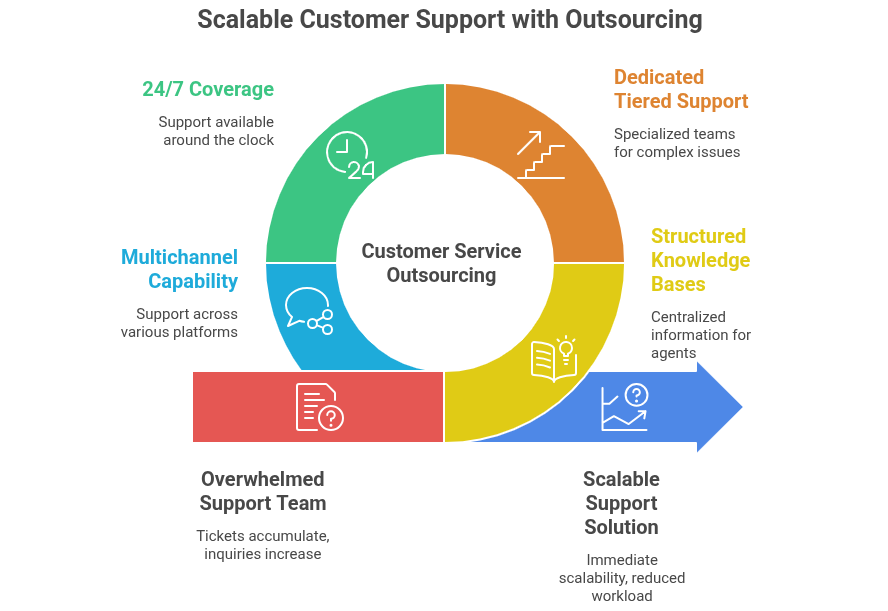
When a business scales quickly, support demand grows even faster. Internal teams often lack:
- Structured knowledge bases
- Dedicated tiered support
- 24 7 coverage
- Multichannel capability
As a result, tickets accumulate and repeat inquiries increase.
Many companies attempt to hire in-house agents rapidly. However, recruiting, onboarding, and training technical support staff takes time and capital. This is where customer service outsourcing solutions provide immediate scalability.
How Outsourced Customer Service Solutions Reduce Ticket Volume
The objective of customer support is not simply to respond faster. The real goal is to reduce unnecessary support tickets while improving the customer experience. When support teams only react to problems, ticket queues grow quickly and operational costs increase.
Strategic customer care outsourcing solutions take a different approach. They focus on identifying the causes of recurring support requests and implementing systems that prevent them from happening again.
When structured correctly, outsourced support operations can reduce ticket volume by as much as 45 percent, allowing businesses to operate more efficiently while maintaining excellent service standards.
Companies such as WOW Customer Support specialize in designing these systems so brands can manage customer inquiries, technical troubleshooting, and product education at scale.
Below are five proven frameworks that help reduce support volume while improving overall customer satisfaction.
1. Knowledge Base Optimization
One of the most effective ways to reduce ticket volume is to empower customers to find answers on their own.
Professional outsourced customer support providers build well organized knowledge bases that include:
- Frequently asked questions
- Step by step troubleshooting guides
- Product setup instructions
- Warranty and return information
- Video walkthroughs for common tasks
When customers can easily locate answers through a self service portal, they no longer need to contact support for routine questions. This significantly reduces repetitive tickets related to order tracking, product setup, account access, or basic troubleshooting.
For example, if a customer is trying to set up a new device or configure software, a detailed guide or tutorial video can resolve the issue instantly without requiring agent assistance.
Teams at WOW Customer Support often help businesses audit their most common inquiries and convert them into structured help center content. Over time, this reduces inbound ticket volume while improving the customer experience through faster self resolution.
2. Tiered Technical Support
Another common reason ticket queues become overwhelmed is poor routing. When every inquiry enters the same queue, agents spend time handling issues that could be resolved more efficiently by specialized teams.
A tiered support structure solves this problem by categorizing requests based on complexity.
Typical support tiers include:
Tier 1 Support
Handles basic inquiries such as order tracking, password resets, billing questions, and simple troubleshooting.
Tier 2 Support
Manages more technical issues that require deeper product knowledge or diagnostic troubleshooting.
Engineering or Product Escalation
Reserved for rare cases involving bugs, product defects, or complex integrations.
This system ensures that simple questions are resolved quickly while complex cases reach the appropriate specialists. It also prevents highly skilled technical teams from being overwhelmed by routine inquiries.
Outsourcing partners like WOW Customer Support design these tiered workflows to ensure faster resolution times and reduced backlog across support channels.
3. Proactive Customer Education
Many support tickets arise not because a product is faulty, but because customers are unsure how to use it properly.
This is particularly common with electronics, software platforms, and subscription services that require onboarding or configuration.
A proactive education strategy can dramatically reduce these avoidable inquiries. Effective support teams create resources such as:
- Welcome and onboarding email sequences
- Quick start setup guides
- Product tutorial videos
- Interactive walkthroughs
- Troubleshooting checklists
These resources help customers understand how to use the product correctly from the beginning.
By providing clear instructions immediately after purchase, companies reduce confusion, minimize product returns, and decrease the volume of support requests related to setup and configuration.
Customer support specialists from WOW Customer Support frequently collaborate with brands to develop educational materials that guide customers through installation, usage, and maintenance. This proactive approach prevents problems before they escalate into support tickets.
8 Scaling Frameworks for Electronics Businesses
Here are eight frameworks electronics companies use when implementing outsourced customer support solutions.
1. Rapid Launch Framework
Ideal for startups entering new markets. Outsourcing enables immediate 24 7 coverage without building a large internal team.
2. Product Launch Surge Model
During new product launches, ticket volume can spike by 200 percent. Outsourced teams handle temporary surges without long term hiring commitments.
3. Global Expansion Framework
Selling internationally requires multilingual support. Outsourced teams provide language coverage and regional expertise.
4. Technical Escalation Matrix
Clear SOPs determine which issues require engineering review. This prevents unnecessary escalations and keeps development teams focused.
5. Warranty Optimization System
Streamlined warranty processing reduces friction and speeds replacements, improving customer satisfaction.
6. Omnichannel Integration Framework
Unified dashboards ensure no inquiry is lost. This reduces repeat contacts and improves response times.
7. Continuous Improvement Loop
Support data feeds directly into product and operations teams. Frequent issues are addressed at the source.
8. Cost Control and Efficiency Model
Instead of fixed overhead, outsourcing converts support into a scalable operational expense aligned with growth.
These frameworks allow electronics brands to scale sustainably while protecting brand reputation.
What to Look for in an Outsourcing Partner
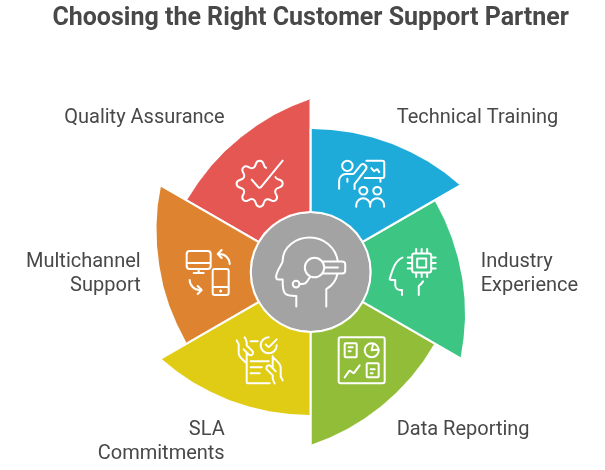
Not all outsourced customer support companies are equal. Business owners should evaluate partners based on:
- Technical training capability
- Experience in electronics or hardware industries
- Data reporting transparency
- SLA commitments
- Multichannel support expertise
- Quality assurance processes
A strong provider does more than answer tickets. They act as an extension of your brand. They understand product specifications, speak your tone of voice, and represent your company professionally.
For electronics businesses seeking scalable and performance driven support, the right partner can transform support from a cost center into a growth engine.
At Wow customer support, the approach focuses on structured processes, performance tracking, and proactive improvement. Instead of reacting to problems, the strategy centers on reducing ticket volume while improving customer experience.
The Real Business Impact
When ticket volume drops by 45 percent:
- Customer wait times decrease
- Refund and return rates improve
- Customer lifetime value increases
- Internal teams regain focus on innovation
- Brand reputation strengthens
In competitive electronics markets, customer experience often determines long term survival. Companies that invest in professional customer service outsourcing solutions position themselves for sustained growth.
Outsourcing is no longer just about cost savings. It is about building scalable infrastructure that supports expansion without sacrificing service quality.
For business owners ready to grow beyond operational bottlenecks, structured outsourced customer service solutions offer a strategic advantage.
FAQs
1. What are outsourced customer service solutions?
They are third party support services that handle customer inquiries, technical issues, and communication on behalf of your business.
2. Can outsourcing reduce technical ticket volume?
Yes. With structured knowledge bases, tiered support, and proactive education, many companies reduce repetitive tickets significantly.
3. Is outsourcing suitable for electronics companies?
Yes. Electronics businesses benefit from technical expertise, multichannel support, and scalable staffing models.
4. Will outsourced teams understand my products?
Reputable providers undergo product training and follow detailed SOPs to represent your brand accurately.
5. Is outsourcing only for large companies?
No. Startups and scaling brands often use outsourcing to manage growth without heavy in house hiring.