If your leadership team still views customer care as a necessary financial liability rather than an active pipeline for customer retention, your operational metrics are incomplete.
Most corporate executives evaluate outsourcing partnerships through a very narrow lens: line-item cost reduction. They focus heavily on hourly agent rates and infrastructure savings while ignoring the financial consequences of slow first-response times, unresolved user queries, and customer churn. Relying on an understaffed or poorly trained support desk quietly erodes consumer trust, lowering your market share over time.
This strategic guide covers advanced financial return metrics, revenue expansion timelines, and the measurable business impact of deploying automated hybrid support networks. You will gain a practical framework to calculate the total financial impact of your customer experience operations.
Table of Contents
What Does ROI Mean in Outsourced Customer Support?
Revenue-Driven ROI: How Outsourced Customer Support Increases Business Growth
How to Calculate the ROI of Outsourced Customer Support
When Does Outsourcing Start Delivering ROI?
How AI and Human Agents Together Improve ROI
Best Practices for Maximizing ROI from Outsourced Customer Support
What Does ROI Mean in Outsourced Customer Support?
Historically, calculating the financial return of support outsourcing focused almost entirely on immediate budget relief. Businesses looked for simple ways to cut overhead, such as:
- Direct labor cost savings by utilizing global talent pools.
- Elimination of local recruitment, background checks, and onboarding expenses.
- Elimination of workspace overhead, hardware provisioning, and enterprise licensing fees.
Why Cost Savings Alone Don't Tell the Whole Story
Evaluating your return solely through expense reduction misses the larger financial picture. Customer care interactions are a primary driver of consumer retention and long-term brand loyalty. When an organization shifts its mindset from viewing care as an operational cost center to treating it as a growth engine, support teams are built to protect and expand existing revenue streams.
Revenue-Driven ROI: How Outsourced Customer Support Increases Business Growth
More than money, outsourced customer support saves in many ways. Let’s see some of them.
Higher Customer Retention Through Faster Support
Long wait times are a primary driver of customer churn. When specialized support networks handle multi-channel customer requests quickly, consumer frustration drops significantly. Resolving issues during the initial interaction builds immediate buyer confidence and keeps customers from migrating to competitors.
Increased Customer Lifetime Value (CLV)
A satisfied customer base naturally spends more over a longer period. Well-trained support agents handle issues with a high level of care, turning transactional buyers into long-term brand advocates. This sustained engagement directly inflates individual lifetime value metrics across your entire database.
Better Customer Satisfaction Leads to More Repeat Purchases
Clear communication and positive resolutions are directly tied to repeat buying behavior. When consumers experience fast, accurate assistance, they develop a strong affinity for the brand, which increases their likelihood of choosing your products for future purchases.
More Upselling and Cross-Selling Opportunities
Support interactions occur when a consumer is actively engaged with your ecosystem. Gifted support agents leverage these moments by recommending relevant product upgrades, complementary accessories, or extended service plans that naturally align with the user's immediate needs.
Slash internal administrative overhead and secure 24/7 coverage by shifting to high-performing customer support outsourcing.
Cost Savings ROI vs Revenue-Driven ROI
|
Evaluation Pillar |
Cost Savings ROI Model |
Revenue-Driven ROI Model |
| Primary Metric | Hourly agent cost reductions | Growth in Customer Lifetime Value (CLV) |
| Operational Goal | Minimize cost per support ticket | Maximize resolution quality and retention |
| Business Impact | Short-term operational budget relief | Long-term growth in repeat purchase rates |
| Financial Outcome | Reduced internal administrative overhead | Lower churn and increased customer advocacy |
How to Calculate the ROI of Outsourced Customer Support
To build an accurate comparison baseline, compile all internal operational costs over the past twelve months. Ensure your calculation includes:
- Base salaries, performance bonuses, and payroll taxes.
- HR recruitment fees and internal training hours.
- Dedicated customer service software licenses and communication platforms.
- Physical workspace costs and computer hardware depreciation.
- Management oversight and quality assurance layers.
Calculate Outsourcing Costs and Revenue Gains
Next, calculate the total annual service fees paid to your outsourced service provider. To measure the full return, contrast this expenditure against the total revenue preserved through lower customer churn, gains from agent up-sells, and the reclaimed capital value of internal management hours.
Sample ROI Formula and Example
To calculate the comprehensive financial return of your support investments, use the standard performance evaluation formula:

For example, if an enterprise invests $100,000 annually in specialized support services, saves $80,000 in internal overhead, and recaptures $70,000 in preserved customer renewals, the total financial gain equals $150,000. Applying the formula yields a clear 50% net return on the investment.
When Does Outsourcing Start Delivering ROI?
First 30 Days: Setup and Knowledge Transfer
The initial month focuses on structural onboarding, documentation transfers, and setting up core workflows. During this phase, the primary financial value comes from freeing up your internal managers, allowing your core team to pivot back to primary product development.
After 60-90 Days: Process Optimization
By the end of the first quarter, workflows stabilize. Average handling times drop, backlog queues clear out, and team performance consistently hits contractual Service Level Agreements (SLAs), creating a faster, more dependable support environment.
After 6 Months: Measurable Financial Performance
At the half-year mark, clear financial returns emerge. Internal operating expenses decrease, customer satisfaction scores improve, and agent productivity trends upward, signaling a highly efficient support engine.
Long-Term ROI: 12 Months and Beyond
Past the one-year mark, the partnership delivers deep strategic value. The business benefits from sustained customer retention, a highly scalable support model that adjusts smoothly to seasonal traffic spikes, and predictable revenue growth built on a loyal customer base.
How AI and Human Agents Together Improve ROI
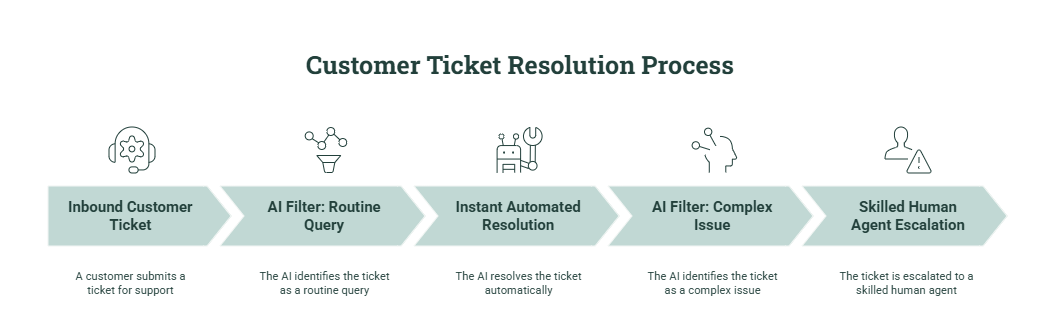
Modern automation tools streamline high-volume support queues by handling repetitive tier 1 inquiries instantly. Automated workflows excel at resolving basic tracking requests, routing complex tickets to the right specialized departments, and generating instant knowledge recommendations to help agents work faster.
Why Human Agents Remain Essential
While automated tools handle routine questions efficiently, skilled human support remains critical for managing complex technical challenges and high-stakes escalations. Human agents provide the nuanced problem-solving and emotional intelligence required to turn frustrated buyers into loyal customers.
The ROI of a Hybrid AI + Human Support Model
Integrating automated systems alongside a skilled team maximizes the efficiency of your support operations. This hybrid approach allows brands to scale their support capabilities smoothly during peak traffic periods without needing to add seasonal headcount, significantly lowering the average cost per ticket.
KPIs That Demonstrate ROI
Operational Performance Metrics
- First Response Time (FRT): The average time a customer waits before receiving an initial agent response.
- Average Resolution Time: The total duration required to completely resolve a customer's issue.
- Cost Per Ticket: Total support operational expenditure divided by the total number of processed tickets.
- SLA Compliance: The percentage of support tickets resolved within agreed-upon contractual timelines.
Customer Experience & Business Growth Metrics
- Customer Satisfaction (CSAT): Transactional feedback measuring the helpfulness of the support experience.
- Customer Retention Rate: The percentage of active buyers preserved over a specific evaluation window.
- Customer Lifetime Value (CLV): The cumulative revenue contribution generated by an individual customer account over time.
- Churn Rate: The percentage of subscribers or buyers who stop interacting with your business.
Best Practices for Maximizing ROI from Outsourced Customer Support
- Select an outsourcing partner with deep, verified experience in your specific industry vertical.
- Establish clear, measurable performance metrics and SLA benchmarks from day one.
- Build and continuously update a comprehensive, central knowledge repository for your support agents.
- Implement a balanced hybrid support model that combines smart automation tools with experienced human agents.
- Run monthly operational performance reviews to uncover and eliminate system bottlenecks.
Frequently Asked Questions
1. Is reducing operating costs the only way to measure the financial impact of support outsourcing?
No, expense reduction is simply the baseline metric. The true value of an optimization strategy shows up in customer retention gains, higher repeat purchase rates, and improvements in overall lifetime value. Protecting your existing customer base is far more cost-effective than constantly funding new user acquisition campaigns.
2. How does a fast customer care response time improve long-term business profitability?
Fast, reliable support directly removes buyer hesitation and lowers cart abandonment. When customers know a brand resolves issues quickly, they buy with confidence and are highly likely to recommend the product to others, driving organic, word-of-mouth growth.
3. Can a small business achieve a strong financial return from support outsourcing early on?
Yes, outsourcing allows smaller brands to deploy a professional, 24/7 support presence without the high costs of local hiring. This scalable approach lets emerging businesses deliver enterprise-grade customer experiences while keeping internal capital focused on product growth.
4. What role does automation play in lowering the total cost of support operations?
Automated tools filter out high-volume, routine inquiries like tracking requests and basic password resets. Handing these repetitive tasks to automated systems reduces the overall workload on your team, allowing your human agents to focus entirely on high-value client resolutions.
Conclusion
Measuring the total return on your support investments requires looking past simple cost-cutting to track long-term business growth. While lower administrative overhead provides immediate budget relief, the true strategic value of modern outsourced customer support services lies in their ability to protect and expand your core revenue streams.
By combining skilled global support teams with smart automation tools, businesses can accelerate resolution times, lower cost-per-ticket metrics, and build a highly loyal customer base that drives consistent repeat purchases.
Selecting an experienced execution partner is the definitive factor in building an efficient system. If you are ready to future-proof your support architecture, optimize customer response metrics, and future-proof your bottom line, partner with the certified specialists at Vserve Solutions to design your support strategy today.