

How Small Businesses Can Gain Fortune 500 Advantage With Virtual Assistant Services in 2025

How Small Businesses Can Gain Fortune 500 Advantage with Virtual Assistant Services

Virtual assistant services can help your business gain a Fortune 500 advantage. Let’s look further to know how.

What transforms a business from a simple, run-of-the-mill company into a reputed Fortune 500 enterprise? The answer is three-fold. There should be operational efficiency, robust service, and focused core offerings. Virtual assistant services can help you achieve these three pillars with remarkable agility. In this article, we explore how small businesses can leverage virtual assistants to punch above their weight and gain that Fortune 500 edge.

Table of Contents

Virtual Assistant for Small Businesses – Why Do You Need Them?

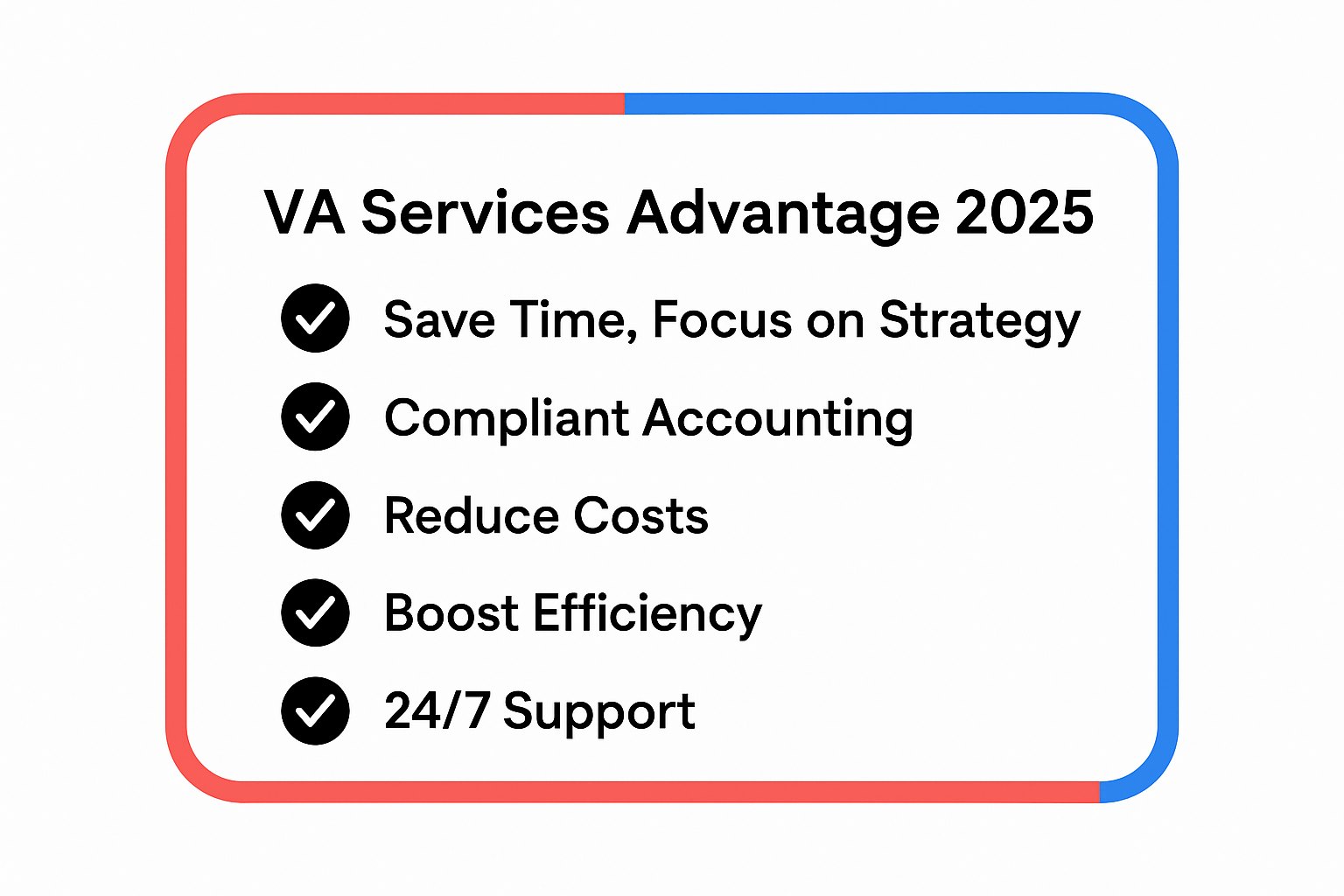
Virtual Assistants Give You Freedom to Focus on Critical Tasks

Virtual Assistants Help Maintain Regulatory-Compliant Books of Account

Virtual Assistants Reduce Your Operational Costs

Five Facts About Virtual Support
FAQs

Conclusion

Virtual Assistant Services

How Virtual Assistants Benefit Small Businesses – Why Do You Need Them?

Small companies often get swallowed by their to-do lists. Mundane chores, scheduling, email triage, and data entry nibble away at their time and energy. Meanwhile, the real mission of building products, delighting customers, and scaling up starts to drift and slow down.

Having a virtual assistant for small businesses changes this equation entirely.

Virtual Assistants Give You Freedom to Focus on Critical Tasks

According to the latest work productivity reports used widely in 2025 (including updated findings from Asana’s Work Index studies), employees still spend close to 60% of their work hours on repetitive tasks. They are busy with tasks like answering emails, organizing meetings, filling out forms, and searching for files. That’s precious capacity wasted. When your team is distracted, innovation dims, and that’s not how Fortune 500s operate.

By hiring a virtual assistant, you can outsource those repetitive tasks. Let them sort your inbox, schedule your calendar, and manage your routine admin duties. This frees you, along with your core team, to invest energy in innovation and strategy. You can do high-impact work that differentiates you.

As a bonus, you keep your employees engaged. When people aren't stuck doing tedious chores, they become more motivated. Disengaged employees drag performance down. But with virtual assistants helping out, your core people can focus on what they do best. That’s how small businesses grow into big-league players.

Virtual Assistants Help

Virtual Assistants Help Maintain Regulatory-Compliant Books of Account

Messing up in accounting can be catastrophic. Just look at what happened to Hertz. Their accountants overlooked uncollectible fees, leading to a $46.3 million loss. Such mistakes are fatal for smaller businesses.

When you hire virtual assistant services to handle your bookkeeping, you get real experts who are well-versed in accounts to handle your financials. They use the latest accounting tools and monitor transactions diligently. These assistants ensure your books are always up-to-date and compliant with relevant 2025 regulations. Your financial health stays sound. Risk goes down, and confidence goes up.

Virtual Assistants Reduce Your Operational Costs

Here’s where small businesses really gain a Fortune 500-style cost advantage.

  • Pay only for the work done: You don’t hire a full-time person for every small task.
  • No infrastructure burden: Virtual assistants use their own internet, workspace, and tools.
  • Lower benefits cost: No insurance, retirement plans, or full-time perks.
  • Flexible pricing: Many VA companies (including WOW Customer Support) provide affordable 2025 packages.

In short, virtual assistants make your operations lean, efficient, and smart. This is just how Fortune 500s like to run things.

Five Facts About Virtual Support

1. Virtual Assistants Increase Workplace Efficiency

Training new staff is expensive. It takes time and money. As of 2025, companies still spend more than 55 hours and nearly $2,000 to train a single employee. For small businesses, that’s a big drain.

2. Efficiency from Day 1

A qualified virtual assistant for small business enterprises arrives battle-tested. They already know tools, processes, and workflows. They don’t need weeks of onboarding. They can start contributing immediately. The result? Fewer mistakes, steady quality, and more uptime for your high-value team.

3. Virtual Assistants Help Build a Strong Online Presence

In 2025, your digital footprint is your storefront. Many top virtual assistant services come with social media and content-savvy assistants who can:

  • Create and polish your social profiles.
  • Run social campaigns and engagement efforts.
  • Generate interesting, shareable content.
  • Schedule posts at the right times.
  • Respond to messages, comments, and tags.
  • Analyze data and derive insights.

4. Help with the Backend

They also manage backend analytics. They build lead-gen forms, track engagement stats, process data, and prepare reports. All of these power a professional, consistent, and compelling online presence.

5. Virtual Assistants Provide 24/7 Customer Service

Some 24x7 virtual assistant service USA providers offer round-the-clock support. Be it customers in different time zones or late-night browsers, all get help.

Good service matters. Research continues to show that 1 in 3 customers purchases only after a positive service experience. On the flip side, 91% of unhappy customers just make an exit without complaining.

With a virtual assistant handling customer care, you reduce such incidents and build loyalty.

Businesses with speedy and empathetic customer service consistently earn 4–8% more revenue. According to the Harvard Business Review, profits can jump 25% to 95%. That’s a serious Fortune 500-style impact.

FAQs

1. How do virtual assistant services benefit small businesses?

VAs offload routine work and reduce operational burden. They let core teams focus on growth.

2. What tasks can a virtual assistant for small businesses handle?

Affordable virtual assistants for small businesses are available who can handle email management, bookkeeping, scheduling, social media, customer service, data entry, and more.

3. Are virtual assistants cost-effective?

Yes. You pay only for the work done. No full-time employee costs.

4. Can I get 24x7 virtual assistant support?

Yes. Many 2025 virtual assistant services offer global, around-the-clock support. A 24x7 virtual assistant service USA partner allows you to grow at a faster pace.

5. How does a virtual assistant help maintain financial compliance?

They follow regulatory standards, use modern accounting tools, and keep books error-free.

Conclusion

In 2025, small businesses don’t have to stay small. They can employ virtual assistant services to operate smarter, leaner, and more boldly. With VAs handling routine tasks, bookkeeping, customer service, and online engagement, you free up your core team to think big, act big, and scale big.

This is outsourcing for leveraging Fortune 500-level discipline and efficiency in a lean, agile way. When done right, affordable virtual assistants for small businesses help them compete, grow, and win.

Want to unlock the Fortune 500 advantage for your small business?

Partner with WOW Customer Support today. Our expert virtual assistant services are tailor-made and affordable. They are designed to elevate your operations and help you focus on building your legacy.

Find the best virtual assistant for small business at WOW!

Suggested Reads

How a Retail Giant’s New AI Virtual Assistant Is Transforming In-Store Shopping

AI Virtual Assistant

Today, AI is no longer abstract but tangible. It is being run on the floors of retail change a store experience. To me, I believe the most exciting is just how the new AI virtual assistant it does breaks through this barrier of innovation: not only changing the very nature of how back-end operations run but also how they interact with customers on the shop floors. This is beyond the upgrade in technology-it's jump to the future of retail, when efficiency touches on personalization.

This innovation takes the customer journey to a different dimension. As much as I'm interested in how technology enhances it, AI in retail is not new, but its applications are more direct than before toward face-to-face customer service. An AI virtual assistant is changing the way shoppers interact with brands and giving every visit to the store a touch of personality instead of the one-size-fits-all model.

More Than Just Tech: The Role of AI in Retail

When thinking of AI in retail, one typically thinks of pretty geeky, really technical, back-office type work—such as optimizing inventory management or forecasting sales trends. A new dimension that artificial intelligence in the retail industry offers is virtual assistant AI on the shop floor. These virtual AI assistants do more than point you towards the right aisle; instead, they deliver personalized product recommendations, actual-time customer queries, and even manage checkout processes.

Imagine walking into your favourite retail store, only to not look for any human staff but rather an AI shopping assistant instead. Here you can ask for recommendations based on previously purchased products, check actual availability in real time, or even find suggestions for complementary products. 62% of customers will make more impulse purchases if they receive personalized recommendations. This is where AI in retail shines by improving the customer experience in ways that sometimes traditional human interactions cannot.

With the infusion of conversational AI into the retailing segment, it becomes doable. The assistant can converse in the natural language used in conversations, just like a friend would. It is seamless, as it removes all frictions in the decision-making process. In a world where time is money, such efficiency comes in handy but is also revolutionary.

image4

How do AI virtual assistants make shopping seamless?

Let's take a virtual dip first to discover just exactly how these intelligent assistants work. Walking into the store, these systems can immediately recognize repeat customers with a loyalty card or even by means of facial recognition technology, quite naturally within privacy guidelines, of course. That allows the virtual AI assistant to pull in the personalized information that will personalize the shopping experience.

For instance, when a person frequently makes purchases, the digital shopping assistant can even greet that individual with suggestions based on that individual's historical purchase behaviour. One can imagine receiving alerts about how a favourite item is finally restocked or how products one routinely buys go on sale. Finally, consider the case of a customer who frequently buys eco-friendly cleaning products. The AI may propose other sustainable brands or show which items are discounted now.

Here's how a typical conversation would go:

  • You ask it to give you recommendations on environment-friendly products
  • Your virtual device's AI assistant will bring options based on your likings
  • Even shows the location of those things, the prices, and offers under those products.

In conclusion, the assistant can even suggest related products that could increase your cart value and complete your shopping process.

So it can even help you at the checkout itself, scanning, paying, and then going without wasting too much time queuing up in a long line. A paper released in 2023 revealed that introducing AI assistants into stores increased customer satisfaction scores by 20%—and most cited ease of use as the sole reason for this fact.

How AI Transformations Shape The Customer Experience: Personalization Meets Convenience

For years, personalization has been the holy grail of retail, although engineering it at scale has proven to be a pipe dream rather than a reality. That changes now with retail AI solutions and how generative AI is applied in retail: enabling real-time, personalized product offerings, offers, and even store layouts based on the individual shopper's preferences.

image2

This type of retail technology innovation will create a culture of convenience, where a customer will not again and again sift through volumes of irrelevant products. From the latest research findings in the retail sector, 75% of customers are bound to return to a store if they experience a sense of comfort as they shop. For example, a customer may be looking for a particular shoe brand. This would lead him or her to the product he or she is looking for and accessories that he or she may never have noticed initially, hence missing them. This enhances the customer experience as more money is generated in the store.

Once deployed, the assistant can trace how customers drift across the store. Pop-up notices will present products that the customer may be interested in when he or she comes near. The system can also machine learn and develop its recommendations based on iterative refinement by subsequent rounds of interactions with the customer. This means that the more one shops, the better the assistant waits at the service.

So, what lies beyond artificial intelligence in retail innovations?

As seen above, retail AI is already revolutionizing how we shop, but in what direction? The future will hold further deep integration into retail AI solutions that will include not only virtual dressing rooms but also predictive analytics in re-stocking products, which will dictate the exact time at which a customer might order, and augmented reality experiences that will enable customers to see and experiment with the offering from their houses.

More importantly, AI retail solutions would merge from larger to more minor store levels, making the technology accessible. Once the foundational aspects of conversational AI in retail penetrate, mid-size retailers will soon be able to offer the same at a relatively lower price and implement it. You might enjoy visiting a boutique clothing store one day with the same AI-based personal experience you may have to navigate through an enormous chain retailer. Scalable retail AI solutions will redefine expectations across the board.

But what really excites me is that virtual shopping assistants, utilizing the power of generative AI in the retail environment, can immediately render real-time offers based on all real-time data related to current store traffic, stock levels, and seasonal trends. This is where the magic of real-time adaptability comes in. Retail commerce AI will predict what's trendy even before the customers realize they need it.

Frequently Asked Questions (FAQs)

How does an AI virtual assistant enhance in-shop purchases?

An AI virtual assistant personalizes the shopping experience by making real time product recommendations and answering customer questions, streamlining checkout processes.

Is AI in retail safe for customer privacy?

The answer is yes. Modern AI systems in retail are designed with strict privacy regulations in mind, ensuring that customers' data is protected and used only to improve the shopping experience.

What makes AI in retail better than human assistants

Just as interacting with humans is top, AI virtual assistants sometimes provide around-the-clock support and tailored suggestions that are often rendered much faster than the competing companies that replace the human staff.

image3

Key Takeaways

As we write these final words on how the new AI virtual assistant of a retail titan changes shopping in-store, the simple truth is that AI in retail is a done deal-it's operational in ways that are fast reshaping customer interactions as much as retail strategies. Benefits abound, no shortages of personalization, enhanced convenience to consumers, and streamlined shopping.

Three takeaways on today are summarized below:

  • Personalized shopping experience: AI virtual assistants can personalize product recommendations for customers and manage real-time inventory, among other things, to provide instant answers to customer inquiries.
  • Efficiency and Convenience: AI's ability to streamline processes such as checkout, product location, and stock update reduces friction in the shopping process, resulting in high customer satisfaction and fast in-store operations.
  • Scalable AI solutions for all retailers: From giants to small boutiques, the solution is scalable, meaning that any store can apply this technology and augment the shopping experience to compete effectively in the market.

It would be great to hear from you after having had your fill of how AI retail solutions are going to revolutionize the industry with not only how shop assistants might become smarter but also how shopping will eventually become faster, more intuitive, and, most importantly, personal. So, have you ever experienced AI in retail firsthand? Let's hear your thoughts and experiences in the comments section below.

Stay connected to us for more detailed information on how technology is used in the provision of customer support and retail. Let's meet on these great social networks: Facebook, and LinkedIn. Stay tuned to the latest trends and strategies as we explore this changing landscape of retail and customer service together!