In today’s fast-paced digital environment, customers expect instant support. Delays in responding to queries can result in lost leads, frustrated clients, and a damaged brand reputation. Many businesses now leverage outsourcing live chat to handle high volumes of customer interactions effectively.
A 24/7 outsourced live chat solution ensures that customer queries are answered promptly, even during off-hours, increasing satisfaction and loyalty. By using an outsource chat support service, companies can focus on core operations while maintaining high-quality support.
Live chat has become one of the most preferred communication channels for online customers. Maintaining in-house staff to cover all chat inquiries is expensive and challenging. Outsourcing provides a cost-effective solution to deliver consistent and timely responses.
A reliable outsource chat service allows businesses to scale support easily, handle peak hours without delay, and ensure that clients always receive immediate assistance.
Top 8 Live Chat Outsource Services
1. Real-Time Customer Support
A 24/7 outsourced live chat team responds instantly to customer inquiries, reducing waiting times and improving client satisfaction.
2. Multi-Platform Chat Handling
An outsourcing live chat provider manages chat across websites, social media, and messaging platforms for consistent service.
3. Lead Qualification
Outsource chat support services can filter inquiries, identify qualified leads, and pass them to your sales team efficiently.
4. Technical Support
A 24/7 outsourced live chat team can assist customers with product troubleshooting and technical issues, improving problem resolution rates.
5. CRM Integration
An outsourcing live chat solution can be integrated with your CRM, ensuring all interactions are logged and tracked accurately.
6. Proactive Chat Engagement
Outsource chat support agents can initiate chats with visitors, answer questions, and provide guidance, increasing conversions.
7. Customer Feedback Collection
A 24/7 outsourced live chat team can gather client feedback after interactions, helping your business continuously improve.
8. Peak Hour Management
During high traffic periods, outsourcing live chat ensures no query is left unanswered, maintaining service quality at all times.
Order management is a crucial part of every business. A business needs to attract more customers, which is why it is vitally important that it efficiently fulfills and processes existing client orders quickly. Order management is the very heart of every enterprise resource planning (ERP) system. You have to decide whether to handle e-commerce order management on your own or through a third party.
Order management business process outsourcing (BPO) ensures that many of your daily tasks can be handled through a third party, giving you a competitive edge in today's demanding market.
Lower Cost and Higher Efficiency: The Strategic Shift
Outsourcing order management can help your business grow for a lower cost and in a more efficient manner. Third parties can be entrusted with the task of performing functions that your business would otherwise spend its valuable time on.
The strategic choice to pursue order management BPO allows you to convert fixed costs (like warehouse rent, full-time employee salaries, and software licenses) into variable costs (pay-per-order). This improves cash flow and operational flexibility, especially crucial for scaling businesses.
Lower Freight Rates
By pursuing order management outsourcing to a Third-Party Logistics (3PL) provider, your business enjoys many benefits including lower freight costs. Remember that shipping costs are a huge expense for every business. The greater the volume, the lower the freight rates. Through outsourced order fulfillment, your business can take advantage of the 3PL's high volumes and secure significantly lower bulk shipping rates that an individual e-commerce store cannot match.
Also, shipping your products from an in-house location does not ensure optimal costs or lesser transit times. Outsourcing order management gives your business a big advantage in the form of Multi-Node Fulfillment (shipping from multiple strategic warehouse locations), which reduces delivery times and cuts expensive air freight costs.
Share the Costs
If your business runs its own warehouse, it must bear all the associated costs. However, when you contract out the running of your warehouse operations, you can share the costs with your partner. This means that expenses like labor and rent, as well as the cost of equipment and utilities, plus miscellaneous costs will be shared. This also includes shared access to expensive Warehouse Management Systems (WMS) and automation tools. The result is significant savings in terms of money and time.
Manage Your Inventory and Technology Access
By choosing order management team outsourcing, your partner will bear all the shipping costs, and in addition, your business gets access to the latest technology without massive capital investment.
Real-Time SaaS OMS: Your partner utilizes cloud-based Order Management Systems (OMS) that offer a single, centralized dashboard providing real-time stock levels and order status.
AI-Driven Forecasting: Modern providers use AI and machine learning to analyze historical data and trends to predict demand more accurately. This helps optimize stock levels, preventing costly stockouts and over-stocking.
Enhanced Customer Service and Reverse Logistics: Providing high-quality customer service is another very important part of every business. When you outsource order process support, your partner can handle the entire returns process (known as Reverse Logistics) more efficiently. This includes quality checking and re-stocking returned items, which is critical as e-commerce return rates can be high.
Order Tracking and Support: Various functions like managing inventory space can safely be entrusted to an outsourcing partner. They are going to ensure that your shipments reach your customers on time, and seamless order tracking support outsourcing will also be taken care of in a more efficient manner, reducing customer inquiries to your core team.
This frees up your time to spend on other tasks, like marketing and product development, that will help your business run more efficiently.
Best Time to Outsource Order Management
The original recommendation to outsource order management after your e-commerce website goes live is now better defined by scalability thresholds and strategic need.
The ideal time to outsource order management is when you find that the cost of each order is greater than that of your provider, or when your business is hindered by any of the following:
Order Volume Thresholds: You consistently ship over 10-15 orders per day. At this volume, your time is better spent focusing on sales and marketing, not packing and shipping.
Scalability for Peak Season: Your infrastructure is not geared to promoting e-commerce growth, especially during holiday spikes. Outsource order management allows you to instantly scale staff and space up and down without hiring/firing temporary labor.
International Ambitions: If your business is ready to get national or international attention, your outsourcing partner can instantly provide localized fulfillment centers abroad and multilingual support, making global expansion feasible.
Volatile Order Volumes:
It is normal for order volume to fluctuate. If you outsource order process fulfillment, your business won't have to deal with fixed costs. In fact, processing orders through a third party ensures more accurate, more cost-effective, and elastic outsourced order fulfillment.
The shift toward outsourcing for strategic and technological advantages is documented in major industry reports. According to the Deloitte Global Outsourcing Survey, organizations are increasingly turning to outsourcing not just for cost reduction, but to leverage vendor capabilities in highly specialized areas such as cloud technology, automation, and AI, all key components of modern order management outsourcing.
Frequently Asked Questions (FAQ) on Outsourced Order Management
1: What is the main difference between outsourced vs. in-house order management?
In-house is a fixed cost (salary, rent, software license) with limited capacity. Order management BPO is a variable cost (pay-per-order) that provides instant access to expertise, lower shipping rates, and scalable capacity.
2: Does outsourcing mean I lose control over my inventory?
No. A reputable partner uses a cloud-based OMS that integrates with your platform, giving you real-time visibility into stock levels and order status 24/7
3: How does a 3PL partner offer lower shipping costs?
They achieve economies of scale. By shipping massive volumes for many clients, they negotiate significantly lower bulk rates with carriers, a benefit passed directly to your business
4: What is the single best time for an e-commerce business to start outsourcing?
When you are consistently shipping over 10-15 orders per day. This is when your time is better spent on growing your business rather than on physical outsourced order fulfillment tasks.
Managing a contact center today is more complex than ever. Customers expect faster resolutions, 24/7 availability, and personalized responses across email, chat, phone, and even social media. At Wow Customer Support, we deliver human-led contact center outsourcing services that meet those expectations while blending efficiency and empathy.
We handle everything from inbound calls to chat support and post-sale queries with a real person behind each interaction. But that doesn’t mean we ignore technology. In fact, we utilize AI contact center solutions to support our team, not replace them. Tools help us move faster, stay organized, and deliver better service, but we still believe it’s the people who make customer support truly exceptional.
Before we dive into the top AI-powered tools contact center outsourcing providers are using in 2025, here’s a quick snapshot of who we are and how we work:
Wow Customer Support
Your Partner in AI-Enhanced Contact Center Outsourcing
Specifics
Details
Key Services
Inbound/outbound calls, chat support, email handling, post-sale assistance, escalation support
Support Channels
Phone, email, live chat, SMS, Facebook, Instagram, WhatsApp, social DMs
At Wow Customer Support, we combine the best of both worlds: real people who care and smart systems that scale. Our AI-enabled contact center services don’t replace humans they support them. From intelligent routing and auto-tagging to chat sentiment detection and performance monitoring, we make sure every tech enhancement makes our team stronger, not smaller.
In this blog, I want to walk you through the top AI-powered tools that contact center outsourcing providers are using in 2025. These tools are helping teams like ours scale efficiently, support customers faster, and ensure no ticket or call falls through the cracks.
1. AI-Powered Chatbots for Instant Response Management
Let’s start with the obvious AI contact center platforms are now packed with chatbot tools that handle Tier 1 inquiries 24/7. Whether it’s checking order status, resetting passwords, or answering FAQs, bots are now doing the heavy lifting for repetitive tasks.
We use chatbots not as a customer-facing wall but as a warm-up layer. A customer might first get help from a bot, but within seconds, they’re routed to a live agent if things get complex. Tools like Zendesk AI and Intercom’s Fin are great at triaging these interactions.
Why we use it:
Reduces response time during high volume
Lets agents focus on high-impact interactions
Keeps support consistent across time zones
According to Salesforce’s 2025 State of Service report, 67% of service professionals say AI tools have improved response times and ticket accuracy. But bots alone aren’t enough. That’s why our AI-powered contact center outsourcing always includes a human-ready handoff option.
2. Sentiment Analysis Tools for Smarter Escalations
Imagine being able to detect when a customer is frustrated even if they never say “I’m angry.” That’s where AI-enabled contact center services shine. Sentiment analysis tools scan customer messages and flag language patterns that suggest stress, urgency, or dissatisfaction.
We use sentiment trackers to:
Escalate issues before customers request it
Alert supervisors to emotional tickets
Prioritize issues that need a soft-touch resolution
One of our clients, a DTC subscription brand, was seeing increased churn. By integrating sentiment analysis with our live chat platform, we detected negative language patterns earlier and routed those chats to our retention team. Over three months, this approach reduced voluntary churn by 19%.
These tools don’t replace our intuition, but they help guide where we put our human energy.
3. AI-Powered Speech Analytics for Quality Monitoring
If your support includes voice calls, then AI automation for customer support can’t stop at text. We use tools like Observe.AI to review calls, analyze tone and keywords, and flag missed steps.
Instead of listening to random call samples, we can now:
Monitor 100% of calls
Track agent compliance in real time
Get coaching alerts for improvement areas
It’s one of the most useful AI tools because it helps us train better and improve faster, without relying on subjective QA scoring. A health & wellness client saw their First Contact Resolution rate jump 15% after we began using speech analysis to tailor our agent training program.
This is where AI customer service outsourcing really adds value, it enhances human skills, it doesn’t replace them.
4. AI Ticket Routing Systems
Routing tickets manually can lead to delays, especially when volumes spike. That’s why we use AI routing systems that automatically sort and send tickets to the right team based on content, urgency, or past interaction.
Our routing system:
Tags tickets by product or issue type
Routes complaints to senior agents
Sends repeat requests to agents who handled them previously
With AI contact center solutions like Freshdesk Freddy or Salesforce Einstein, we’ve reduced average ticket routing time from 3 minutes to under 15 seconds.
It’s a small change that adds up. Faster routing = faster responses = happier customers.
5. AI Knowledge Base Tools for Faster Agent Responses
Sometimes, an agent knows what to say, but they just can’t find the documentation quickly. AI-powered knowledge tools solve this by surfacing help articles or canned responses in real time.
These tools:
Recommend articles based on keywords
Auto-suggest replies for FAQs
Help new agents onboard faster
Our contact center outsourcing team uses this daily. A logistics client reduced average handle time by 28% after we rolled out AI-augmented search within their knowledge base. When agents have answers at their fingertips, they deliver better experiences fast.
6. AI Workforce Forecasting and Scheduling
Staffing a contact center is a math problem: too few agents = delays, too many = wasted cost. AI tools help us predict when we’ll be busy based on:
Seasonal patterns
Website traffic spikes
Marketing campaign launches
Tools like NICE and Playvox allow us to build smarter schedules that adjust dynamically. In one example, our team forecasted a 3x volume spike during a client's Black Friday campaign, and staffed just enough to keep SLAs intact without overspending.
As companies go global, language support gets tricky. We use AI contact center platforms with real-time translation to help agents communicate across 15+ languages.
It helps us:
Support customers in their native language
Avoid hiring separate agents for every locale
Offer inclusive service without adding complexity
Of course, our agents still review all translations before sending replies, but this AI layer gives us reach without sacrificing accuracy. For a SaaS client expanding in Europe, AI translation cut resolution times by 36% in non-English tickets.
8. AI-Powered QA Scoring Tools
QA is essential, but manually scoring hundreds of interactions a week is slow. With AI QA tools, we review a much larger sample size while keeping human oversight.
These platforms:
Grade voice and text interactions
Flag tone issues, dead air, or non-compliance
Benchmark team performance
For one eCommerce brand, our QA scores improved by 22% after we adopted automated scoring combined with human review. This is how we scale quality within AI-enabled contact center services.
Case Study: How AI Tools Helped a Retail Brand Handle a Holiday Surge
A leading U.S. apparel brand partnered with us to handle their holiday customer service overflow. They expected double the volume but didn’t want to compromise experience.
1. Are AI tools replacing live agents in contact centers?
No. AI supports agents by handling simple tasks and surfacing answers more quickly, but real conversations still require human empathy and decision-making.
2. Do I need expensive platforms to benefit from AI in outsourcing?
Not necessarily. Many popular tools, such as Zendesk, Freshdesk, and Intercom, include AI features in their standard plans. We help clients choose what fits their needs and budget.
3. Can AI really improve customer satisfaction?
Yes, when used correctly. Faster routing, smarter FAQs, and quicker responses enhance satisfaction, but human follow-up remains key.
Key Takeaways
In wrapping up our exploration of AI tools used by contact center outsourcing providers, it’s clear that these technologies help improve speed, accuracy, and scalability. But it’s the human element that turns tools into real solutions. Here are three streamlined takeaways:
Use AI to Scale Smart:Automate ticket sorting, call monitoring, and FAQs but keep agents focused on what matters most.
Support Agents with Insight: Tools that guide not dictate, help your team deliver better outcomes.
Keep People in the Loop:The best contact center outsourcing services balance automation with real human empathy.
We’ve walked through the tools, making a real impact in 2025. Want to explore how AI can work alongside your team? Let’s talk.
To stay up-to-date on customer support insights and strategies, be sure to check out our social media accounts as well: Facebook, and LinkedIn.
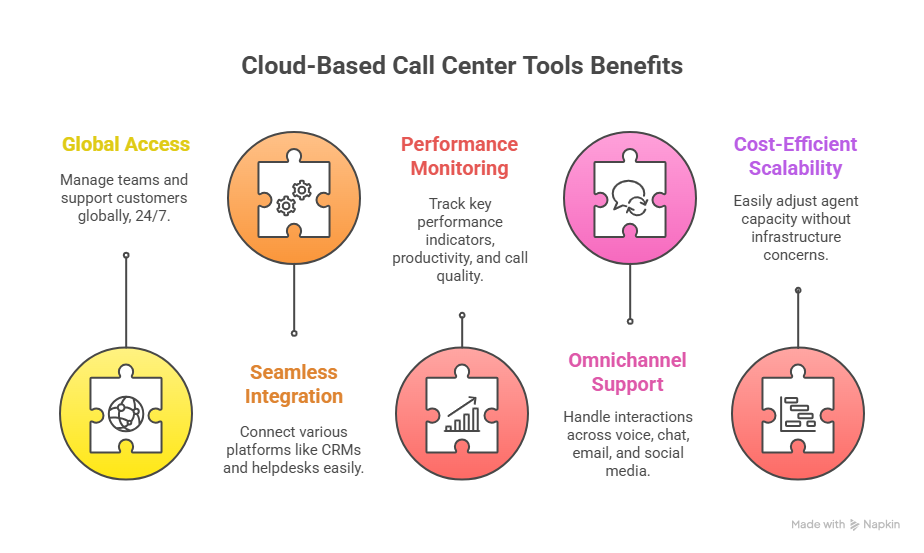
There are hundreds of cloud-based tools available today that promise smarter routing, real-time analytics, and faster resolutions for call center operations. But with so many overlapping features and buzzwords—especially around AI—it can be overwhelming for small and mid-sized businesses to choose the right platform. At Wow Customer Support, we’ve spent years testing and using these tools firsthand to manage outsourced call center operations across industries.
That’s why we’re sharing a curated list of cloud-based platforms that actually work in real outsourced environments—tools that strike the right balance between automation and human connection. But before we dive into that list, here’s a quick look at who we are and what we do best.
Wow Customer Support
Your Partner in Human-Centered Call Center Outsourcing
Specifics
Details
Key Services
Inbound and outbound customer support, technical helpdesk, call handling, email and live chat support, order management
Industries Served
E-commerce, retail, healthcare, finance, logistics, tech startups, SaaS, home services, and more
Support Channels
Voice, email, live chat, ticketing, social media messaging, WhatsApp, and helpdesk systems
Technology Used
Freshdesk, Aircall, CloudTalk, Talkdesk, Zendesk, Five9, Salesforce, Intercom, and more
Locations Served
USA, Philippines, India, and other global support regions
Wow Customer Support has grown into a trusted name for businesses that want to deliver excellent service without the overhead of managing an in-house support team. Whether it's a small business struggling to keep up with call volumes or an enterprise needing multilingual support across time zones, our flexible call center solutions scale to match client needs.
While cloud platforms and AI-enhanced customer service features have become more common, we believe technology should empower—not replace—human agents. That’s why we invest in training, empathy, and real conversation, supported by tools that make our agents faster, better informed, and more available.
Now that you’ve gotten to know us, let’s explore the top cloud-based call center tools we trust and recommend for 2025.
1. Freshdesk Contact Center (Formerly Freshcaller)
Freshdesk Contact Center is one of the most flexible cloud-based call center tools I’ve seen for companies of all sizes. It’s built for outsourced teams and makes it easy to scale up or down depending on your business needs.
What I like most is how it supports remote agents without the hassle of physical infrastructure. Whether you're working with freelancers or an offshore team, setup is quick, and managing them is simple.
Some highlights:
Browser-based calling (no downloads required)
Real-time call monitoring and performance reports
Smart routing, IVR, and auto-replies
Integrations with CRMs like Zoho, HubSpot, and Salesforce
It also lightly touches on AI-driven call handling for SMEs, using voice bots to answer simple queries before passing the caller to a human agent. This balance is ideal for keeping costs low while preserving the human touch.
2. Five9 Cloud Contact Center
If you're looking for AI-powered enterprise customer support, Five9 is a robust platform designed for high-volume operations. It’s a go-to for companies looking for a full suite of call center features—automated workflows, predictive dialers, and omnichannel support.
From what I’ve seen, Five9 works particularly well for enterprise call center solutions with multiple teams and locations. It enables leaders to track KPIs across all agents and maintain service quality at scale.
Why I’d recommend it:
Built-in workforce management
AI tools for call summarization (not replacements for reps)
Omnichannel support: voice, email, chat, SMS, social
Cloud-native with high uptime
Five9 is powerful, but it does come with a learning curve—making it better suited for larger teams or outsourced support centers like ours that are already trained to handle the platform.
3. Aircall
Aircall is one of my personal favorites, especially for call center services for small businesses. It's lightweight, integrates with your existing tools, and is simple enough that teams can get started in a day.
Why Aircall shines:
Quick setup, even for non-tech folks
Easy call recording and coaching tools
Live feed of calls, hold times, and missed calls
Budget-friendly for startups and small teams
Aircall’s focus isn’t on AI automation—but it does offer AI-enhanced customer service for small enterprises through features like call transcription and keyword tracking, which can help us analyze performance trends.
4. CloudTalk
CloudTalk is a hidden gem. It’s an affordable tool with powerful features for both inbound and outbound call management. We often recommend it to clients who want to outsource call center services but still maintain transparency and control.
AI-based speech analytics (generic insights, not replacements)
It’s a great option if you’re looking for low-cost AI-driven customer service features without going full-on automation. It provides just enough intelligence to help managers coach reps better without removing the human layer.
5. Talkdesk
Talkdesk is ideal for companies ready to scale and experiment with AI-driven call center solutions—while still keeping agents in control. Their AI isn’t the pushy kind—it works quietly in the background, helping agents with prompts, real-time suggestions, and post-call notes.
I’ve worked with a retail brand that outsourced to our team and used Talkdesk. Their challenge was long training cycles for new agents. With Talkdesk’s AI-powered agent assist, we cut training time by 30%—without sacrificing service quality.
Best parts of Talkdesk:
AI-enhanced quality assurance tools
Easy integration with CRMs and helpdesk tools
Cloud-native and secure for enterprise needs
Real-time reporting and SLA tracking
This is one of the few tools that work equally well for AI-powered outsourced customer support and AI call center services for small businesses.
Case Study: Supporting a Growing Health Supplement Brand
We partnered with a U.S.-based health supplement brand that struggled with managing seasonal spikes in customer service requests. They had tried an AI chatbot, but it couldn’t answer questions about product usage or delayed shipping—which hurt customer satisfaction.
We helped them move to a hybrid model using Aircall and a team of trained agents from our center. Aircall’s smart call tracking and CRM integration made it easy to route calls and provide personalized responses. We handled over 2,000 customer queries per week, improved their CSAT score from 3.1 to 4.7 in 90 days, and reduced missed calls by 85%.
This showed how important affordable call center services are when paired with simple tech—AI may assist, but it’s the human conversation that seals the deal.
The Role of AI in Call Center Outsourcing—But Not the Whole Story
Let’s be clear: AI has transformed how outsourced call centers operate—but it’s not a full replacement. Most AI-enhanced customer service solutions for corporations focus on routine queries, sentiment analysis, and routing optimization. But when things get emotional, confusing, or urgent, you need a human.
That’s where services like ours come in. We use cloud-based tools that allow agents to work from anywhere, with features that support—but never replace—them.[a]
A few real-world AI benefits we’ve seen:
Faster call logging and summaries
Keyword alerts for complaint escalation
Smart queue management based on past behavior
But we keep humans at the heart of every support experience. That’s what makes AI-powered small business customer support and AI call center outsourcing truly work—when there’s a thoughtful balance.
Frequently Asked Questions (FAQs)
1. What is the main advantage of cloud-based call center tools for outsourcing?
They allow businesses to manage remote agents with no physical setup—just internet access and a headset. This is key for flexible and affordable AI call center services.
2. Do these tools require a lot of training?
Not always. Tools like Aircall and CloudTalk are beginner-friendly, while Five9 or Talkdesk may need some onboarding. We help our clients get up to speed fast.
3. Is AI replacing live agents in call centers?
No, AI supports live agents by handling repetitive tasks or summarizing calls. But for complex or emotional issues, people still prefer speaking with a human.
4. Are these tools budget-friendly for small businesses?
Yes. Many offer scalable pricing plans, with basic features that suit startups and small teams. We help businesses pick tools that fit their goals and budgets.
Key Takeaways
As we wrap up this deep dive into the top cloud-based tools for outsourced call center management, it's clear that technology, when combined with the right people, can completely transform customer service for businesses of all sizes. Here are three key insights to remember:
Smart Tools, Human Support:Cloud-based platforms like Freshdesk, Five9, and Aircall allow teams to operate from anywhere while maintaining high-quality, human-led support. These tools enhance—not replace—our people-first approach.
Scalability for Any Size:Whether you're a small business or a growing enterprise, tools like CloudTalk and Talkdesk make it easier to scale support teams, track performance, and adapt quickly to customer needs.
AI as a Support System, Not a Stand-In:AI-driven features like auto-summaries and smart routing are helpful add-ons—but they work best when paired with empathetic, real people behind the calls.
We’ve covered the most useful tools, how they fit different business sizes, and how to balance automation with authentic service.
Now it’s your turn: Have you tried any of these platforms? Drop your thoughts and questions in the comments—we’d love to hear your take.
To stay up-to-date on customer support insights and strategies, remember to check out our social media accounts too: Facebook, and LinkedIn. Let's keep the conversation going!
When I first began working with eCommerce and service-based companies, I didn't realize the power of email support. It just seemed like another channel—plain, passive, and easily overlooked in favor of live chat or phone. But I've come to learn something critical: email support is where long-term customer relationships are created or destroyed.
Customers don't always write in when everything is going right. They contact us when they're frustrated, confused, or waiting for a response. And how we reply—how quickly, how precisely, and how politely—makes all the difference. That's why many companies today opt to outsource email support, not only to save time, but to enhance their customer retention rates.
In this blog, I'll take you through exactly how email support outsourcing services can assist you in keeping more customers, enhancing loyalty, and scaling sustainably. We'll also discuss where AI-based email support solutions can assist (and where they can't).
Why Email Support Plays a Huge Role in Customer Retention
When we speak of retention, we think of loyalty programs, one-to-one marketing, or onboarding. But great support is the key. In a report by HubSpot, 93% of customers are likely to remain loyal to a business that provides great customer service.
Now, why email?
Because it's:
Private and detailed
Easy for customers to refer to later
Available 24/7
Less stressful than live chat for sensitive topics
But in order for email to drive retention, the answer has to be:
Quick
Personal
Simple
Problem-solving, not templated
This is where email support services excel—particularly when you outsource them to a talented team that's been trained to deal with volume and subtlety.
The Problem With Handling Email Support In-House
I’ve seen it happen many times: a business grows fast, and email tickets pile up. The team gets overwhelmed. Responses are delayed. A customer who waited two days for a shipping update suddenly becomes a lost sale—and probably leaves a negative review.
Common in-house issues include:
Slow response times due to limited staffing
Inconsistent tone or branding
Missed follow-ups
Poor prioritization (urgent issues buried in general inquiries)
And let’s be honest—most business owners and managers are juggling too many responsibilities already. Email often becomes the "we’ll handle it later" task.
That’s why more companies are turning to outsourced email support—not just to clear the inbox, but to keep customers happy and coming back.
Let’s dive into the core of this blog: how outsourced email support boosts retention rates.
Faster Response Time = Smiling Customers
Outsourcing vendors work with dedicated agents and shift coverage, usually providing 24/7 or near real-time responses. Customers anticipate email replies in 6 hours, as Forrester reports, yet most companies take more than 24. Speed counts.
Consistency and Professionalism
An outsourced team is taught to employ brand voice, script when necessary, and escalate properly. This establishes trust. A fractured tone or inappropriate response from an untrained person can destroy that trust quickly.
Proactive Follow-Ups
Retention isn't fixing the problem—it's following up once it's fixed. Outsourced teams tend to utilize ticketing systems that mark pending resolutions, so no customer ever feels ignored.
Multilingual Support
If your platform or store has customers all over the world, customer service email outsourcing allows you to support customers in various languages—a feat difficult to accomplish in-house.
Detailed Documentation
Each email is logged, labeled, and sorted. You can use this to find repetitive issues, make better products, and provide increased long-term value to customers.
The Role of AI in Email Support—And Why It’s Not Enough Alone
We can't discuss support today without mentioning AI-powered email support. From automated email customer service to smart replies, AI solutions assist teams in responding quickly and minimizing manual effort.
What AI solutions can do:
Sort and tag tickets by priority
Generate draft responses based on keywords
Detect sentiment (frustrated vs. neutral vs. happy)
Trigger canned responses for FAQs
Assist agents with response suggestions
Popular software such as Zendesk, Freshdesk, and Gorgias employs AI-driven email customer service capabilities to assist in streamlining workflow.
But here's what AI isn't good at:
Reading between the lines of complicated or emotional questions
Solving subtle product problems
Providing empathy and context
Changing tone according to customer mood
That's why we employ AI-enhanced email support services as a tool—not a substitute. The best outcome is achieved when AI is incorporated into human-driven support—particularly in a retention-driven model.
Case Study: How Email Support Turned Around Customer Retention for a Subscription Brand
We had one client, a DTC wellness brand, which was facing a steady drop in customer retention. Their support mailbox was deluged, with an average response time of around 30 hours. Refunds were on the rise, and churn was becoming increasingly problematic.
Employed 3 dedicated email support staff working shifts
Implemented automated ticket tagging and escalation workflows via AI tools
Redrafted support templates to be more empathetic and brand-friendly
Implemented 24-hour follow-ups on subscription-related questions
Results within 90 days:
Response time fell to below 6 hours
Customer churn fell by 18%
NPS scores increased from 38 to 61
Had fewer refund requests due to proactive, friendly responses
This client now recognizes their email support as a central component of their retention strategy, rather than a back-office function. We provide this same level of service to brands in eCommerce and services.
Not all outsourced providers are created equal. Here's what I always suggest you look for:
Agents with training in your niche or industry
Shift coverage that aligns with your busiest times
Tools or workflows involving AI-driven email support outsourcing
Integration with ticket systems (such as HelpScout, Gorgias, Zendesk)
Performance reporting and quality assurance
Protocol for escalated high-risk or difficult issues
The aim is to ensure that email support services should be indistinguishable from members of your own team—not an isolated third party.
Frequently Asked Questions (FAQs)
1. How do I know if it’s time to outsource email support?
If your team is overwhelmed, your response time is slow, or you’re losing customers due to poor support, outsourcing can help you scale and regain control.
2. Will customers know the support is outsourced?
Not if done right. Agents are trained to use your brand voice, and the experience feels seamless.
3. Can outsourced teams use our existing tools?
Yes. Most email support outsourcing services work inside your current helpdesk tools for easy integration and reporting.
Key Takeaways
In summarizing our investigation on how email support outsourcing services enhance your customer retention rate, it's certain that timely, professional, and consistent email support is crucial in today's customer-centric culture. Below are three key takeaways:
Respond With Speed: Outsourced email support enables your brand to deliver customer expectations of quick, 24/7 service, directly influencing satisfaction and loyalty.
Stay Consistent and Human:Trained agents provide empathetic, brand-relevant responses that establish trust over time and avoid churn.
Balance AI With Human Support: Although AI-driven email response systems increase productivity, long-term retention results from valuable human interactions.
We've discussed how strategic email support outsourcing enhances retention and safeguards your brand reputation. If you'd like to continue the discussion or learn how we help growing businesses, leave a comment or contact us.
For additional tips and customer service trends, connect with us on Facebook, and LinkedIn. Let's construct support that brings your customers back.
For gaming businesses, player support is the foundation of player retention and satisfaction. Whether it's resolving technical issues, in-game questions, or debug payment issues, an effective gaming customer support system guarantees a smooth player experience. But the question on everyone's mind is: do gaming businesses handle support internally or outsource it to an expert gaming customer support provider?
As someone who has worked closely with gaming customer service outsourcing, I’ve seen how outsourced player support services can help gaming companies save money, scale operations, and offer round-the-clock assistance. At the same time, in-house support offers more control but comes with higher operational costs.
In this blog, we will contrast gaming customer support outsourcing and in-house support, discuss the cost and efficiency aspects, and assist you in deciding what would work best for your gaming company.
Player Support Services include a customer care team, which will focus on client trouble regarding the players, technical glitches, in-game disputes, and account-related queries. Having high-gambling speed in the industry, and instant solution expectation from players increase the urgency of good gaming customer services for player retention and positive gaming experience.
Why Player Support Is Important:
Increases Player Retention – Player tends to stay loyal only when it finds that support is around for the players.
Boosts In-Game Purchases – Effective support encourages confident spending on microtransactions, DLCs, and subscriptions.
Reduces Churn Rate – Poor customer support is a leading cause of player frustration and game abandonment.
According to Statista, 63% of gamers expect real-time support, whether through live chat, email, or in-game assistance. Without proper player support services for gaming companies, negative reviews and customer churn can severely impact a game’s reputation.
How Does Gaming Customer Service Outsourcing Improve Player Satisfaction?
Gaming customer service outsourcing enables businesses to collaborate with experienced third-party vendors who manage player queries, technical support, and community interaction.
How Outsourcing Enhances Player Satisfaction:
24/7 Support Accessibility – Players across various time zones always receive assistance, minimizing frustration.
Multilingual Support – Facilitates international gaming communities with native speakers.
Faster Response Times – Outsourced teams employ AI chatbots and auto-ticketing for instant resolutions.
A 2023 Deloitte report revealed that outsourcing the customer support of games enhances response times by 40% and decreases operational expenditures by 30%.
Having a professional gaming customer support team guarantees that gamers get expert-level support for technical and game-related issues.
Major Advantages of Professional Gaming Support:
Expertise – Support agents are instructed on game mechanics, troubleshooting, and player interactions.
Scalability – Outsourced teams can expand or reduce staff upon the demand of the game.
Cost-Effective – Evades hiring and training expense in-house employees, thus, reducing expenditure.
Access to Advanced Tools – The AI-driven chatbots, automated ticketing, and analytics for higher efficiency.
How Do Gaming Companies Choose Between In-House Support and Outsourcing?
In making an in-house vs. outsourced customer support decision for games, businesses have to weigh cost, efficiency, and scalability.
Consider the Following:
Budget:Is your business able to sustain full-time, in-house personnel and infrastructure?
Scalability:Is your game subject to traffic bursts that need quick scaling up?
24/7 Support Requirements:Do you have international users needing multilingual support?
Gartner research indicated that gaming businesses that outsource customer support can save as much as 50% of operating expenses versus sustaining in-house teams.
Gaming support outsourcing is much more cost-effective than employing and training internal staff.
Outsourcing vs. In-House Costing Breakdown:
In-House Support Expenses:
Support staff salaries ($40K–$60K per agent per year).
Training & software costs.
Infrastructure & operational expenses.
Outsourced Support Expenses:
Flexible pricing models (hourly, per-ticket, or subscription-based).
No recruitment or training expenses.
Lower international labor expenses.
A Forrester study found that gaming companies outsourcing customer support cut expenses by 60% while maintaining high player satisfaction.
How Does Outsourced Gaming Customer Support Handle Technical Issues and In-Game Queries?
Outsourced player support teams are trained to handle game-specific issues, including:
Bug reports & troubleshooting
Account recovery & payment processing
In-game abuse & cheating reports
Outsourcing solutions train their agents with game-specific modules, making them an extension of the in-house team of the gaming company.
How Do Gaming Customer Service Providers Ensure 24/7 Support for Players?
Those gaming companies that have global player bases have to offer constant support. Outsourcing makes it possible by:
Employing international support agents across various time zones.
Utilizing AI chatbots for immediate responses.
Employing multi-channel support (live chat, email, Discord, in-game support).
According to a report by Zendesk, 73% of players assume customer support must be present 24/7, and therefore outsourcing is an intelligent move for covering all areas of the globe.
Frequently Asked Questions (FAQs)
1. What types of gaming companies benefit most from outsourcing support?
MMORPGs, mobile games, and free-to-play models benefit the most, as they require high player engagement and scalable support.
Yes, many providers offer community management and player behavior monitoring.
3. Is outsourcing better than using AI for gaming customer service?
A mix of AI chatbots and human agents provides the best results, offering both instant responses and complex issue resolution.
Key Takeaways
Customer support outsourcing for gaming is a cost-effective, scalable, and effective solution for gaming companies looking to concentrate on game development while ensuring high player satisfaction.
Three Key Takeaways:
Outsourcing gaming support reduces costs by up to 60%, while improving response times and player retention.
24/7 player support is essential for global gaming companies – outsourced teams provide multi-language assistance and round-the-clock coverage.
Gaming customer support providers offer advanced tools, including AI chatbots, automated ticketing, and scalable staffing models.
We’ve explored the pros and cons of in-house vs. outsourced gaming customer support, including cost-saving insights and real-world benefits. What’s your experience with player support services? Share your thoughts in the comments!
To stay updated on gaming industry trends and customer support strategies, follow Wow Customer Support on Facebook, and LinkedIn.
Being abreast of trends in customer care services, I can affirm with certainty that outsourcing live chat support services has become a game-changer for businesses, particularly in the e-commerce and B2B industries. In the year 2025, businesses will use this strategy more than ever to deliver better customer experiences, reduce costs, and scale up.
The Benefits of Outsourcing Live Chat Support Services
In 2025, customer expectations are at an all-time high. A recent report by Statista shows that 79% of customers prefer live chat for instant responses compared to other communication channels. Outsourcing live chat support services ensures businesses meet these demands without overburdening their in-house teams.
Key Benefits:
24/7 Availability: An outsourced team can handle customer queries round the clock, which is critical for global e-commerce brands.
Expertise and Specialization: Leading providers train their agents to efficiently handle technical, sales, and general inquiries.
Scalability: Outsourced teams can scale operations during peak seasons like Black Friday without compromising quality.
The live chat agents form an emotional bond with the customers. A skilled agent can convert a complaint into a loyal relationship, which results in retention factors.
How Live Chat Service Providers Improve Customer Satisfaction and Retention
In addition, Zendesk found that 90% of customers regard the promptness of their response as "essential" or "very important" in live chat. Outsourcing, hence, is a crucial investment in enhancing customer satisfaction and retention.
When I worked with a client who operates in the retail sector, there was a 25% increase in customer retention through outsourcing chat support. The improvement came as the provider could take:
30 seconds or less to respond to inquiries.
Use pre-trained agents who understand the client's industry-specific needs.
Upsell or cross-sell during chat interaction subtly increases each conversation's value.
Live chat services can also personalize the customer experience. For instance, chat histories enable agents to greet their returnees with the correct name and offer tailored solutions.
Why Live Chat Outsourcing is Important for E-commerce Growth
E-commerce is highly competitive. Online sales are expected to reach $8.1 trillion by 2026. Outsourcing live chat support is an option for businesses to enjoy these benefits.
Why it matters:
Quicker Problem Solving: About 73% of consumers are willing to purchase more from live chat companies.
Multilingual Support: Outsourced providers usually have agents who are conversant in several languages and cater to worldwide audiences.
Higher Conversions: With live chat, users are 2.8 times more likely to convert because they get support right when making the decision.
Outsourcing, in general also enables e-commerce brands to focus on their core operations and allow customer engagement to the experts who best understand how to handle such matters.
Used in the proper context, live chat support services can serve as a direct conversion revenue driver. According to a study by the American Marketing Association, live chat can boost conversion rates by a whopping 20% or more.
In one campaign, proactive chat prompts increased sales by 15% within three months. Simple strategies such as answering questions about products or payment immediately can eliminate hesitation over purchasing.
Industries That Benefit the Most from Outsourcing Live Chat Support
Although nearly every industry can benefit, some that stand out are:
E-commerce: in order to recover the cart and provide instant support
SaaS: for resolving technical issues
Travel and Hospitality: for booking help and itineraries change.
Healthcare and education markets follow suit, proving the ubiquitous appeal of outsourcing your live chat support.
How to Evaluate the Quality of Outsourced Live Chat Services
Answer Time: Leading companies will respond in under 30 seconds.
Customer Comments: Employ end-chat surveys for an assessment.
Agent Performance Measures: Track resolution times and review rates of escalation.
Audit regularly so that your service provider continues to uphold high standards.
Omnichannel Support: Integrating live chat with email, social media, and phone support.
AI and Automation: For quick resolutions to FAQs.
Personalization Tools: Agents equipped with customer history and preferences.
All these features improve the experience of the user and foster long-term loyalty.
Frequently Asked Questions (FAQs)
1. Can small businesses benefit from outsourcing live chat?
Absolutely! Small businesses can use outsourcing to offer 24/7 support without hiring an in-house team, reducing costs significantly.
2. Are outsourced agents as effective as in-house teams?
Yes, with proper training and brand guidelines, outsourced agents can match or even surpass the performance of in-house teams.
3. How do live chat providers ensure data security?
Reputable providers comply with GDPR, HIPAA, or industry-specific standards, ensuring customer data is secure.
Key Takeaways
Moving to 2025, outsourcing live chat support services provides transformational opportunities for growth, efficiency, and customer satisfaction. Key takeaways:
Advancing Customer Satisfaction: As long as live chat support is outsourced, 24/7 personalization and multilingual support may raise retention and satisfaction scores.
Improving Efficiency and Reducing Costs: With help from outsourced expertise, businesses can cut operational expenses by up to 40 percent and use internal resources on core activities.
Drive Conversions and Growth: Inevitably, a proactive live chat service always converts up to 20% of visitors from browsing to converting. This makes them very important for scaling e-commerce and B2B operations.
We'd love to hear your thoughts! What challenges or successes have you encountered with live chat support? Let us know in the comments below, or connect with us on our social media pages.
To learn more customer support insights and strategies, follow Wow Customer Support on Facebook, and LinkedIn.
As companies extend their global business reach, the demand for excellent customer service increases. Contact center outsourcing is one strategic solution for expanding operations, reducing costs, and enhancing customer satisfaction.
Let me share with you why I believe this is an effective strategy and how it could help businesses of any size worldwide.
What Are the Key Benefits of Outsourcing Contact Center Services?
Outsourcing contact center services is a big deal for a business looking to reach global markets. It will provide companies with the opportunity to engage with specialized providers that can:
Lower Cost: Outsourcing saves the investment cost of infrastructure, technology, and training. According to Deloitte, outsourcing saves 30% of operational costs.
Global talent access: Outsourced services combine multilingual professionals with the appropriate skill sets to enable smooth communication with even the most diverse customers.
Focus on core business: Outsourcing customer service allows companies to focus on the core business and engage more deeply in growth and innovations.
For example, it can outsource customer service to regions where it may have local expertise. This allows it to focus more attention on its core business, e-commerce.
How Can Call Center Support Services Improve Customer Satisfaction?
Round-the-Clock Availability: Customers will continuously want assistance that is always available round the clock. Zendesk research has found that 69% of customers value 24/7 service availability.
Less Waiting Time: Outsourced teams are equipped with advanced tools to handle a large number of inquiries simultaneously.
Tailored Support: Outsourcing providers use CRM tools and give tailored experiences that enhance customer loyalty.
For example, Zappos outsourced its support services, which help them solve issues promptly and make them good at customer care.
What Should Businesses Look for in a Call Center Service Provider?
The choice of service provider is a critical issue. Here's what to look for:
Expertise and Track Record: Find providers with extensive industry experience and proven success cases.
Technology Integration: Make sure they use the latest technologies, including AI-driven chatbots and predictive analytics.
Scalability: Choose a partner that can grow with your business and support seasonal demands.
For example, some of the top organizations include Teleperformance and Concentrix, known for their infrastructure and handling of complicated operations.
What Is the Difference Between Call Center Support and Contact Center Services?
Call center support and contact center services are terms that are used interchangeably, yet have a lot of differences between them:
Call Center Support: This primarily deals with voice-customer interaction, which can be in the form of inquiries or complaints.
Contact Center Services: This also comprises a wider range of communication channels, such as email, live chat, and social media.
Since customers are becoming more digitally conscious, the contact center acts as an imperative to those organizations that look forward to providing an omnichannel experience.
Why Is Contact Center Outsourcing a Growing Trend for Global Businesses?
Value for Money: Indian and Philippines-based offshore providers offer productive talent at a much-reduced price.
Access to Technology: The leading outsourcing companies spend lavishly on advanced technologies like AI and automation.
Customer Experience Focused: Companies outsource to ensure their customers experience world-class service across geographies.
A Gartner report shows that 65% of organizations believe they will add more budget to their outsourcing programs in the future, raising awareness about its growing popularity.
How Do 24/7 Call Center Services Enhance Customer Experience?
The 24-hour customer service service is essential in today's globalized economy. Outbound companies are well aware of providing round-the-clock services through:
Time Barriers Elimination: Clients get help anytime, without time barriers.
Handling High Volume: Scalable teams make sure no question remains unanswered.
Pro-Active Assistance: In real-time, support is rendered to minimize cases of escalations and build up customer trust.
This model has proved very effective for any business, like Uber, that operates on global outsourcing.
How Does Outsourcing Call Center Services Reduce Operational Costs?
Labor Cost Savings: Offer competitive pricing through providers from developing countries.
Infrastructural Cost Saving: The company does not have to set up infrastructures.
Efficiency Cost Saving: More sophisticated and trained personnel will complete tasks faster, saving time and money.
According to IBM, outsourcing cuts operations costs by an average of 40% to 60%, making it a strategic move for cost-conscious companies.
What Industries Benefit the Most From Call Center Outsourcing?
Indeed, all industries can gain from outsourcing, but some sectors require it more than others:
E-commerce: It manages tonnes of inquiries and return requests
Healthcare: It offers patient care along with appointment reservations
Technology: Technical issue resolutions and product queries.
For example, Apple is meant to outsource the customer care job of responding to non-technical questions, while the in-house team is assumed to be available to answer only the complex ones.
Outsourcing helps businesses grow in global markets because:
Customer Experience: This service promises multilingual support to ensure that the service delivered is uniform across different markets
Growth in Operations: Providers are ideally suited to business fluctuations in terms of volume
Brand Image: Good service keeps customers loyal and happy and makes them praise the brand.
For instance, Shopify outsources customer service to outsourcing partners, saving time and creating a more significant global presence.
Frequently Asked Questions (FAQs)
1. Is contact center outsourcing service viable for small enterprises?
Yes, because practically, outsourcing is always scalable, aligned with the budget and needs of small enterprises, and it provides professional support without significant overheads.
2. In what ways do outsourcing providers guard data security?
The best providers are GDPR-compliant and ISO certified to ensure that customer information is well protected.
3. Would the outsourced call centers increase first-call resolution?
Yes. The most productive agents and elaborate tools allow providers to solve problems on the very first call.
Key Takeaways
We have seen thus far that contact center outsourcing is an excellent strategy for businesses wishing to expand geographically. Three key takeaways follow:
Improve Customer Experience: Outsource to provide 24/7 multilingual and omnichannel support to different customer types.
Save Costs and Scale with Ease: Businesses can save operational costs while scaling services easily.
Leverage Domain Expertise: Partnering with industry leaders will provide advanced tools, technology, and professional skills.
We explore the key benefits and tactics of outsourcing worldwide. What are your opinions on this? Please share your experiences or insights in the comment section below!
For more customer service insights and strategies, follow us on our social media profiles, Facebook, and LinkedIn. Stay with us for more on optimizing business operations with outsourcing!
Customer service is a very important part of any business. It can make or break a business's image and have a direct effect on how happy and loyal customers are. Email support services are now an important part of customer service tactics in this digital age. However, handling email help in-house can take a lot of time and resources. Businesses can make a huge difference by hiring their email support services in this case.
In this article, we will explore the benefits of outsourcing email support and how it can transform your customer service experience.
Offering customer support and help through email is what email support services are all about. Answering questions from customers, fixing problems, and sending them useful information via email are all part of the job. Email support can be used for many things, like technical help, questions about products, help with bills, and more.
Businesses often choose to outsource their email help because it saves them money. Putting together an in-house email support team needs a lot of money to be spent on infrastructure, technology, training, and people. Businesses can avoid these up-front costs by outsourcing and instead choose a more cost-effective option. Businesses can pay only for the services they need from outsourcing companies that often have flexible price models.
2. 24/7 Support
Customer problems and questions can happen at any time, even when the business isn't open. Businesses can get round-the-clock help by outsourcing email support services, which makes sure that customer questions are answered quickly. By doing this, you can make customers much happier and keep them from leaving.
3. Expertise and Specialization
Businesses can use the skills and knowledge of dedicated customer service workers by outsourcing email support. These people have been taught to answer customer questions quickly and correctly. They have the skills and understanding to give correct and timely answers, which guarantees a good experience for the customer.
4. Scalability
Demand for customer service often goes up and down for businesses. The number of customer questions can go through the roof during busy times, like holidays or new product launches. Businesses can change the size of their customer service teams based on demand by outsourcing email support services. This flexibility makes sure that all customer questions are answered quickly, no matter how many there are.
5. Multilingual Support
In today's world market, companies often serve customers who speak different languages. Businesses that outsource their email support can get help from support teams that speak more than one language. These teams can talk to customers in the language they prefer, which gets rid of language hurdles and makes customers happier.
What Does Email Support Do?
Email support plays a crucial role in ensuring customer satisfaction and resolving customer issues. Here are some key functions of email support:
1. Addressing Customer Inquiries
Email support teams are in charge of answering customers' questions quickly and correctly. It's important for them to understand what the customer is asking and give clear, useful information or answers. Customers will be more likely to trust and stick with you if you provide good email support.
2. Troubleshooting Technical Issues
Customers often worry about technical problems. Technical issues can be fixed by email support teams who are trained to help customers through the process. They might give you step-by-step steps, suggest ways to get around the problem, or report it to the right department for more help.
3. Resolving Product or Service-related Issues
Customers may have problems with the goods or services they bought. Email support teams are in charge of fixing these problems by either coming up with the right answers or working with other departments to do so. Quick and effective settlement of problems with a product or service can have a big effect on how satisfied a customer is.
4. Providing Product Information
Customers who want to know more about a product or service often first contact the support team via email. They need to know a lot about what the company sells and be able to give customers true, complete information. This gives customers more information to help them make better buying choices and improves their overall experience.
When the Mail Server is Not Responding: Troubleshooting Tips
Occasionally, customers may encounter issues with their email service, such as when the mail server is not responding. Here are some troubleshooting tips to help address this problem:
Check Internet Connection: Ensure that your internet connection is stable and working properly. A weak or intermittent connection can prevent your email client from connecting to the mail server.
Verify Server Settings: Double-check your email client's server settings to ensure they are correctly configured. Incorrect server settings can prevent your email client from establishing a connection with the mail server.
Disable Firewall or Antivirus: Temporarily disable your firewall or antivirus software to check if they are blocking the connection to the mail server. If the issue is resolved after disabling these security measures, consider adjusting their settings to allow the email client's access.
Contact Email Service Provider: If the issue persists, reach out to your email service provider's support team for assistance. They can help diagnose and resolve any server-related issues.
Popular Email Services
There are several popular email services available today, each offering unique features and functionalities. Let's explore some of the most widely used email services:
1. Gmail
Gmail, developed by Google, is one of the most popular email services globally. It offers a user-friendly interface, ample storage space, powerful search capabilities, and integration with other Google services.
2. Outlook
Outlook, provided by Microsoft, is another widely used email service. It offers a comprehensive suite of features, including email management, calendar, contacts, and tasks. Outlook also integrates seamlessly with other Microsoft Office applications.
3. Yahoo Mail
Yahoo Mail is a free email service that provides users with a simple and intuitive interface. It offers features such as customizable themes, powerful search, and integration with Yahoo's news and entertainment platforms.
4. Apple Mail
Apple Mail is the default email client for Apple devices, including iPhones, iPads, and Mac computers. It offers a seamless integration with Apple's ecosystem and provides a user-friendly interface with advanced features.
Conclusion
Email support services are an important part of providing great customer service. Businesses that outsource their email support can save money, get help 24/7, get support in multiple languages, and gain expertise and specialization.
Email support teams answer questions from customers, fix technology problems, handle issues with products or services, and give information about products. How to fix problems with the mail server
If you are looking for the best email support outsourcing, check out Wow Customer Support today. We have an experienced email customer service outsourcing team ready to assist you 24/7.
In this fast-paced business world, customer service is the heart of a company's success. When well invested, I've experienced firsthand how quality customer service contributes to customer loyalty and establishing a good reputation for the company. Here's the catch, however: How do you handle and manage customer support without overwhelming chaos, expense, and, candidly, inefficiency, especially for smaller and midsized businesses? This is where contact center outsourcing comes in.
Over the years, I've learned that outsourcing isn't just about cutting costs; it's about integrating innovative solutions that can change your customer service experience. Let's see how contact center outsourcing can help optimize your customer support while offering opportunities for integrating cutting-edge innovations.
When I started researching customer service outsourcing, my first question was the one many business owners asked: will it work for my business? In the proper context, outsourcing your customer support can make all the difference. Instead of having an outsized internal team, a contact center outsourcing solution lets you partner with experienced, specialized providers who know how to engage with and support customers.
It enables you to
Scalable customer service operation without all the infighting that comes with internal recruitment.
Experienced agents who have already walked through handling any customer query.
You don't need an extra workforce to provide all services continuously and 24/7.
Facts show that 59% of clients who outsource at the contact center increase efficiency in daily activities and customer satisfaction. This is a strong argument for outsourcing, which can significantly improve customer support without breaking the bank.
Implementing Higher Technology for Improved Customer Service
The most important thing I have experienced with outsourcing is integrating technology with customer service. Solutions providers come to the contact center with tools that most businesses cannot access or, heaven forbid, need to learn how to use correctly. These tools can, among other things, automate tasks and improve the quality of interactions.
Some crucial innovations in this area include:
Artificial Intelligence (AI) and Chatbots: AI-based chatbots can handle the most routine questions so that human agents can work on more complex issues. A Gartner report says, "By 2025, AI will answer 80 percent of all calls related to routine customer queries." It's incredible how this innovation would help smoothen operations.
Omnichannel Support: Customers these days expect service on multiple channels, either inbound, email support, social media support, or even via messaging apps. Outsourcing allows companies to provide seamless omnichannel support without maintaining individualized platforms.
CRM Integration: The outsourced contact centers have enabled customers to integrate customer relationship management (CRM) tools directly into the support systems, thus giving the agents complete information to personalize support.
The integration of all these technologies not only speeds up the speed and efficiency of customer support but also improves the overall customer experience. In a competitive market, customer experience makes all the difference.
Who to Choose
Not all contact center solutions providers are equal. When consulting businesses and working with clients, I tell them to choose a provider that reflects their brand values and customer service goals. Here's a quick checklist I recommend for businesses looking to outsource their customer support:
Industry Specific Knowledge: Experience a provider that knows the unique challenges related to your business' industry. For instance, an eCommerce contact center will more effectively address order-related questions than a generalist provider.
Customization and Flexibility: Your business is unlike any other, and neither are your customer support needs. I look for providers who can provide customized solutions to scale your business.
Proven Track Record: Check customer reviews, case studies, and testimonials. After all, nothing speaks louder than a proven track record.
75% of companies switching to outsourced contact centers reported improved customer satisfaction six months after the switch. Choosing the right provider can significantly impact your business.
Innovations in Contact Center Solutions You Can't Ignore
Being at the curve's front edge embraces the innovations that would enhance your customer support processes. I am particularly looking forward to some of the more advanced developments in contact centers that would reshape customer interaction.
Speech Analytics: With speech analytics, customer calls can be analyzed in real-time to reflect on customer sentiment and reveal areas for improvement. Businesses that employ speech analytics can cut their call resolution time down to 20 percent.
Predictive Dialers: Predictive dialers can be a game-changer in outbound sales and support. This technology dials a number automatically, thereby connecting agents to customers only after the call is answered, wasting much less time.
Remote Workforce Solutions: As remote work becomes more common, contact center outsourcing providers have intensified their efforts to offer cloud-based solutions. These allow agents to work from any location, thus ensuring uninterrupted service regardless of the situation.
These innovations aren't high-tech gizmos but solutions to everyday troubles businesses face in customer service.
Let's face it. Outsourcing is a challenging pill to swallow. I've seen companies swallow their pride and refuse to outsource due to fears about a lack of control over customer interfaces and the challenges of resultant cultural and language barriers. These are valid objections but certainly not insurmountable.
Here are a few strategies that have helped me:
Clear Communication Channels: Establish clear communication channels with your outsourcing partner. Regular updates and feedback loops help prevent issues before they become too complicated to untangle.
Cultural Training for Agents: Many contact center solutions providers offer cultural training so that agents understand the subtle differences in your customer base.
Quality Monitoring: Tools like call recording can help you determine the quality of support extended by outsourced agents. You can also use customer feedback surveys to establish the kind of support provided.
Present to these challenges and enjoy outsourcing free from the usual pitfalls. Businesses that invest in properly integrating and monitoring their outsourced contact centers report a 30% increase in customer retention.
Frequently Asked Questions (FAQs)
How can I ensure quality when outsourcing my contact center?
Clearly outline communication channels and establish key performance indicators that are measurable from the beginning. Use tools like call recordings to measure performance against your outsourcing partner.
Are multilingual handling capabilities supported by contact center outsourcing?
Most contact center solution providers offer the service in multiple languages; you do not need to hire more in-house multilingual agents to reach a large customer base.
What is the most crucial advantage of contact center outsourcing?
Outsourcing offers the highest benefits of scaling fast and reaping the benefits of cutting-edge technology without the expense of maintaining in-house teams.
Key Takeaway
In a nutshell, we can see clearly from our discussion on the maximization of customer support through outsourcing in contact centers that integrating it with new technology would transform the interaction style between businesses and their customers. To summarize, here are three of the key takeaways:
Leverage Technology: Contact center solutions providers allow you to easily integrate advanced tools, including AI-driven chatbots and omnichannel support, to improve customer experience and boost efficiency.
Customize for Success: Not all outsourcing solutions are created equal. You want a provider offering flexible, industry-specific services tailored to your customer support needs.
Manage Challenges with Better Communication: Proper communication in outsourcing ensures a higher quality of service as you face challenges such as cultural barriers or loss of control to your advantage.
We have witnessed the revolution of contact center outsourcing and the relevance of integrating innovations to ensure customer satisfaction. If you plan to outsource or have already outsourced, I would like your thoughts and experiences regarding this topic in the comment section below.
Want more insight into some of the best customer service strategies? Remember to follow us on social media: Facebook, Instagram, and LinkedIn. Keep in touch as we explore the future of customer service together!